

Home
Class 12
PHYSICS
Six steel balls of identical size are li...

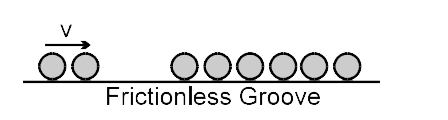
Six steel balls of identical size are lined up long a straight frictionless groove. Two similar balls moving with a speed V along the groove collide with this row on the extreme left hand then-

Promotional Banner

Similar Questions

Explore conceptually related problems

Six steel balls of identical size are lined up along a straight frictionless groove. Two similar balls moving with speed v along the groove collide with this row on the extreme left end. Then

STATEMENT - 1 : Two identical balls B and C lie on a horizontal smooth straight groove so that they are touching. A third identical ball A moves at a speed v along the groove. And collides with B as shown in figure. If the collisions are perfectly elastic, then after the collision, balls A and B will come to rest and ball C moves with velocity v to the right. because STATEMENT - 2 : In an elastic collision, linear momentum and kinetic energy are both conserved.

STATEMENT - 1 : Two identical balls B and C lie on a horizontal smooth straight groove so that they are touching. A third identical ball A moves at a speed v along the groove. And collides with B as shown in figure. If the collisions are perfectly elastic, then after the collision, balls A and B will come to rest and ball C moves with velocity v to the right. because STATEMENT - 2 : In an elastic collision, linear momentum and kinetic energy are both conserved.

Four smooth steel balls of equal mass at rest are free to move along a straight line without friction. The first ball is given a velocity of 0.4 m/s . It collides head on with the second elastically, the second one similarly with the third and so on. The velocity of the last ball is

A steel ball of radius 2 cm is at rest on a frictionless surface. Another ball of radius 4 cm moving at a velocity of 81 cm//see collides elast cally with first ball. After collision the smaller ball moves with speed of

A stick of length L and mass M lies on a frictionless horizontal surface on which it is free to move in any way. A ball of mass m moving with speed v collides elastically with the stick as shown in the figure. If after the collision the ball comes to rest, then what would be the mass of the ball?

A stick of length L and mass M lies on a frictionless horizontal surface on which it is free to move in any way. A ball of mass m moving with speed v collides elastically with the stick as shown in the figure. If after the collision the ball comes to rest, then what would be the mass of the ball?