Home
Class 14
REASONING
In each of the following questions, two ...

In each of the following questions, two statements are given, followed by two conclusions I and II. You have to consider the statements to be true even if they seem to be at varlance from commonly known facts. You have to decide which of the glven conclusions if any, follow from the given statements.
Statements :
1. All scholars are eccentric.
2. No woman is eccentric.
Conclusions :
I. No woman is scholar.
II. All eccentric are men.

A

Only conclusion II follows

B

Neither conclusion I nor II follows

C

Both conclusions I and II follow

D

Only conclusion I follows

Text Solution

Verified by Experts

The correct Answer is:
D

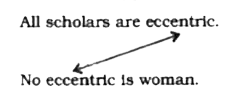
First Premise is Universal Affirmative (A - type) .
Second Premise is Universal Negative (E - type) .
All scholars are eccentric

No eccentric is woman .
A + E `implies` E - type of Conclusion "No scholar is woman" .
Conclusion 1 is Converse of it .
Promotional Banner

Similar Questions

Explore conceptually related problems

In each of the following questions, two statements are given, followed by two conclusions I and II. You have to consider the statements to be true even if they seem to be at varlance from commonly known facts. You have to decide which of the glven conclusions if any, follow from the given statements. Statements : 1. All students are girls. 2. No girl is dull. Conclusions : I. There are no boys in the class. II. No student is dull.

In the following question, two statements are given each followed by two Conclusions I and II. You have to consider the statements to be true even if they seem to be at variance from commonly known facts. You have to decide which of the given Conclusions, if any, follows from the given statements. Statements : I. All dogs are bullocks. II. All bullocks are goats. Conclusions : I. All dogs are goats. II. All goats are dogs.

In each of the following questions, two statements are given followed by two/four conclusions I, II III and IV. You have to consider the two statements to be true even if they seem to be at variance from commonly known facts. You have to decide which of the given conclusions, if any, follow from the given statements. Statements : (a) All peacocks are lions. (b) Some tigers are peacocks. Conclusions : I. Some lions are not tigers. II. All tigers are lions. III. Some tigers are lions. IV. All peacocks are tigers.

In each of the following questions, two statements are given followed by two/four conclusions I, II, III and IV. You have to consider the two statements to be true even if they seem to be at variance from commonly known facts. You have to decide which of the given conclusions, if any, follow from the given statements. Statements : (a) All benches are table. (b) No table is chair. Conclusion: I. All benches are chiars II. All tables are benches III. No tables are benches IV. No benches are chairs

In each of the following questions one/two statements are given followed by two conclusions I and II. You have to consider the two statements to be true even if they seem to be at variance from commonly known facts. You have to decide which of the given conclusions, if any, follow from the given statements. Statements : All animals are birds. Some animals are human beings. Conclusions : I. Some human beings are birds. II. Some birds are human be ings.

In each of the following questions, two statements are given followed by two/four conclusions I, II, III and IV. You have to consider the two statements to be true even if they seem to be at variance from commonly known facts. You have to decide which of the given conclusions, if any, follow from the given statements. Statements : (a) All pens are papers. (b) No as a eraser paper. Conclusions : I. No eraser is a pen. II. Some papers are pens.

In each of the following questions, two statements are given followed by two/four conclusions I, II, III and IV. You have to consider the two statements to be true even if they seem to be at variance from commonly known facts. You have to decide which of the given conclusions, if any, follow from the given statements. Statements : (a) No girl is a parrot. (b) Sowmya is a girl. conclusions : I. Sowmya is not a parrot. II. All girls are not Sowmya.

In the following question, two statements are given followed by two conclusions I and II. You have to consider the statements to be true even if they seem to be at variance from commonly known facts. You have to decide which of the given conclusions, if any, follows from the given statements. Statements : Some bags are hot. All hot things are cakes. Conclusions : I. All cakes are bags. II. All bags are cakes.

In each of the following questions two/three statements are given followed by two/four conclusions I, II, III and IV. You have to consider the statements to be true even if they seem to be at variance from commonly known facts. You have to decide which of the given conclusions, if any, follow from the given statements. Statements: (a) No flower is a pot. (b) No pot is a garden. Conclusions: I. No flower is a garden. II. All gardens are pots.

In the following question, two statements are given followed by two conclusions I and II. You have to consider the statements to be true even if they seem to be at variance from commonly known facts. You have to decide which of the given conclusions, if any, follows from the given statements. Statements : All men are prisoners. No prisoners are educated. Conclusions : I. All prisoners are educated. II. No men are educated.

Recommended Questions
  1. In each of the following questions, two statements are given, followed...

    Text Solution

    |

  2. किन्ही दो संयोजक कड़ी वाले जन्तुओ के नाम तथा वे किस संघ से संबंधित कड़ी ...

    Text Solution

    |

  3. 60 W-220 V तथा 100 W-220 V के दो बल्ब श्रेणीक्रम में जोड़कर 220 व...

    Text Solution

    |

  4. एक इलेक्ट्रॉन तथा एक प्रोटॉन जिनकी गतिज उर्जाएँ समान है, एकसमान चुम्बक...

    Text Solution

    |

  5. प्रदत्त चित्र में दो लम्बे समान्तर धारावाही चालकों में 1 ऐम्पियर तथा ...

    Text Solution

    |

  6. एक राजमार्ग पर दो बिन्दु A और B एक दूसरे से 90 किमी की दूरी पर है। एक ...

    Text Solution

    |

  7. श्री मोहित ने एक निश्चित दूरी के लिए ट्रेडमिल पर चलने का फैसला किया है...

    Text Solution

    |

  8. समस्याओ में रेखिक समीकरणों के युग्म बनाइए और उनके हल (यदि उनका ...

    Text Solution

    |

  9. एक मित्र दूसरे से कहता है कि 'यदि मुझे एक सौ दे दो, तो मैं आपसे दो गुन...

    Text Solution

    |

