Home
Class 14
MATHS
In the following questions, the followIn...

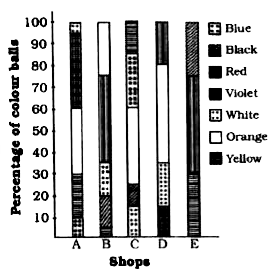
In the following questions, the followIng Bar Diagram shows the percentage of 7 coloured balls sold in 5 shops A, B, C, D and E. Study the graph and answer. all the questions.

In shop A, the ratio of percentage of violet balls and yellow balls is:

A

`2 : 7`

B

`7 : 4`

C

`6 : 1`

D

`2 : 4`

Text Solution

Verified by Experts

The correct Answer is:

B
Promotional Banner

Similar Questions

Explore conceptually related problems

In the following questions, the followIng Bar Diagram shows the percentage of 7 coloured balls sold in 5 shops A, B, C, D and E. Study the graph and answer. all the questions. The shops having equal percentage of white balls are :

In the following questions, the followIng Bar Diagram shows the percentage of 7 coloured balls sold in 5 shops A, B, C, D and E. Study the graph and answer. all the questions. The difference between total number of percentage of violet balls and total number of percentage of blue balls is:

In the following questions, the followIng Bar Diagram shows the percentage of 7 coloured balls sold in 5 shops A, B, C, D and E. Study the graph and answer. all the questions. The ratio of total percentage of red balls and total percentage of orange balls is :

In the following questions, the followIng Bar Diagram shows the percentage of 7 coloured balls sold in 5 shops A, B, C, D and E. Study the graph and answer. all the questions. What fraction of the total percentage of colour balls is to the percentage of total yellow balls?

The bar diagram shows the monthly expenditure of a company. Study the graph and answer the questions. The percentage of money spent on miscellaneous is

The given bar graph represents the Percentage of non-electrified villages in 6 states A, B, C, D, E and F. Study the graph and answer the question that follows. How many states have at most 30% or less non-electrified villages?

Directions: The following bar graph shows the number of pages in five different books (viz. A, B, C, D and E). Study the graph carefully and answer the following questions. What is the ratio of total number of pages in book B and E together to the total number of pages in book C and D together?
