

Home
Class 11
PHYSICS
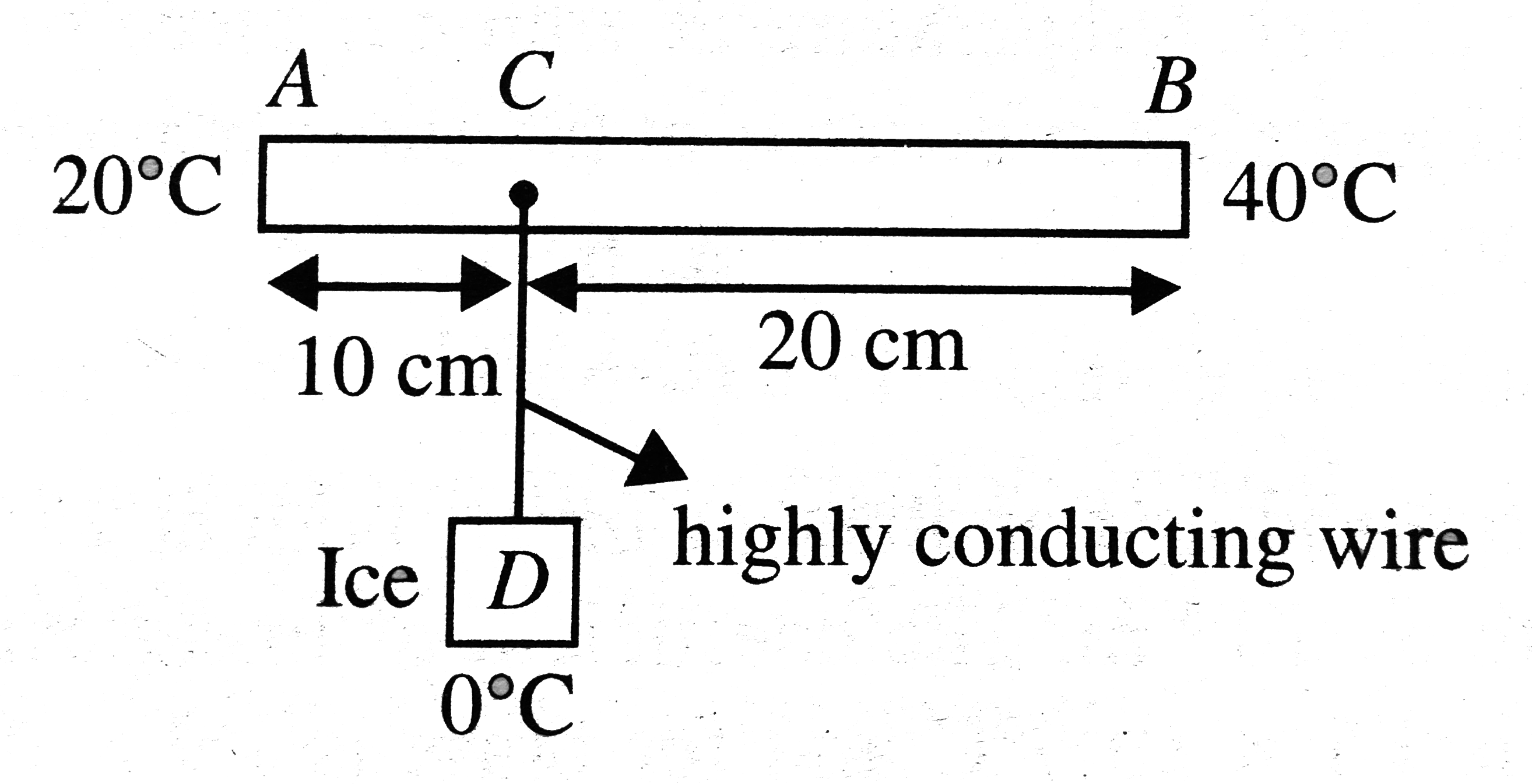
As shown in Fig. AB is rod of length 30 ...


As shown in Fig. AB is rod of length 30 cm and area of cross section 1.0`cm^2` and thermal conductivity 336 SI units. The ends A and B are maintained at temperatures `20^@C` and `40^@C`, respectively .A point C of this rod is connected to a box D, containing ice at `0^@C` through a highly conducting wire of negligible heat capacity. The rate at which ice melts in the box is (assume latent heat of fusion for ice `L_f=80 cal//g`)

Promotional Banner

Similar Questions

Explore conceptually related problems

Two ends of a conducting rod of varying cross-section are maintained at 200^(@)C and 0^(@)C respectively. In steady state:

Two ends of a conducting rod of varying cross-section are maintained at 200^(@)C and 0^(@)C respectively. In steady state:

Five rods of same material and same cross-section are joined as shown. Lengths of rods ab, ad and bc are l, 2l and 3l respectively. Ends a and c are maintained at temperatures 200^(@)C and 0^(@)C respectivelly. For what length x of rod dc there will be no heat flow through rod bd ?

Five rods of same material and same cross-section are joined as shown. Lengths of rods ab, ad and bc are l, 2l and 3l respectively. Ends a and c are maintained at temperatures 200^(@)C and 0^(@)C respectivelly. For what length x of rod dc there will be no heat flow through rod bd ?

Two rods of similar area of cross section and length are joined as shown in the figure. The ratio of their thermal conductivity is 2:3. The free ends are maintained at 100^(@)C and 0^(@)C respectivley. THE temperature at junction in steady state is

Two rods of similar area of cross section and length are joined as shown in the figure. The ratio of their thermal conductivity is 2:3. The free ends are maintained at 100^(@)C and 0^(@)C respectivley. THE temperature at junction in steady state is

Two identical rods AB and CD, each of length L are connected as shown in figure-4.22. Their cross-sectional area is A and their thermal conductivity is k. Ends A, C and D are maintained at temperatures T_(1),T_(2) and T_(3) respectively. Neglecting heat loss to the surroundings, find the temperature at B.