

Home
Class 11
PHYSICS
A particle P is initially at rest on the...

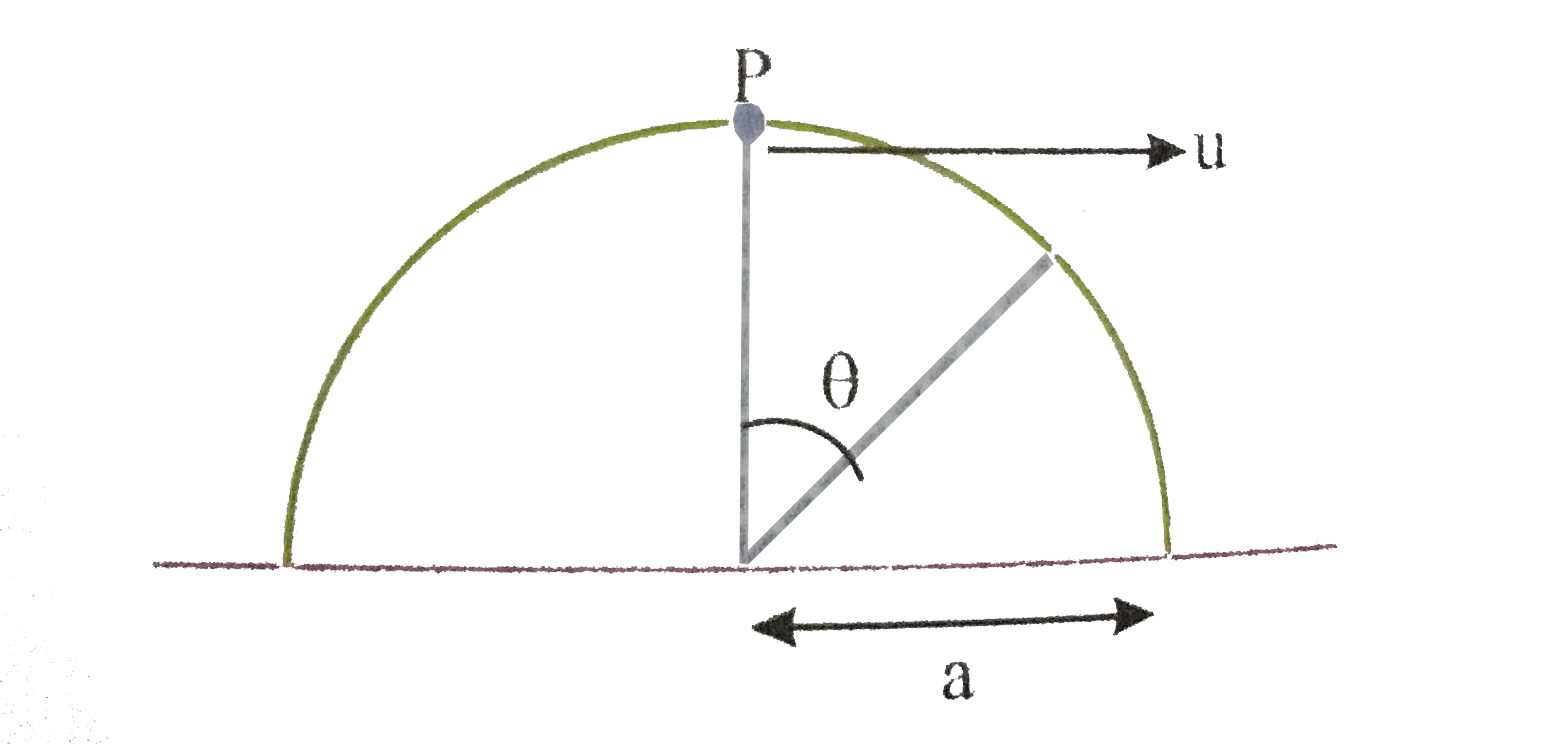
A particle `P` is initially at rest on the top `pf`a smooth hemispherical surface which is fixed on a horizontal plane. The particle is given a velocity `u` horizontally. Radius of spherical surface is `a`.
.

Promotional Banner

Similar Questions

Explore conceptually related problems

A particle of mass m is released from the top of a smooth hemisphere of radius R with the horizontal speed mu . Calculate the angle with verticle where it loses contact with the hemisphere.

A particle rests on the top of a smooth hemisphere of radius r . It is imparted a horizontal velocity of sqrt(etagr) . Find the angle made by the radius vector joining the particle with the vertical at the instant the particle losses contact with the sphere.

A particle rests on the top of a smooth hemisphere of radius r . It is imparted a horizontal velocity of sqrt(etagr) . Find the angle made by the radius vector joining the particle with the vertical at the instant the particle losses contact with the sphere.

A particle at rest is constrained to move on a smooth horizontal surface. Another identical particle hits the stationary particle with a velocity v at an angle theta=60^(@) with horizontal. If the particles move together, the velocity of the combination just after the impact is equal to

A particle at rest is constrained to move on a smooth horizontal surface. Another identical particle hits the fractional particle with a velocity v at an angle theta=60^(@) with horizontal. If the particles move together, the velocity of the combination just after impact is equal to

A particle at rest is constrained to move on a smooth horizontal surface. Another identical particle hits the stationary particle with a velocity v at an angle theta=60^(@) with horizontal. If the particles move together, the velocity of the combination just after the impact is equal to

A particle at rest is constrained to move on a smooth horizontal surface. Another identical particle hits the fractional particle with a velocity v at an angle theta=60^(@) with horizontal. If the particles move together, the velocity of the combination just after impact is equal to

A particle of mass m initially at rest starts moving from point A on the surface of a fixed smooth hemisphere of radius r as shown. The particle looses its contact with hemisphere at point B.C is centre of the hemisphere. The equation relating theta and theta' is .