

Home
Class 11
PHYSICS
A load of 10 KN is supported from a pul...

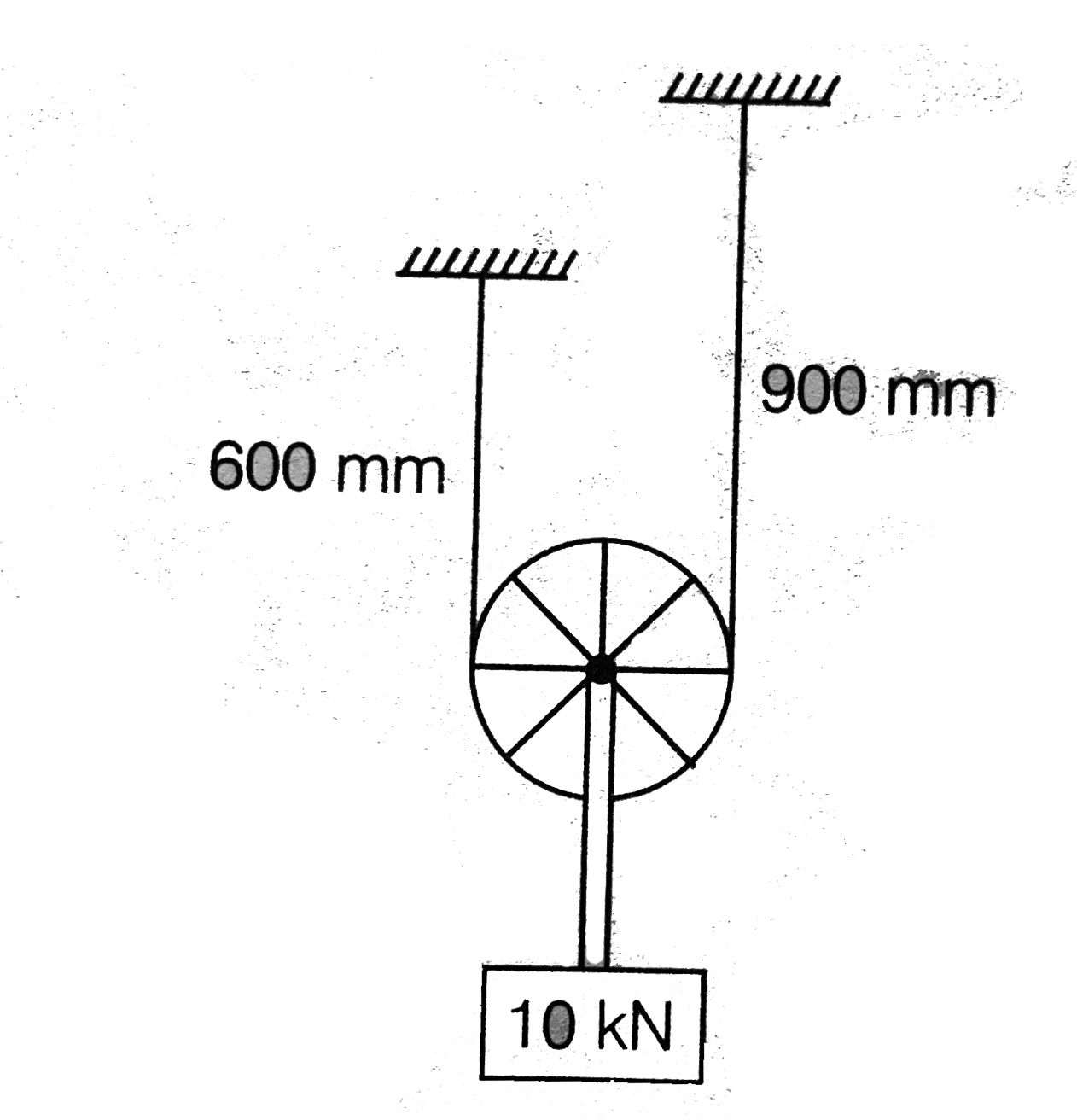
A load of `10 KN` is supported from a pulley , which in turn is supported by a rope of cross-sectional area `10^(3) mm^(2)` and modulus of elasticity `10^(3) Nmm^(-2)` as shown in the figure. Neglecting friction at the pulley , then downward deflection of the load (in mm) is

Promotional Banner

Similar Questions

Explore conceptually related problems

A load of 10 kN is supported from a pulley which in turn is supported by a rope of sectional area 1xx10^(3)mm^(2) and modulus of elasticity 10^(3)Nmm^(-2) , as shown in figure. Neglecting the friction at the pulley, determine the deflection of the load.

The axle of a pulley of mass 1 kg is attached to the end of an elastic string of length 1m , cross- sectional area 10^(-3) m^(2) and young's modulus 2xx10^(5) Nm^(-2) ,whose other end is fixed to the ceiling. A rope of negligible mass is placed on the pulley such that its left end is fixed to the ground and its right end is hanging freely , from the pulley which is at rest in equilibrium . Now, the rope and the pulley can be neglected. (Given, g = 10 ms^(-2) ) The elongation of the string before applying force is

The axle of a pulley of mass 1 kg is attached to the end of an elastic string of length 1m , cross- sectional area 10^(-3) m^(2) and young's modulus 2xx10^(5) Nm^(-2) ,whose other end is fixed to the ceiling. A rope of negligible mass is placed on the pulley such that its left end is fixed to the ground and its right end is hanging freely , from the pulley which is at rest in equilibrium . Now, the rope and the pulley can be neglected. (Given, g = 10 ms^(-2) ) The elongation of the string before applying force is

The axle of a pulley of mass 1 kg is attached to the end of an elastic string of length 1m , cross- sectional area 10^(-3) m^(2) and young's modulus 2xx10^(5) Nm^(-2) ,whose other end is fixed to the ceiling. A rope of negligible mass is placed on the pulley such that its left end is fixed to the ground and its right end is hanging freely , from the pulley which is at rest in equilibrium . Now, the rope and the pulley can be neglected. (Given, g = 10 ms^(-2) ) The elongation of the string before applying force is

The axle of a pulley of mass 1 kg is attached to the end of an elastic string of length 1m , cross- sectional area 10^(-3) m^(2) and young's modulus 2xx10^(5) Nm^(-2) ,whose other end is fixed to the ceiling. A rope of negligible mass is placed on the pulley such that its left end is fixed to the ground and its right end is hanging freely , from the pulley which is at rest in equilibrium . Now, the rope and the pulley can be neglected. (Given, g = 10 ms^(-2) ) The elongation of the string before applying force is

A force of 100 N produces a change of 0.01% in a length of wire of area of cross -section 1.0 mm^2 . Young's modulus of the wire is

A load of 1kg weight is attacheed to one end of a steel wire of cross sectional area 3mm^(2) and Young's modulus 10^(11) N//m^(2) . The other end is suspended vertically form a hook on a wall, then load is pulled horizonatally and relased. When the load passes through its lowest position the fractional change in length is (g = 10m//s^(2))

Speed of transverse wave in a string of density 100kg//m^(3) and area of cross-section 10mm^(2) under a tension of 10^(3) N is

Speed of transverse wave in a string of density 100kg//m^(3) and area of cross-section 10mm^(2) under a tension of 106^(3) N is

A load o f 1 kg weight is a attached to one end of a steel wire o f area of cross-section 3mm^(2) and Young's modulus 10^(11) N//m^(2) . The other end is suspended vertically from a hook on a wall , then the load is pulled horizontally and released .When the load passes through its lowest position the fraction al change in lenght is (Take g = 10m//s^(2))