

Home
Class 12
PHYSICS
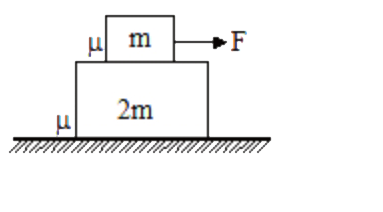
The system of two blocks is at rest an ...

The system of two blocks is at rest an shown in the figure. A variable Horizontal force is applied to the upper block. The maximum possible constant force exerted by the horizontal ground surface on the lower block is ( coefficient of friction for both the contracts is `mu` )

Promotional Banner

Similar Questions

Explore conceptually related problems

For the two blocks shown in the adjacent figure, an external force of 18N is applied on the lower block. Find the acceleratiion of the upper block.

A block of mass m_(2) is placed on a horizontal table and another block of mass m_(1) is placed on top is it. An increasing horizontal force F = alpha t is exerted on the upper block but the lowwer block never moves as a result. If the coefficient of friction between the blocks is mu_(1) coefficient of friction between the blocks is mu_(1) and that between the lower block and the table is mu_(2), then what is the maximum possible value of mu_(1)//mu_(2) ?

A block of mass m_(2) is placed on a horizontal table and another block of mass m_(1) is placed on top is it. An increasing horizontal force F = alpha t is exerted on the upper block but the lowwer block never moves as a result. If the coefficient of friction between the blocks is mu_(1) coefficient of friction between the blocks is mu_(1) and that between the lower block and the table is mu_(2), then what is the maximum possible value of mu_(1)//mu_(2) ?

A horizontal force of 20 N is applied to a block of 10 kg resting on a rough horizontal surface. How much additional force is required to just move the block, if the coefficient of static friction between the block and the surface is 0.4 ?

A block of unknown mass is at rest on a rough, horizontal surface. A horizontal force F is applied to the block. The graph in the figure shows the acceleration of the block with respect to the applied force. The mass of the block is

A block of unknown mass is at rest on a rough, horizontal surface. A horizontal force F is applied to the block. The graph in the figure shows the acceleration of the block with respect to the applied force. The mass of the block is

A small block of mass 20kg rests on a bigger block of mass 30kg , which lies on a smooth horizontal plane. Initially the whole system is at rest. The coefficient of friction between the blocks is 0.5 . The horizontal force F=50N is applied on the lower block. a. Find the work done by fricitonal force on upper block and on the lower block in t=2s . b. Is the magnitude of work done by the frictional force on upper and lower blocks same? c. Is the work done by the frictional force on the upper block converted to heat or mechanical energy or both?

A small block of mass 20kg rests on a bigger block of mass 30kg , which lies on a smooth horizontal plane. Initially the whole system is at rest. The coefficient of friction between the blocks is 0.5 . The horizontal force F=50N is applied on the lower block. a. Find the work done by fricitonal force on upper block and on the lower block in t=2s . b. Is the magnitude of work done by the frictional force on upper and lower blocks same? c. Is the work done by the frictional force on the upper block converted to heat or mechanical energy or both?

A block rests on a horizontal surface. A horizontal force F is applied to the block. The acceleration (a) produced in the block as a function of applied force (F) has been plotted in a graph (see figure). Find the mass of the block.