

Home
Class 11
PHYSICS
An object of mass 0.8kg is attached to o...

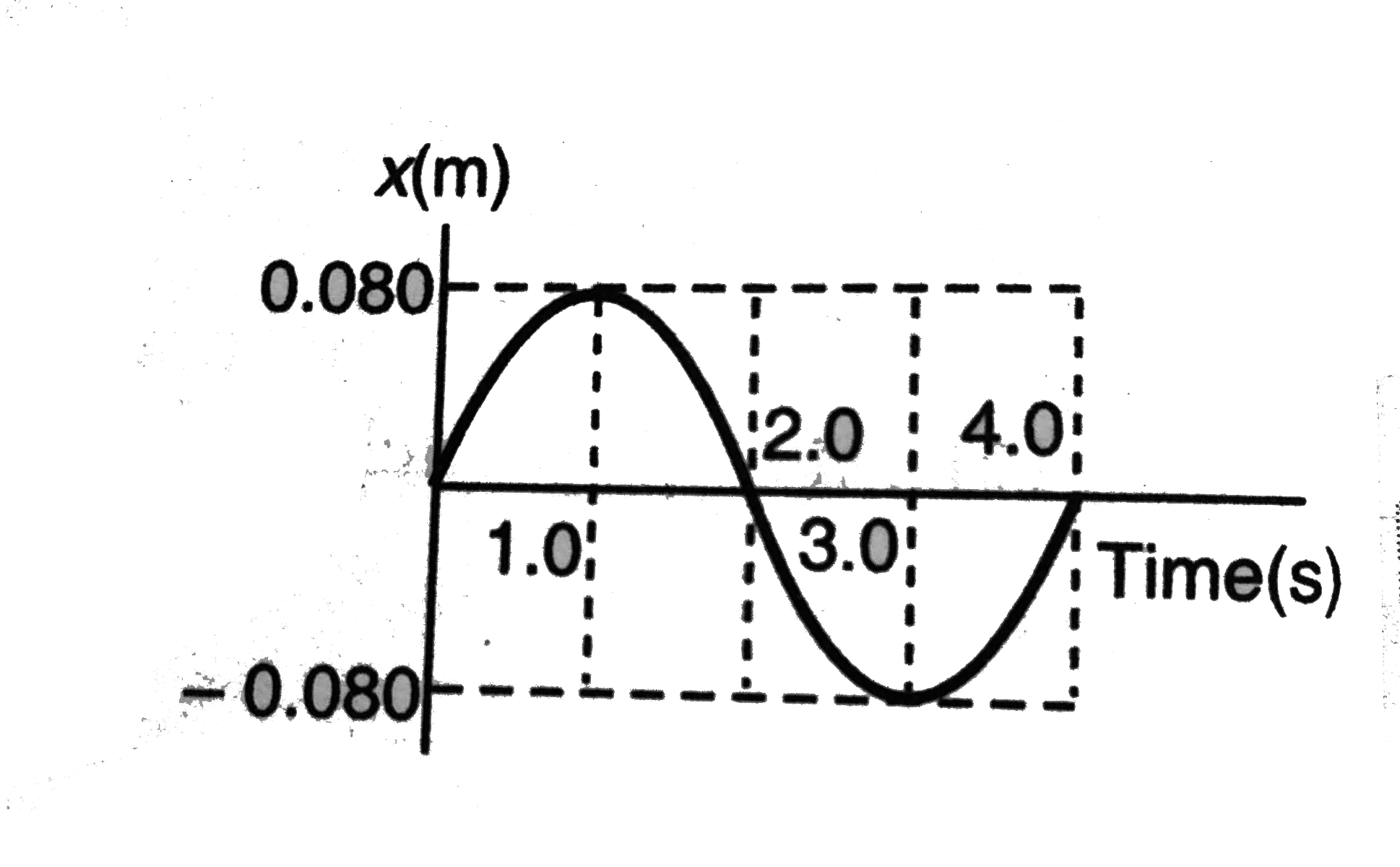
An object of mass `0.8kg` is attached to one end of a spring and the system is set into simple harmonic motion. The displacement `x` of the object as a fuction of time is shown in the figure. With the aid of the data, determine
(a) the amplitude `A` of the motion,
(b) the angular frequency `omega`,
( c) the spring constant `K`,
(d) the speed of the object at `t = 1.0 s` and
(e) the magnitude of the object's acceleration at `t = 1.0 s`.

Promotional Banner

Similar Questions

Explore conceptually related problems

A body of mass m attached to one end of an ideal spring of force constant k is executing simple harmonic motion. Establish that the time - period of oscillation is T=2pisqrt(m//k) .

An object of mass m, oscillating on the end of a spring with spring constant k has amplitude A. its maximum speed is

Find an expression for the time period of a loaded spring in simple harmonic motion.

A 5kg mass bounces in simple harmonic motion at the end of a spring. At which point the acceleration of the mass is the greatest?

A 5kg mass bounces in simple harmonic motion at the end of a spring. At which point the acceleration of the mass is the greatest?

A 0.20kg object mass attached to a spring whose spring constant is 500N/m executes simple harmonic motion. If its maximum speed is 5.0m/s, the amplitude of its oscillation is

A simple harmonic motion has an amplitude of A and an angular frequency of omega . Determine the distance of the point from the equilibrium position where the magnitudes of velocity and acceleration of the motion are equal.

The acceleration displacement graph of a particle executing simple harmonic motion is shown in figure. The time period of simple harmonic motion is

If a mass of 2.0 kg is attached to one end of a spring and the spring has a spring constant 1500Nm^(-1) , then calculate the maximum velocity and acceleration of the mass body for an amplitude 0.05 m .

A mass on the end of a spring undergoes simple harmonic motion with a frequency of 0.5 Hz. If the attached mass is reduced to one quarter of its value, then the new frequency in Hz is