

Home
Class 12
PHYSICS
Two parallel beams of light P and Q (sep...

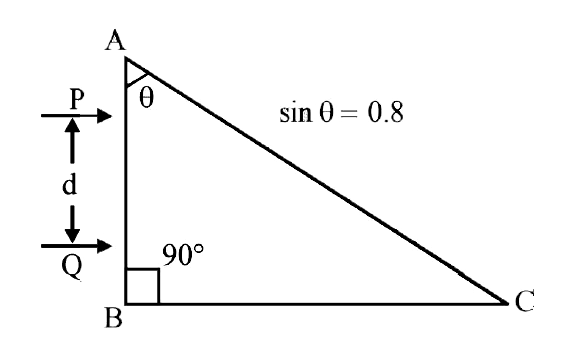
Two parallel beams of light P and Q (separation d) containing radiation of wavelengths `4000A` and `5000A` (which are mutually coherent in each wavelength separately) are incident normally on a prism as shown in fig. The refractive index of the prism as a function of wavelength is given by the relation. `mu(lamda)=1.20+(b)/(lamda^(2))` Where `lamda` is in `A` and b is positive constant. The value of b is such that the condition wave length and is not satisfied for the other.
(a) Find the value of b.
(b) find the deviation of the beams transmitted through the face AC. (c) A convergent lens is used to bring these transmitted beams into focus. If the intensities of transmission form the face AC, are 41 and I respectively, find the resultant intensity at the focus. `

Promotional Banner

Similar Questions

Explore conceptually related problems

Two parallel beams of light P and Q (separation d) containing radiations of wavelengts 4000Å and 5000 Å (which are mutually coherent in each wavelength separately) are incident normally on a prism as shown in figure the refractive index of the prism as a function of wavelength is given by the relation mu(lamda)=1.20+(b)/(lamda^(2)) where lamda is in Å and b is a positive constant. The value of b is such that the condition for total reflection at the face AC is just satisfied for one wavelength and is not satisfied for the other. A convergent lens is used to bring these transmitted beams into focus. If the intensities of the upper and the lower beams immediately after transmission from the face AC, are 4I and I respectively, find the resultant intensity at the focus.

Two parallel beams of light P and Q (separation d) containing radiations of wavelengts 4000Å and 5000 Å (which are mutually coherent in each wavelength separately) are incident normally on a prism as shown in figure the refractive index of the prism as a function of wavelength is given by the relation mu(lamda)=1.20+(b)/(lamda^(2)) where lamda is in Å and b is a positive constant. The value of b is such that the condition for total reflection at the face AC is just satisfied for one wavelength and is not satisfied for the other. A convergent lens is used to bring these transmitted beams into focus. If the intensities of the upper and the lower beams immediately after transmission from the face AC, are 4I and I respectively, find the resultant intensity at the focus.

The refractive index ( mu ) of glass is related to the wavelength (lambda) of incident light as mu = A +(B)/(lambda^(2)) , where A and B are constants. Find out the dimensions of A and B.

According to Cauchy's formula, the refractive index mu of a material is related to wavelength lamda as………. .

If the velocity and wavelength of light in air is V_a and lamda_a and that in water is V_w and lamda_w then the refractive index of water is,

Find the thickness of a plate which will produce a change in optical path equal to half the wavelength lamda of the light passing through it normally. The refractive index of the plate is mu .

Find the thickness of a plate which will produce a change in optical path equal to half the wavelength lamda of the light passing through it normally. The refractive index of the plate is mu .

Find the thickness of a plate which will produce a change in optical path equal to half the wavelength lamda of the light passing through it normally. The refractive index of the plate is mu .

The refractive index of a medium is given by mu=A+(B)/(lambda^(2)) where A and B are constants and lambda is the wavelength of light. Then the dimensions of B are the same as that of