

Home
Class 12
BIOLOGY
Alfred Hershey and Martha Chase made a b...

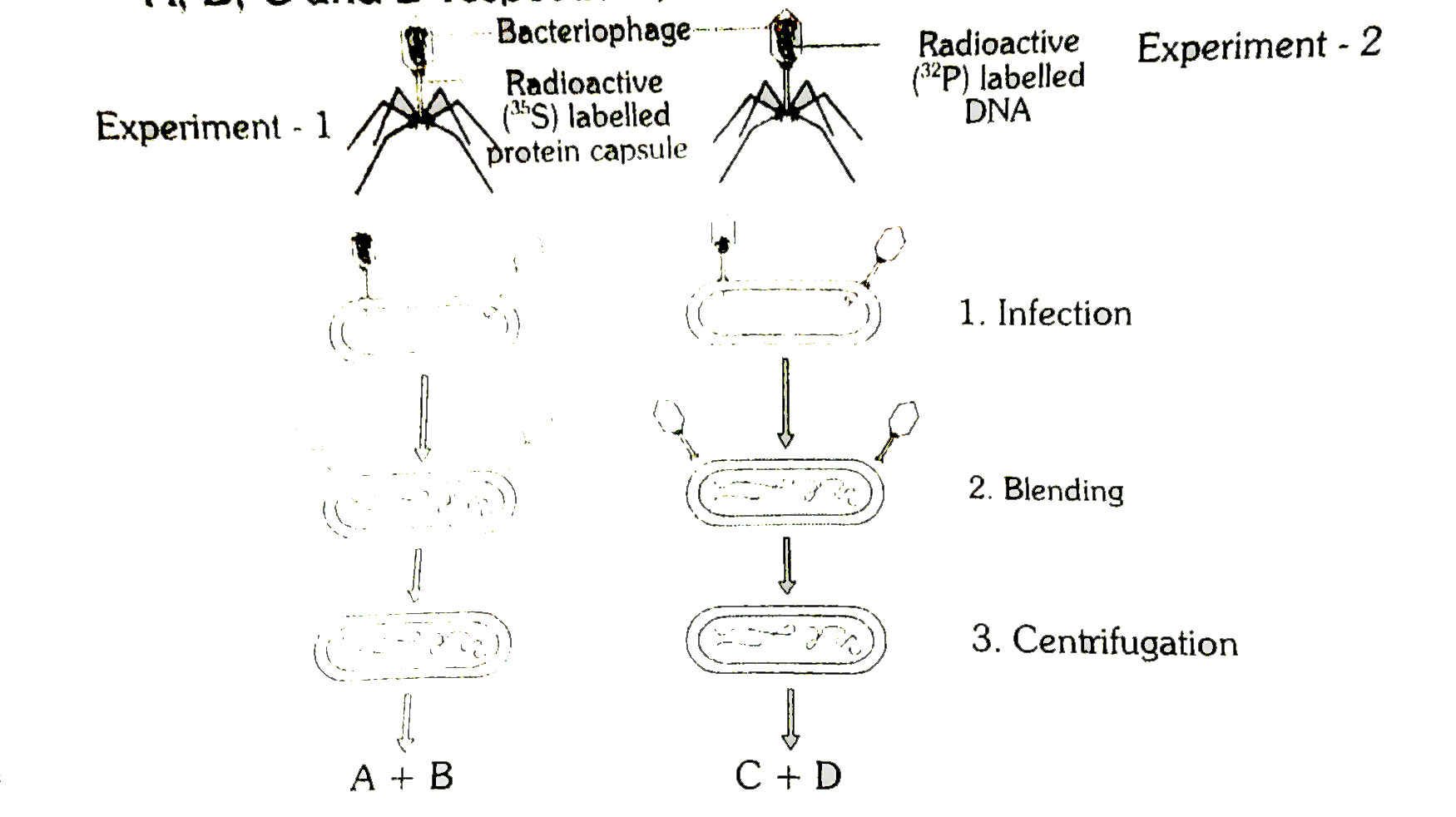
Alfred Hershey and Martha Chase made a big contribution in providing DNA role as the hereditary molecules. The experiment is shown in the figure. A and C are the presence or absence of radioactivity detected in cells . B and D are the presence or absence of radioactivity detected in supernatants cells. Identify A,B,C and D respectively

Promotional Banner

Similar Questions

Explore conceptually related problems

Given figure shows the sequence of the development process in a plant cell, identify labelled parts A,B,C and D.

The root cap is not used in absorption of water due to (a) Presence of roots hairs (b) Absence of root hairs (c) Its presence in elongation zone (d) None of the above

The root cap is not used in absorption of water due to (a) Presence of roots hairs (b) Absence of root hairs (c) Its presence in elongation zone (d) None of the above

Figure-I-Mango, Figure-II-Coconut are shown in the following digram. Identify the parts of the fruit A,B,C and D are respectively

(a) What is this diagram representing? (b) Name the parts a, b and c. (c) In the eukaryotes the DNA molecules are organized within the nucleus. How is the DNA molecule organized in a bacterial cell in absence of a nucleus?

(a) What is this diagram representing? (b) Name the parts a, b and c. (c) In the eukaryotes the DNA molecules are organized within the nucleus. How is the DNA molecule organized in a bacterial cell in absence of a nucleus?

(a) What is this diagram representing? (b) Name the parts a, b and c. (c) In the eukaryotes the DNA molecules are organized within the nucleus. How is the DNA molecule organized in a bacterial cell in absence of a nucleus?

(a) What is this diagram representing? (b) Name the parts a, b and c. (c) In the eukaryotes the DNA molecules are organized within the nucleus. How is the DNA molecule organized in a bacterial cell in absence of a nucleus?

Study the given figure and identify the cells labelled as A, B, C and D

Study the given figure and identify the cells labelled as A, B, C and D