

Home
Class 9
MATHS
It is given that angleXYZ=64^(@) and XY ...

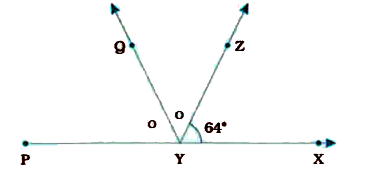
It is given that `angleXYZ=64^(@)` and XY is produced to point P. Draw a figure from the given information. If ray YQ bisects `angleZYP`, find `angleXYQ` and reflex `angleQYP`.

Promotional Banner

Topper's Solved these Questions

  • LINES AND ANGLES

    NCERT GUJARATI|Exercise EXERCISE XERCISE - 4.3|19 Videos
  • LINES AND ANGLES

    NCERT GUJARATI|Exercise EXERCISE XERCISE - 4.4|17 Videos
  • LINES AND ANGLES

    NCERT GUJARATI|Exercise EXERCISE XERCISE - 4.1|11 Videos
  • LINEAR EQUATIONS IN TWO VARIABLES

    NCERT GUJARATI|Exercise EXERCISE 8.5|1 Videos
  • POLYNOMIALS AND FACTORISATION

    NCERT GUJARATI|Exercise TRY THESE|5 Videos

Similar Questions

Explore conceptually related problems

In the given figure, sides QP and RQ of DeltaPQR are produced to points S and T respectively. If angleSPR=135^(@) and anglePQT=110^(@) , find anglePRQ .

In the given figure, angle PQR = 100^(@), where P, 9 and R are points on a circle with centre O. Find angle OPR.

Ray 1 is the bisector of an angle angle A and B is any point on I. BP and BQ are perpendiculars from B to the arms of angle A (see the given figure). Show that: (i) triangleAPB=triangleAQB (ii) BP = BQ or B is equidistant from the arms of angleA

Two parallel beams of light P and Q (separation d) containing radiations of wavelengts 4000Å and 5000 Å (which are mutually coherent in each wavelength separately) are incident normally on a prism as shown in figure the refractive index of the prism as a function of wavelength is given by the relation mu(lamda)=1.20+(b)/(lamda^(2)) where lamda is in Å and b is a positive constant. The value of b is such that the condition for total reflection at the face AC is just satisfied for one wavelength and is not satisfied for the other. A convergent lens is used to bring these transmitted beams into focus. If the intensities of the upper and the lower beams immediately after transmission from the face AC, are 4I and I respectively, find the resultant intensity at the focus.

A quarter cylinder of radius R and refractive index 1.5 is placed on a table.A point object P is kept at a distance of mR from it. Find the value of m for whicha ray from P will emerge parallel to the table as shown in the figure.

AB is a line segment. P and Q are points on opposite sides of AB such that each of them is equidistant from the points A and B (see the given figure). Show that the line PQ is the perpendicular bisector of AB.

A TV tower stands vertically on a bank of a canal. From a point on the other bank directly opposite the tower, the angle of elevation of the top of the tower is 60^(@) . From another point 20m away from this point on the line joining this point to the foot of the tower, the angle of elevation of the top of the tower is 30^(@) (see the given figure). Find the height of the tower and the width of the canal.

In the given figure points A and C are on the horizontal ground & A and B are in same vertical plane. Simultaneously bullets are fired from A, B and C and they collide at D. The bullet at B is fired horizontally with speed of 72/5 km//hr and the bullet at C is projected vertically upward at velocity of 54/5 km//hr . Find velocity of the bullet projected from A in m//s .

Which of the following statements are true and which are false ? Give reasons for your answers : (i) Only one line can pass through a single point. (ii) There are an infinite number of lines which pass through two distinct points. (iii) A terminated line can be produced indefinitely on both the sides. (iv) If two circles are equal, then their radii are equal. (v) In the given figure, if AB = PQ and PQ = XY, then AB = XY.

The lens governing the behavior of the rays namely rectilinear propagation laws of reflection and refraction can be summarised in one fundamental law known as Fermat's principle. According to this principle a ray of light travels from one point to another such that the time taken is at a stationary value (maximum or minimum). if c is the velocity of light in a vacuum the velocity in a medium of refractive index mu is (c)/(mu) hence time taken to travel a distance l is (mul)/(c) if the light passes through a number of media, the total time taken is ((1)/(c))summul or (1)/(c)intmudl if refractive index varies continuously. Now summul is the total path, so that fermat's principle states that the path of a ray is such that the optical path in at a stationary value. this principle is obviously in agreement with the fact that the ray are straight lines i a homogenous isotropic medium. it is found that it also agrees with the classical laws of reflection and refraction. Q. The optical path length followed by ray from point A to B given that laws of refraction are obeyed as shown in figure.