

Home
Class 9
MATHS
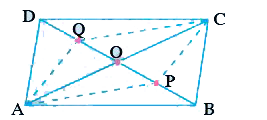
ABCD is a parallelogram. AC and BD are t...

ABCD is a parallelogram. AC and BD are the diagonals intersect at O. P and Q are the points of tri section of the diagonal BD. Prove that `CQ" ||" AP` and also AC bisects PQ (see figure).

Promotional Banner

Topper's Solved these Questions

  • QUADRILATERALS

    NCERT GUJARATI|Exercise EXERCISE - 8.4|6 Videos
  • QUADRILATERALS

    NCERT GUJARATI|Exercise EXERCISE - 8.2|3 Videos
  • PROOFS IN MATHEMATICS

    NCERT GUJARATI|Exercise EXERCISE - 15.4|15 Videos
  • REAL NUMBERS

    NCERT GUJARATI|Exercise EXERCISE - 1.4|37 Videos

Similar Questions

Explore conceptually related problems

In a parallelogram ABCD, E and F are the midpoints of the sides AB and DC respectively. Show that the line segments AF and EC trisect the diagonal BD.

In parallelogram ABCD, two points P and Q are taken on diagonal BD such that DP= BQ (see the given figure) Show that: AP= CQ

ABCD is a parallelogram whose diagonals meet at P. If O is a fixed point, then bar(OA)+bar(OB)+bar(OC)+bar(OD) equals :

If P and Q are the middle points of the sides BC and CD of the parallelogram ABCD, then AP+AQ is equal to

ABCD is a parallelogram AP and CQ are perpendiculars drawn from vertices A and C on diagonal BD (see figure) show that (i) DeltaAPB ~= DeltaCQD (ii) AP = CQ

The diagonal AC of a parallelogram ABCD intersects DP at the point Q, where ‘P’ is any point on side AB. Prove that CQ xx PQ = QA xx QD .

In parallelogram ABCD, two points P and Q are taken on diagonal BD such that DP= BQ (see the given figure) Show that: DeltaAQB ~= DeltaCPD

In parallelogram ABCD, two points P and Q are taken on diagonal BD such that DP= BQ (see the given figure) Show that: DeltaAPD ~= DeltaCQB

ABCD is a parallelogram. L is a point on BC which divides BC in the ratio 1:2 . AL intersects BD at P.M is a point on DC which divides DC in the ratio 1 : 2 and AM intersects BD in Q. PQ : DB is equal to

ABCD is a trapezium in which AB||DC and its diagonals intersects each other at the point O. Show that (AO)/(BO)=(CO)/(DO) .