Home
Class 9
MATHS
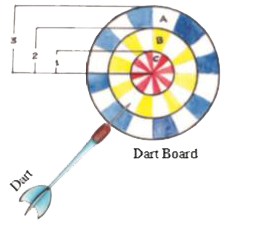
Assume that a dart will hit the dart boa...

Assume that a dart will hit the dart board and each point on the dart board is equally likely to be hit in all the three concentric circles where radii of concetric circles are 3 cm, 2 cm and 1 cm as shown in the figure below.
Find the probability of a dart hitting the board in the region A. (The outer ring)

Text Solution

Verified by Experts

The correct Answer is:

0.556
Promotional Banner

Topper's Solved these Questions

  • PROBABILITY

    NCERT GUJARATI|Exercise EXERCISE - 14.1|8 Videos
  • PROBABILITY

    NCERT GUJARATI|Exercise TRY THESE|7 Videos
  • POLYNOMIALS AND FACTORISATION

    NCERT GUJARATI|Exercise TRY THESE|5 Videos
  • PROOFS IN MATHEMATICS

    NCERT GUJARATI|Exercise EXERCISE - 15.4|15 Videos

Similar Questions

Explore conceptually related problems

Find the probability of the dart hitting the board in the circular region B (i.e. ring B).

Without calculating, write the percentage of probability of the dart hitting the board in circular region C (i.e. ring C).

An archery target has three regions formed by three concentric circles as shown in the given figure. If the diameters of the circle are in ratio 1:2:3 , then find the ratio of the areas of three regions.

Find the area of the shaded region in the figure, in which two circles with centres A and B touch each other at the point C, where AC=8cm and AB=3cm

What is the probability that a randomly thrown dart hits the square board in shaded region (Take π = (22)/(7) and express in percentage)

In the given figure, two circles with centres A and B touch each other internally at point C. If AC = 8 cm and AB = 3cm, find the area of the shaded region.

The area of an equilateral triangle ABC is 17320.5 cm^(2) . With each vertex of the triangle as centre, a circle is drawn with radius to half the length of the side of the triangle (see the given figure). Find the area of the shaded region. (Use pi = 3.14 and sqrt(3) = 1.73205 )

A closed cubical box is made of perfectly insulating material and the only way for heat to enter or leave the box is through two solid cylindrical metal plugs, each of cross sectional area 12cm^(2) and length 8cm fixed in the opposite walls of the box. The outer surface of one plug is kept at a temperature of 100^(@)C . while the outer surface of the plug is maintained at a temperature of 4(@)C . The thermal conductivity of the material of the plug is 2.0Wm^(-1).^(@)C^(-1) . A source of energy generating 13W is enclosed inside the box. Find the equilibrium temperature of the inner surface of the box assuming that it is the same at all points on the inner surface.

two concentric rings of radii r and 2r are placed with centre at origin. Tow charges +q each are fixed at the diametrically opposite points of the rings as shown in figure . Smaller ring is now rotated by an angle 90^@ about Z-axis then it is again rotated by 90^@ about Y-axis . Find the work done by electrostatic forces in each step . If finally larger ring is rotated by 90^@ about X-axis , find the total work required to perform all three steps . .

A point source is emitting 0.2 W of ultravio- let radiation at a wavelength of lambda = 2537 Å . This source is placed at a distance of 1.0 m from the cathode of a photoelectric cell. The cathode is made of potassium (Work function = 2.22 eV ) and has a surface area of 4 cm^(2) . (a) According to classical theory, what time of exposure to the radiation shall be required for a potassium atom to accumulate sufficient energy to eject a photoelectron. Assume that radius of each potassium atom is 2 Å and it absorbs all energy incident on it. (b) Photon flux is defined as number of light photons reaching the cathode in unit time. Calculate the photon flux. (c) Photo efficiency is defined as probability of a photon being successful in knocking out an electron from the metal surface. Calculate the saturation photocurrent in the cell assuming a photo efficiency of 0.1. (d) Find the cut – off potential difference for the cell.
