

Home
Class 10
MATHS
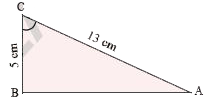
Find (i) sin C (ii) cos C and (iii) tan ...

Find (i) `sin C (ii) cos C and (iii) tan C ` in the adjacent triangle.

Promotional Banner

Topper's Solved these Questions

  • TRIGONOMETRY

    NCERT GUJARATI|Exercise TRY THIS|8 Videos
  • TRIGONOMETRY

    NCERT GUJARATI|Exercise THINK AND DISCUSS|12 Videos
  • TRIGONOMETRY

    NCERT GUJARATI|Exercise OPTIONAL EXERCISE|6 Videos
  • TANGENTS AND SECANTS TO A CIRCLE

    NCERT GUJARATI|Exercise Try this|2 Videos

Similar Questions

Explore conceptually related problems

Area of the triangle is calculated by the formula A=(1)/(2)ab sin C . If C = (pi)/(6) and error in the measure of C is x%, find the approximate change in the area of the triangle. Where a and b are constant.

The vertices of Delta ABC are A (2,2) , B ( -4, -4) and C (5,-8) . Find the length of a median of a triangle , which is passing though the point C

Consider the equation 5 sin^2 x + 3 sin x cos x - 3 cos^2 x =2 .......... (i) sin^2 x - cos 2 x =2-sin 2 x ........... (ii) If tan alpha , tan beta satisfy (i) and cos gamma , cos delta satisfy (ii) , then tan alpha * tan beta + cos gamma + cos delta can be equal to

Find the value of : (i) sin 30^(@)+cos 60^(@) (ii) sin 0^(@)-cos 0^(@) (iii) tan 45^(@)- tan 37^(@) (iv) sin 390^(@) (v) cos 405^(@) (vi) tan 420^(@) (vii) sin 150^(@) (viii) cos 120^(@) (ix) tan 135^(@) (x) sin (330^(@)) (xi) cos 300^(@) (xii) sin (-30^(@)) (xiii) cos (-60^(@)) (xiv) tan (-45^(@)) (xv) sin (-150^(@))

Find (i) int cos^(2)x,dx (ii) int sin (2x)cos (3x)dx , (iii) int sin^(3)x dx.

In the adjacent figure, it is given that AB =AC, angleBAC = 36^(@) , angleADB = 45^(@) and angleAEC = 40^(@) . Find (i) angleABC (ii) angleACB (iii) angleDAB (iv) angleEAC .

Write length of "Hypotenuse ","Opposite side "and "Adjacent side "for the given angles in the given triangles. 1. Foa angle C . For angle A

If 3 tan A =4 ,then find sin A and cos A

Consider the equation 5 sin^2 x + 3 sin x cos x - 3 cos^2 x =2 .......... (i) sin^2 x - cos 2 x =2-sin 2 x ........... (ii) If alpha is a root of (i) and beta is a root of (ii), then tan alpha + tan beta can be equal to

For any "Delta"A B C the value of determinant |sin^2\ \ A cot A1sin^2B cot B1sin^2\ \ C cot C1| is equal to- s in A s in B s in C b. 1 c. 0 d. s in A+s in B+s in C