Home
Class 11
PHYSICS
Consider the collision depicted in figur...

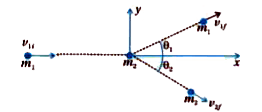
Consider the collision depicted in figure to be between two billiard balls are equal masses `m_(1)=m_(2)` . The first ball is called the cue while the second ball is called the target . The billiard player wants to 'sink ' the target ball in a corner pocket , which is at angle `theta_(2) = 37^(@)` .Assume that the collision is elastic and that friction and rotational motion are not important . Obtain `theta_(1)` .

Text Solution

Verified by Experts

From momentum conservation, since the masses are equal
`v_(1i)= v_(1f)+v_(2f)`
or, `v_(1i)""^(2)=(v_(1f)+v_(2f))*(v_(1f)+v_(2f))`
`=v_(1i)""^(2)+v_(2f)""^(2)+2v_(1f)*v_(2f)`
`={v_(1f)""^(2)+v_(2f)""^(2)+2v_(1f)v_(2f) cos(theta_1 +37^(@))}" "(6.32)`
Since the collision is elastic and `m_(1)= m_(2)` it follows from conservation of kinetic energy that
`v_(1f)""^(2)= v_(1f)""^(2)+v_(2f)""^(2)` (6.33)
Comparing Eqs. (6.32) and (6.33), we get
`cos (theta_(1)+37^(@))=0`
or, `theta_(1)+ 37^(@)= 90^(@)`
Thus, `theta_(1)= 53^(@)`.
This proves the following result : when two equal masses undergo a glancing elastic collision with one of them at rest, after the collision, they will move at right angles to each other.
Promotional Banner

Topper's Solved these Questions

  • WORK, ENERGY AND POWER

    NCERT GUJARATI|Exercise EXERCISES|44 Videos
  • WORK, ENERGY AND POWER

    NCERT GUJARATI|Exercise EXERCISES (ADDITIONAL EXERCISES)|5 Videos
  • WAVES

    NCERT GUJARATI|Exercise Exercises|27 Videos

Similar Questions

Explore conceptually related problems

Consider the collision depicted in gif . To be between two billiard balls with equal masses second ball is called the target .The billiard player wants to 'sink' the target ball in corner pocket , what is at an angle theta_(2) =32^(@) Assume that collision is elastic and that friction and rotational motion are not important Obtain theta_(1) .

A ball is projected as shown in figure. The ball will return to point:

Which of the following potential energy curves in figure cannot describe the elastic collision of two billiard balls ? Here r is the distance between centres of the balls .

A boy while catching a ball experiences impulse of 6 Ns. If mass of ball is 200 gram, then what will be speed of ball during catch

Two identical ball bearings in contact with each other and resting on a frictionless table are hit head - on by another ball bearing of the same mass moving initially with a speed V. If the collision is elastic , which of the following fgures is a possible result after collision ?

A ball hits the floor and rebounds after an inelastic collision. In this case

Two billiard balls each of mass 0.05 kg moving in opposite directions with speed 6 m s^(-1) collide and rebound with the same speed. What is the impulse imparted to each ball due to the other ?

Two identical ball bearings in contact with each other and resting on a frictionless table are hit heat-on by another ball bearing of the same mass moving initially with a speed V as shown in figure. If the collision is elastic, which of the following (figure) is a possible result after collision ?

Two billiard balls each of mass 0.05 kg moving in opposite directions with speed 6 ms-1 collide and rebound with the same speed. What is the impulse imparted to each ball due to the other ?
