

Home
Class 11
PHYSICS
A thermodynamic system is taken from an ...

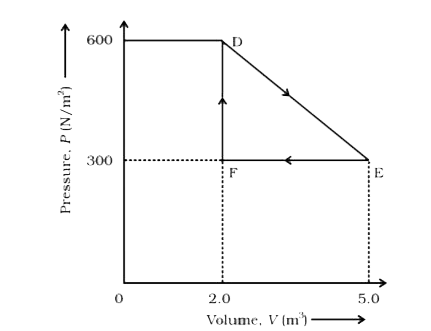
A thermodynamic system is taken from an original state to an intermediate state by the linear process shown in Fig. (12.13)

Its volume is then reduced to the original value from E to F by an isobaric process. Calculate the total work done by the gas from D to E to F

Promotional Banner

Topper's Solved these Questions

  • THERMAL PROPERTIME OF MATTER

    NCERT GUJARATI|Exercise EXERCISES|31 Videos
  • UNITS AND MEASUREMENT

    NCERT GUJARATI|Exercise EXERCISE (ADDITIONAL EXERCISE)|9 Videos

Similar Questions

Explore conceptually related problems

A thermodynamic system is taken from an original state to an intermediate state by the linear process shown in figure. Its volume is then reduced to the original value from E to F by an isobaric process. Calculate the total work done by the gas from D to E to F.

Three moles of an ideal gas (C_p=7/2R) at pressure, P_A and temperature T_A is isothermally expanded to twice its initial volume. It is then compressed at constant pressure to its original volume. Finally gas is compressed at constant volume to its original pressure P_A . (a) Sketch P-V and P-T diagrams for the complete process. (b) Calculate the net work done by the gas, and net heat supplied to the gas during the complete process.

A thermodynamic system is taken from an initial state I with internal energy U_i=-100J to the final state f along two different paths iaf and ibf, as schematically shown in the figure. The work done by the system along the pat af, ib and bf are W_(af)=200J, W_(ib)=50J and W_(bf)=100J respectively. The heat supplied to the system along the path iaf, ib and bf are Q_(iaf), Q_(ib),Q_(bf) respectively. If the internal energy of the system in the state b is U_b=200J and Q_(iaf)=500J , The ratio (Q_(bf))/(Q_(ib)) is

In changing the state of a gas adiabatically from an equilibrium state A to another equilibrium state B, an amount of work equal to 22.3 J is done on the system. If the gas is taken from state A to B via a process in which the net heat absorbed by the system is 9.35 cal,how much is the net work done by the system in the latter case ? (Take 1 cal = 4.19 J)

In changing the state of a gas adiabatically from an equilibrium state A to another equilibrium state B, an amount of work equal to 22.3 J is done on the system. If the gas is taken from state A to B via process in which the net heat absorbed by the system is 9.35 cal, how much is the net work done by the system in the latter case ? (Take 1 cal = 4.19 )

A gas is enclosed in a cylinder with a movable frictionless piston. Its initial thermodynamic state at pressure P_i=10^5 Pa and volume V_i=10^-3m^3 changes to a final state at P_f=(1//32)xx10^5Pa and V_f=8xx10^-3m^3 in an adiabatic quasi-static process, such that P^3V^3=constant. Consider another thermodynamic process that brings the system form the same initial state to the same final state in two steps: an isobaric expansion at P_i followed by an isochoric (isovolumetric ) process at volume V_r. The amount of heat supplied to the system i the two-step process is approximately

An ideal monoatomic gas occupies volume 10^(-3)m^(3) at temperature 3K and pressure 10^(3) Pa. The internal energy of the gas is taken to be zero at this point. It undergoes the following cycle: The temperature is raised to 300K at constant volume, the gas is then expanded adiabatically till the temperature is 3K , followed by isothermal compression to the original volume . Plot the process on a PV diagram. Calculate (i) The work done and the heat transferred in each process and the internal energy at the end of each process, (ii) The thermal efficiency of the cycle.

An ideal gas expands isothermally from volume V_(1) to V_(2) and is then compressed to original volume V_(1) adiabatically. Initialy pressure is P_(1) and final pressure is P_(3) . The total work done is W . Then

One mole of an ideal monatomic gas is taken round the cyclic process ABCA as shown in figure. Calculate (a) the work done by the gas. (b) the heat rejected by the gas in the path CA and the heat absorbed by the gas in the path AB, (c) the net heat absorbed by the gas in the path BC, (d) the maximum temperature attained by the gas during the cycle.