Home
Class 12
PHYSICS
(a) a conductor a with a cavity given...

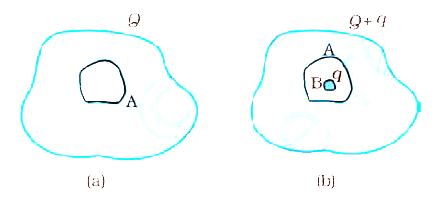
(a) a conductor a with a cavity given a charge Q show that the entire charge must appear on the outer surface of the conductor (b) another condluctor B with charge q is sensitive instrument is to be shielded from the strong electrosatitic fields in its environment suggest a possible way

Text Solution

Verified by Experts

The force is `10^(-2)` in the negative z direction that is in the direction of decreasing electric field you can check that this is also the energy of the dipole torque is zero
Promotional Banner

Topper's Solved these Questions

  • ELECTRIC CHARGES AND FIELDS

    NCERT GUJARATI|Exercise EXERCISES|34 Videos
  • DUAL NATURE OF RADIATION AND MATTER

    NCERT GUJARATI|Exercise EXERCISES|41 Videos
  • ELECTROMAGNETIC INDUCTION

    NCERT GUJARATI|Exercise ADDITIONAL EXERCISES|7 Videos

Similar Questions

Explore conceptually related problems

(a) A conductor A with a cavity as shown in figure (a) is given a charge Q. Show that the entire charge must appear on the outer surface of the conductor. (b) Another conductor B with charge q is inserted into the cavity keeping B insulated from A. Show that the total charge on the outside surface of A is Q + q figure (b) ( C) A sensitive instruments is to be shielded from the strong electrostatic fields in its environment. Suggest a possible way.

A hollow charged conductor has a tiny hole cut in to its surface show that the electric field in the hole is n where n is the charge density near the hole

A spherical conducting shell of inner radius r_(1) and outer radius r_(2) has a charge Q. (a) A charge q is placed at the centre of the shell. What is the surface charge density on the inner and outer surfaces of the shell? (b) Is the electric field inside a cavity (with no charge) zero, even if the shell is not spherical, but has any irregular shape? Explain.

An ellipsoidal cavity is carved within a perfect conductor. A positive charge q is placed at the centre of the cavity. The points A and B are on the cavity surface as shown in the figure. Then

Two conducting plates A and B are placed parallel to each other. A is given a charge Q_1 and B a charge Q_2 . Prove that the charges on the inner surfaces are of equal magnitude and opposite sign.

(a) Show that the normal component of electrostatic field has a discontinuity from one side of a charged surface to another given by (E_(2)-E_(1)).n = sigma/epsilon_(0) where hatn is a unit vector normal to the surface at a point and sigma is the surface charge density at that point. (The direction of hatn is from side 1 to side 2.) Hence, show that just outside a conductor, the electric field is sigma hatn //epsilon_(0) . (b) Show that the tangential component of electrostatic field is continuous from one side of a charged surface to another. [Hint: For (a), use Gauss’s law. For, (b) use the fact that work done by electrostatic field on a closed loop is zero.]

A charge Q is uniformly distributed over a rod of length l . Consider a hypothetical cube of edge l with the centre of the cube at one end of the rod. Find the minimum possible flux of the electric field through the entire surface of the cube.

A charged particle q is placed at the centre O of cube of length L(A B C D E F G H). Another same charge q is placed at a distance L from O. Then the electric flux through ABCD is

The region between two concentric spheres of radii 'a' and 'b', respectively (see figure), has volume charge density rho =A/r , where A is a constant and r is the distance from the centre. At the centre of the spheres is a point charge Q. The value of A such that the electric field in the region between the spheres will be constant is :

The region between two concentric spheres of radii 'a' and 'b', respectively (see figure), have volume charge density rho=A/r , where A is a constant and r is the distance from the centre. At the centre of the spheres is a point charge Q. The value of A such that the electric field in the region between the spheres will be constant, is:

NCERT GUJARATI-ELECTRIC CHARGES AND FIELDS -EXERCISES
  1. Consider a uniform electric field E=3xx10^(3) hati N/C (a) what is ...

    Text Solution

    |

  2. What is the net flux of the uniform electric field of exercise th...

    Text Solution

    |

  3. Careful measurement of the electric field at the surface of a black b...

    Text Solution

    |

  4. A point charge + mu c is a distance 5 cm directly above the centre of...

    Text Solution

    |

  5. A point charge of 2.0 mu c is at the centre of a cubic gaussian ...

    Text Solution

    |

  6. A point charge causes an elelctric flux of -1.0 xx10^(3) Nm^(2) /C to...

    Text Solution

    |

  7. A conducting sphere of radius 10 cm has an unknown charge if the elect...

    Text Solution

    |

  8. A uniformly charged conducting sphere of 2.4 m diameter has a (a)...

    Text Solution

    |

  9. An infinite line charge produces a field of 9xx10^(4) N/C at a dis...

    Text Solution

    |

  10. Two large thin metal plates are parallel and close to each other on...

    Text Solution

    |

  11. An oil drop of 12 exess electrons is held stationary under a consta...

    Text Solution

    |

  12. Which among the curves cannot possibly represent electrostatic fie...

    Text Solution

    |

  13. In a certain region of space electric field is along the z direction...

    Text Solution

    |

  14. (a) a conductor a with a cavity given a charge Q show that the enti...

    Text Solution

    |

  15. A hollow charged conductor has a tiny hole cut in to its surface sho...

    Text Solution

    |

  16. Obtain the formula for the electric field due to a long thin wire ...

    Text Solution

    |

  17. It is now established that protons and neutrons are themselves bui...

    Text Solution

    |

  18. (a) consider an arbitrary electrostic field configuration a small tes...

    Text Solution

    |

  19. A particle of mass m and charge enters the region between the two char...

    Text Solution

    |

  20. Suppose that the particle in exercise in 1.33 an electron projecrt...

    Text Solution

    |
