Home
Class 12
PHYSICS
A rsisitance of R Omega draws current f...

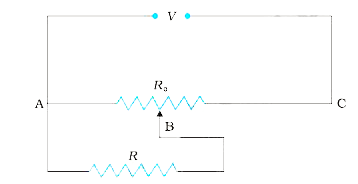
A rsisitance of `R Omega ` draws current from a potentiometer. Te potentiometer has a total resistance `R _(0) Omega` A voltage V is supplited to the potentiometer. Derive an expression for the voltage across R when the sliding contact is in the middle of the potenttometer.

Text Solution

Verified by Experts

While the silde is in the middle of the potentiometer only half of its resistance `(R _(0) //2)` will be between the points A and B. Hence, the toal resictance between A and B, say, `R _(1),` will be given by the following expression:
` (1)/(R _(1)) = (1)/(R) + (1)/((R _(0) //2))`
`R _(1) = (R_(0) R )/( R _(0) + 2R)`
The total resistance between A and C will be sum of resistance between A and B and B and C, i.e., `R _(1) + R _(0) //2`
`therefore` The current following through the potentiometer will be
`I = (V)/(R _(1) + R _(0) //2) = (2V)/( 2 R_(1) + R _(0))`
The voltage `V _(1)` taken from the potentiometer will be the product of current I and resistance `R _(1),`
`V _(1) = I R _(1) ((2V)/(2R_(1) + R _(0))) xx R_(1)`
`V _(1) = (2 V)/(2 ((R _(0) xx R)/( R _(0) + 2R )) + R) xx (R_(0) xx R)/( R _(0) +2R)`
`V _(1) = (2VR)/( 2R+ R_(0) + 2R)`
or ` V _(1) = (2VR)/( R _(0) + 4R)`
Promotional Banner

Topper's Solved these Questions

  • CURRENT ELECTRICITY

    NCERT GUJARATI|Exercise EXERCISES|12 Videos
  • CURRENT ELECTRICITY

    NCERT GUJARATI|Exercise ADDITIONAL EXERCISES|9 Videos
  • ATOMS

    NCERT GUJARATI|Exercise ADDITIONAL EXERCISE|10 Videos
  • DUAL NATURE OF RADIATION AND MATTER

    NCERT GUJARATI|Exercise EXERCISES|41 Videos

Similar Questions

Explore conceptually related problems

The internal resistance of a cell of emf 4 V is 0.1 Omega . It is connected to a resistance of 3.9 Omega . The voltage across the cell will be

A 100 V voltmeter having an internal resistance of 20 k Omega is connected in series with a large resistance R across a 110 V line. What is the magnitude of resistance R if the voltmeter reads 5 V ?

In order to get a current of 0.5A in a circuit by connecting a bulb of resistance 20Omega with 12V battery, what should be the resistance to be connected in series? What will be the voltage drop across the bulb?

To the potentiometer wire of L and 10Omega resistance, a battery of emf 2.5 volts and a resistance R are connected in series. If a potential difference of 1 volt is balanced across L/2 length, the value of R is Omega will be

In fig. battery E is balanced on 55cm length of potentiometer wire but when a resistance of 10Omega is connected in parallel with the battery then it balances on 50cm length of the potentiometer wire then internal resistance r of the battery is:-

It is observed in a potentiometer experiment that no current passes through the galvanometer, when the terminals of the potentiometer, wire. On shunting the cell by a 2Omega resistance, the balancing length is reduced to half. The internal resistance of the cell is:-

A potentiometer wire has resistance 40Omega and its length is 10m. It is connected by a resistance of 760Omega in series if emf of battery is 2V then potential gradient is:-

A potentiometer wire of length L and a resistance r are connected in series with a battery of e.m.f. E_(0) and a resistance r_(1) . An unknown e.m.f E is balaned at a length l of the potentiometer wire. The e.m.f E will be given by :

An experimental setup of verification of photoelectric effect is shown in the diagram. The voltage across the electrode is measured with the help of an ideal voltmetar, and which can be varied by moving jockey 'J' on the potentiometer wire. The battery used in potentiometer circuit is of 20 V and its internal resistance is 2omega . The resistance of 100 cm long potentiometer wire is 8 omega . The photo current is measured with the help of an ideal ammeter. Two plates of potassium oxide of area 50 cm^(2) at separation 0.5 mm are used in the vacuum tube. Photo current in the circuit is very small so we can treat potentiometer circuit an indepdent circuit. The wavelength of various colours is as follows : |{:("Light",underset("Violet")(1),underset("Blue")(2),underset("Green")(3),underset("Yellow")(4),underset("Orange")(5),underset("Red")(6)),(lambda "in" Årarr,4000-4500,4500-5000,5000-5500,5500-6000,6000-6500,6500-7000):}| It is found that ammeter current remians unchanged (2muA) even when the jockey is moved from the 'P' to the middle point of the potentiometer wire. Assuming all the incident photons eject electron and the power of the light incident is 4 xx 10^(-6) W . Then colour of the incident light is :

An experimental setup of verification of photoelectric effect is shown in the diagram. The voltage across the electrode is measured with the help of an ideal voltmetar, and which can be varied by moving jockey 'J' on the potentiometer wire. The battery used in potentiometer circuit is of 20 V and its internal resistance is 2omega . The resistance of 100 cm long potentiometer wire is 8 omega . The photo current is measured with the help of an ideal ammeter. Two plates of potassium oxide of area 50 cm^(2) at separation 0.5 mm are used in the vacuum tube. Photo current in the circuit is very small so we can treat potentiometer circuit an indepdent circuit. The wavelength of various colours is as follows : |{:("Light",underset("Violet")(1),underset("Blue")(2),underset("Green")(3),underset("Yellow")(4),underset("Orange")(5),underset("Red")(6)),(lambda "in" Årarr,4000-4500,4500-5000,5000-5500,5500-6000,6000-6500,6500-7000):}| The number of electrons appeared on the surface of the cathode plate, when the jockey is connected at the ened 'P' of the potentiometer wire. Assume that no radiation is falling on the plates.
