Home
Class 12
PHYSICS
A metallic rod of 1 m length is rotated ...

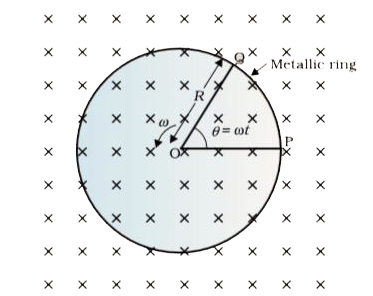
A metallic rod of 1 m length is rotated with a frequency of 50 rev/s, with one end hinged at the centre and the other end at the circumference of a circular metallic ring of radius 1 m, about an axis passing through the centre and perpendicular to the plane of the ring (Fig.). A constant and uniform magnetic field of 1 T parallel to the axis is present everywhere. What is the emf between the centre and the metallic ring?

Text Solution

Verified by Experts

Method I
As the rod is rotated, free electrons in the rod move towards the outer end due to Lorentz force and get distributed over the ring. Thus, the resulting separation of charges produces an emf across the ends of the rod. At a certain value of emf, there is no more flow of electrons and a steady state is reached. Using Eq. (6.5), the magnitude of the emf generated across a length dr of the rod as it moves at right angles to the magnetic field is given by ` d epsi = Bv d r` . Hence,
`epsi = int d epis = int_(0)^(R) Bv d r = int_(0)^(R) B omega r dr = (B omega R^2)/(2)`
Note that we have used `v = omega r `. This gives.
`epsi = 1/2 xx 1.0 xx 2pi xx 50 xx (1^2)`
`= 157 V`
Method II
To calculate the emf, we can imagine a closed loop OPQ in which point O and P are connected with a resistor R and OQ is the rotating rod. The potential difference across the resistor is then equal to the induced emf and equals B `x×` (rate of change of area of loop). If `theta` is the angle between the rod and the radius of the circle at P at time t, the area of the sector OPQ is given by
`pi R^2 xx (theta)/(2pi) = 1/2 R^2 theta`
where R is the radius of the circle . Hence , the induced emf is
`epsi = B xx d/(dt) [1/2 R^2 theta] = 1/2 BR^2 (d theta)/(dt) = (B omegaR^2)/(2)`
[Note : `(d theta)/(dt) = omega = 2pi v`]
This expression is identical to the expression obtained by Method I and we get the same value of `epsi`.
Promotional Banner

Topper's Solved these Questions

  • ELECTROMAGNETIC INDUCTION

    NCERT GUJARATI|Exercise EXERCISES|10 Videos
  • ELECTROMAGNETIC INDUCTION

    NCERT GUJARATI|Exercise ADDITIONAL EXERCISES|7 Videos
  • ELECTRIC CHARGES AND FIELDS

    NCERT GUJARATI|Exercise EXERCISES|34 Videos
  • ELECTROMAGNETIC WAVES

    NCERT GUJARATI|Exercise ADDITIONAL EXERCISES|5 Videos

Similar Questions

Explore conceptually related problems

A metallic rod of 1 m length is rotated with a frequency of 50 rev/s, with one end hinged at the centre and the other end at the circumference of a circular metallic ring of radius 1 m, about an axis passing through the centre and perpendicular to the plane of the ring as per figure. A constant and uniform magnetic field of 1T parallel to the axis is present everywhere. What is the emf between the centre and the metallic ring ?

Find the moment of inertia of ring about an axis passing through the centre and perpendicular to its plane.

A circular disc of radius r and mass m rotates about the axis passing through the centre and perpendicular to its plane. What will if rotational kinetic energy?

Find the moment of inertia of a uniform circular disc about an axis passing through its geometrical centre and perpendicular to its plane and radius of gyration.

A uniform equilateral triangular lamina of side a has mass m. Its moment of inertia about the axis passing through the centroid and perpendicular to the plane of the lamina is :-

A 1.0 m long metallic rod is rotated with an angular frequency of "400 rad s"^(-1) about an axis normal to the rod passing through its one end. The other end of the rod is in contact with a circular metallic ring. A constant and uniform magnetic field of 0.5 T parallel to the axis exists everywhere. Calculate the emf developed between the centre and the ring.

Find the moment of inertia and radius of gyration of uniform cross-section rod of mass 4 kg and length 90 cm about an axis through one end and perpendicular to the length of rod.

Three rods each of mass m and length l are joined together to form an equilateral triangle as shown in figure. Find the moment of inertial of the system about an axis passig through its centre of mass and perpendicular to the plane of the particle.

Find the moment of inertia of thin and massless rod about an axis passing through its centre of mass of rod and pair of mass is suspended on both end of this rod.
