

Home
Class 12
PHYSICS
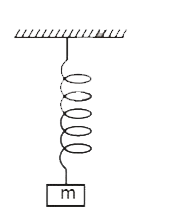
A mass m is attached to the free end of ...

A mass m is attached to the free end of a massless spring of spring constant k with its other end fixed to a rigid support as shown in figure. Find out the time period of the mass, if it is displaced slightly by an amount x downward.

Promotional Banner

Similar Questions

Explore conceptually related problems

A mass of 0.2 kg is attached to the lower end of a massless spring of force constant 200(N)/(m) the other end of which is fixed to a rigid support. Study the following statements.

Two identical springs of spring constant k are attached to a block of mass m and to fixed supports as shown in the figure. The time period of oscillation is

Two identical springs of spring constant k are attached to a block of mass m and to fixed supports as shown in the figure. The time period of oscillation is

A particle of mass m is attached to three identical massless springs of spring constant 'k' as shown in the figure. The time period of vertical oscillation of the particle is

A rod of mass m and length L is kept on a horizontal smooth surface. The rod is hinged at its one end A . There are two springs, perpendicular to the rod, kept in the same horizontal plane. The spring of spring constant k is rigidly attached to the lower end of rod and spring of spring constant 12k just touches the rod at its midpoint C , as shown in the figure. If the rod is slightly displaced leftward and released then, the time period for small osciallation of the rod will be

A rod of mass m and length L is kept on a horizontal smooth surface. The rod is hinged at its one end A . There are two springs, perpendicular to the rod, kept in the same horizontal plane. The spring of spring constant k is rigidly attached to the lower end of rod and spring of spring constant 12k just touches the rod at its midpoint C , as shown in the figure. If the rod is slightly displaced leftward and released then, the time period for small osciallation of the rod will be

A mass M is attached to a horizontal spring of force constant k fixed one side to a rigid support as shown in figure. The mass oscillates on a frictionless surface with time period T and amplitude A. When the mass M is in equilibrium position, another mass m is gently placed on it. When will be the new amplitude of ocillation?