

Home
Class 11
PHYSICS
Two discs, each having mass m, are attac...

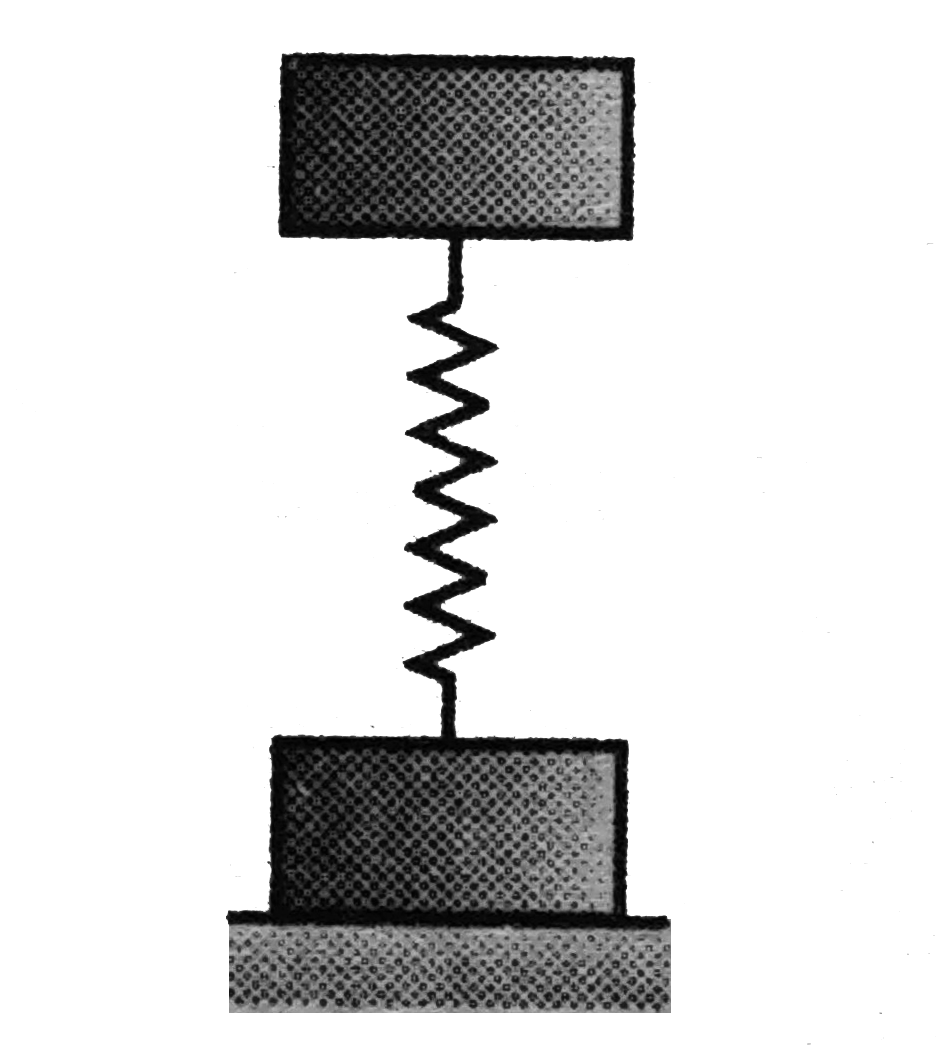
Two discs, each having mass `m`, are attached rigidly to the ends of a vertical spring. One of the discs rests on a horizontal surface and the other produces a compression `x_0` on the spring when it is in equilibrium. How much further must the spring be compressed so that when the force causing compression is removed, the extension of the spring will be able to lift the lower disc off the table?

Promotional Banner

Similar Questions

Explore conceptually related problems

Two plates of some mass are attached rigidly to the two ends of a spring as shown in figure. One of the two ends of a spring s shown in figure. One of the plates resets on a horizontal surface to the other rusults a compression y of the spring when it is in equilibrium state. The further minimum compression required, so that when the force causing compression is removed the lower plate is lifted off the surface, will be :

When a spring is compressed by 0.05 m a restoring force of 10 N is developed in it. Then the force constant of the spring is

Two blocks each having mass m is attached to each other with a spring having force constant k. The system is placed on a rough horizontal surface having coefficient of friction mu . The maximum initial compression, that can be given to the spring so that when released the blocks do not move is

A 16kg block moving on a frictionless horizontal surface with a velocity of 4m//s compresses an ideal spring and comes to rest. If the force constant of the spring be 100N//m , then how much is the spring commpressed ?

A 16kg block moving on a frictionless horizontal surface with a velocity of 4m//s compresses an ideal spring and comes to rest. If the force constant of the spring be 100N//m , then how much is the spring commpressed ?

An object of mass M is attached to a vertical spring and in the equilibrium position the extension of the spring is x. The mass is raised upwards, till the extension of the spring is reduced to zero and then mass is released. The maximum extension of the spring in this case is

Figure shows a force compression curve of a spring. A body of mass 5kg moving with the velocity of 8m//s hits the spring. Calculate the force constant of the spring and also the compression produced in the spring when the body hits it.

Two masses m and 2m are attached to two ends of an ideal spring as shown in figure. When the spring is in the compressed state, the energy of the spring is 60 J, if the spring is released, then at its natural length