

Home
Class 12
PHYSICS
A lens of focal length f is cut along th...

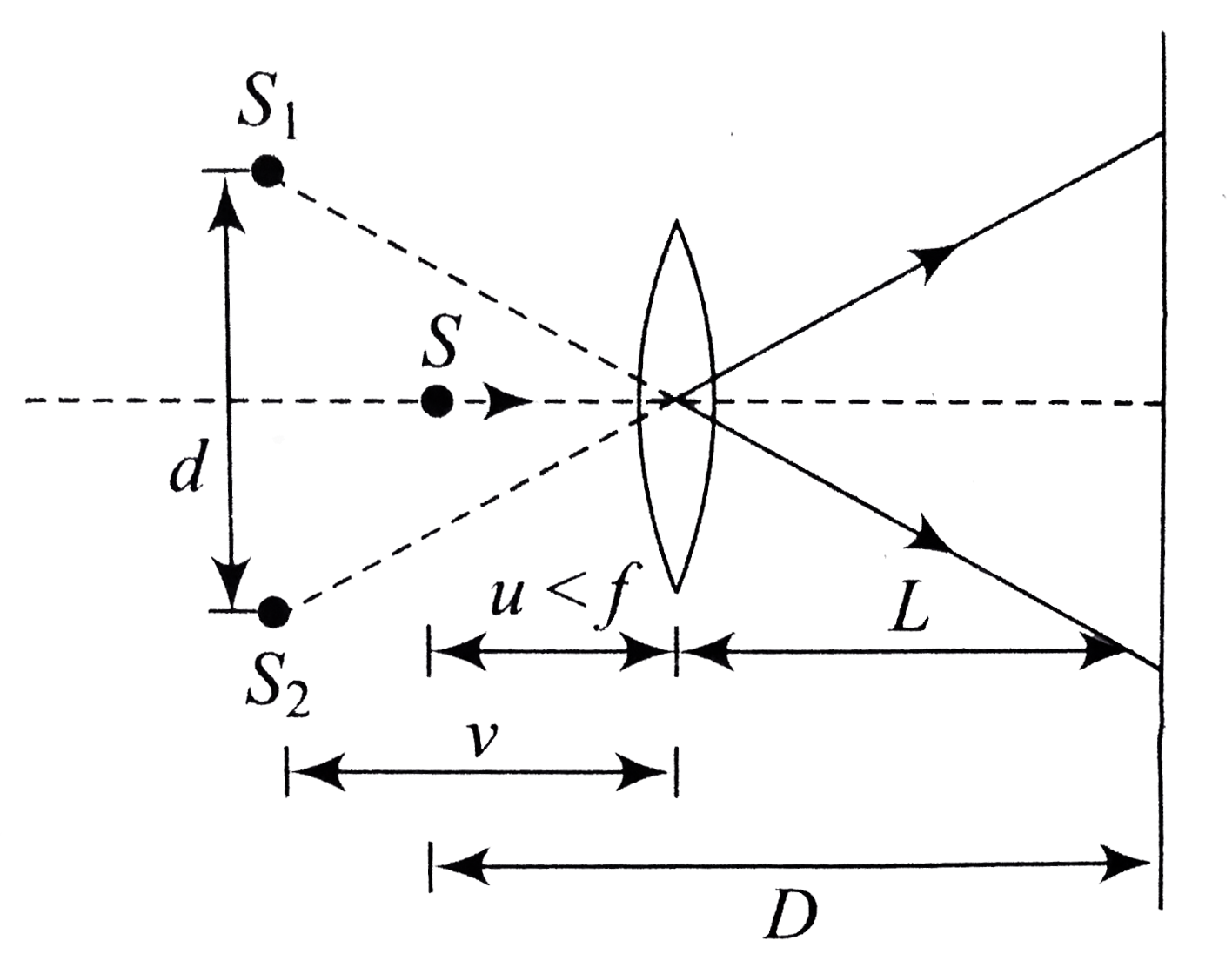
A lens of focal length f is cut along the diameter into two identical halevs. In this process, a layer of the lens t in thickness is lost, then the halves are put together to form a composite lens. In between the focal plane and the composite lens, a narrow slit is placed near the focal plane. The slit is emitting monochromatic `lambda`. Behind the lens, a screen is located at a distance L front it.

Find the fringe width for the pattern obtained under given arrangement on the screen.

Promotional Banner

Similar Questions

Explore conceptually related problems

A lens of focal length f is cut along the diameter into two identical halevs. In this process, a layer of the lens t in thickness is lost, then the halves are put together to form a composite lens. In between the focal plane and the composite lens, a narrow slit is placed near the focal plane. The slit is emitting monochromatic lambda . Behind the lens, a screen is located at a distance L front it. The expression for the number of visible maxima which are obtained through above said arrangement will turn out to be

A lens of focal length f is cut along the diameter into two identical halevs. In this process, a layer of the lens t in thickness is lost, then the halves are put together to form a composite lens. In between the focal plane and the composite lens, a narrow slit is placed near the focal plane. The slit is emitting monochromatic lambda . Behind the lens, a screen is located at a distance L front it. The expression for the number of visible maxima which are obtained through above said arrangement will turn out to be

A lens of diameter 5.0cm and focal length f = 25.0 cm was cut along the diameter into two identical halves. In the process, the layer of the lens alpha = 1.00 mm in thieckness was lost. Then the halves were put together to form a composite lens. In this focal plane a narrow slit was placed, emitting monochromatic light with wavelength lambda = 0.60 mu m . Behind the lens a screen was located at a distance b = 50 cm from it. Find: (a) the which of a fringe on the screen and the number of possible maxima, (b) the maximum width of the slit del_(max) at which the fringes on the screen will be still observed sufficiently sharp.

In Billet's Lens Arrangement, a convex lens of focal length 50 cm is cut along the diameter into two indentical halves Å and B and in the process a layer C of the lens thickness 1 mm is lost. Then the two halves A and B are put together to form a composite lens. Now, infront of this composite lens a source of light emitting wavelength lambda = 6000 Å is placed at a distance of 25 cm as shown in the figure. Behind the lens there is a screen at a distance 50 cm from it. Find the fringe width fo the interference pattern obtained on the screen.

An equiconvex lens of focal length 15 cm is cut into two equal halves in thickness. What is the focal length of each half ?

An equiconvex lens of focal length 15 cm is cut into two equal halves in thickness. What is the focal length of each half ?

A diverging lens of focal length f is cut in two identical parts each part forming a plano concave lens. What is the focal length of each part?

A equiconvex lens of focal length 30 cm is divided into two equal halves in thickness.find the focal lnegth of eah half.