Home
Class 11
PHYSICS
A metallic rod of length 1m is rigidly ...

A metallic rod of length ` 1m` is rigidly clamped at its midpoint. Longitudinal stationary waves are set up in the rod in such a way that there are two nodes on either side of the mid - point and those of constituent waves in the rod . `( Y = 2 xx 10^(11) N//m^(2) and rho = 8 xx 10^(3) kg// m^(3))`

Text Solution

Verified by Experts
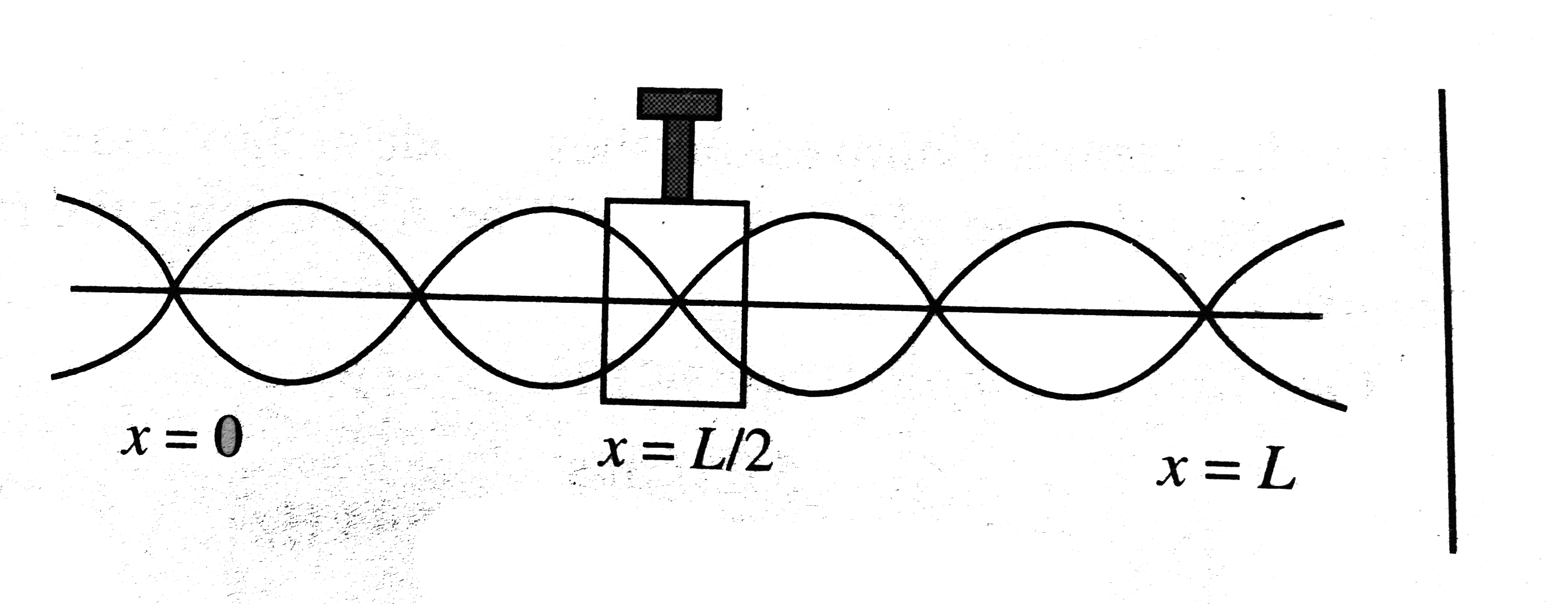
As found in case of strings , in case of rods also the clamped point behaves as a node while the free end antinode . The situation is shown in Fig . 7.63.
Because the distance between two consecutives nodes is `(lambda//2)` while between a node and antinide is `lambda//4` , hence
` 4 xx [ (lambda)/( 2)] + 2 [(lambda)/( 4)] = L or lambda = ( 2 xx 1)/( 5) = 0.4 m`
Further , it is given that
` Y = sqrt((Y)/( rho)) = sqrt(( 2 xx 10^(11))/( 8 xx 10^(3))) = 5000 m//s`
Hence , from ` v = n lambda`,
` n = (v)/( lambda) = (5000)/( 0.4) = 12500 Hz`
Now if incident and reflected waves along the rod are
`y_(1) = A sin ( omega t - kx) and y _(2) = A sin ( omega t + k x + phi )`
Hence , from ` v = n lambda` ,
` n = (v)/( lambda) = ( 5000)/(0.4) = 12500 Hz`
Now if incident and reflected waves along the rod are
`y_(1) = A sin ( omega t - kx) and y_(2) = A sin ( omega t + kx + phi)`
The resultant wave will be
` y = y_(1) + y_(2) A [ sin ( omega t - kx) + sin ( omega t + kx + phi)]`
`= 2 A cos ( kx + (phi)/( 2)) sin ( omega t + ( phi)/(2))`
Because there is an antinode at the free end of the rod , hence amplitude is maximum at ` x = 0` . So
` Cos (k xx 0 + (phi)/(2)) = "Maximum" = 1 i.e., phi = 0`
And
`A_(max) = 2 A = 2 xx 10^(-6) m` (given)
` y = 2 xx 10^(-6) cos kx sin omega t`
` y = 2 xx 10^(-6) cos [ ( 2pi x )/( lambda)]sin ( 2 pi nt)`
Putting values of `lambda and n` , we get
` y = 2 xx 10^(-6) cos 5 pi x sin 25000 pi t`
Now , because for a point ` 2cm` from the midpoint ` x = (0.50 +- 0.02)`, hence
`y = 2 xx 10^(-6) cos 5 pi ( 0.5 +- 0.02) sin 25000 pi t`
Promotional Banner

Similar Questions

Explore conceptually related problems

A metallic rod of length 1m is rigidly clamped at its mid point. Longirudinal stationary wave are setup in the rod in such a way that there are two nodes on either side of the midpoint. The amplitude of an antinode is 2 xx 10^(-6) m . Write the equation of motion of a point 2 cm from the midpoint and those of the constituent waves in the rod, (Young,s modulus of the material of the rod = 2 xx 10^(11) Nm^(-2) , density = 8000 kg-m^(-3) ). Both ends are free.

A metallic rod of length 1m is rigidly clamped at its end points. Longitudinal stationary waves are setup in the ord in such a way that there six antinodes of displacement wave observed along the rod. The amplitude of the anotinode is 2 xx 10^(-6) m . Write the equations of the stationary wave and the component waves at the point 0.1 m from the one end of the rod. [Young modulus = 7.5 xx 10^(10)N//m^(2) , density = 2500 kg//m^(3) ]

A metallic rod of length 1m has one end free and other end rigidly clamped. Longitudinal stationary waves are set up in the rod in such a way that there are total six antinodes present along the rod. The amplitude of an antinode is 4 xx 10^(-6) m . young's modulus and density of the rod are 6.4 xx 10^(10) N//m^(2) and 4 xx 10^(3) Kg//m^(3) respectively. Consider the free end to be at origin and at t=0 particles at free end are at positive extreme. The magnitude of strain at midpoint of the rod at t = 1 sec is

A metallic rod of length 1m has one end free and other end rigidly clamped. Longitudinal stationary waves are set up in the rod in such a way that there are total six antinodes present along the rod. The amplitude of an antinode is 4 xx 10^(-6) m . young's modulus and density of the rod are 6.4 xx 10^(10) N//m^(2) and 4 xx 10^(3) Kg//m^(3) respectively. Consider the free end to be at origin and at t=0 particles at free end are at positive extreme. The equation describing stress developed in the rod is

A metallic rod of length 1m has one end free and other end rigidly clamped. Longitudinal stationary waves are set up in the rod in such a way that there are total six antinodes present along the rod. The amplitude of an antinode is 4 xx 10^(-6) m . young's modulus and density of the rod are 6.4 xx 10^(10) N//m^(2) and 4 xx 10^(3) Kg//m^(3) respectively. Consider the free end to be at origin and at t=0 particles at free end are at positive extreme. The equation describing displacements of particles about their mean positions is.

Given Y = 2 xx 10^(11)N//m^(2), rho = 10^(4) kg//m^(3) Find out elongation in rod.

Calculate the speed of longitudinal wave in steel. Young's modulus for steel is 3xx10^(10)N//m^(2) and its density 1.2xx10^(3)kg//m^(3)

A metallic rod of length 1 m, young's modulus 3xx10^(11)Nm^(-3) and density is clamped at its middle. Longitudinal stationary vibrations are produced in the rod with the total number of displacement nodes equal to 3. The frequency of vibrations is

