Home
Class 10
BIOLOGY
Distinguish between unisexual and bisexu...

Distinguish between unisexual and bisexual flowers giving one example of each.
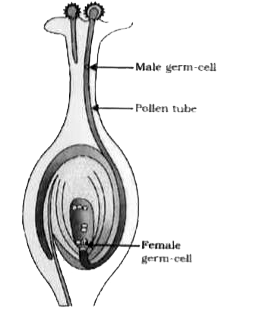
Draw a neat diagram showing fertilisation in a flower and label:
a] Pollen tube
b] Male germ cell
c] Female germ cell, on it.
OR
Draw the diagram showing the germination of pollen on stigma and label the part on which pollination takes place.
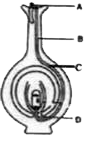
Answer the following questions based on diagram given aside.
i] Name the part marked 'P. in the diagram.
ii] How does 'P. reach part 'B'?
iii] State the importance of the part 'C'.
iv] What happens to the part marked 'D' after fertilisation is over?
Mention the role of gamete and zygote in sexually reproducing organisms.

Text Solution

Verified by Experts
Unisexual flowers: The flowers in which either the male or the female reproductive organs are present only, are called unisexual flowers. They are called incomplete flowers. They undergo cross-pollination in order to reproduce.
Example: Papaya, Watermelon, Corn, etc.
Bisexual flowers: The flowers in which both the male and female reproductive organs are present, are known as complete or bisexual flowers. They are capable of selfpollination.
Example: Mustard, rose, lily, hibiscus, etc.

OR
i] Part marked with alphabet W. is Pollen grain.
ii] Part marked with alphabet .B. is stigma. Pollen grain reaches to stigma by external agents such as water, winds, insect and birds.
iii] Part marked with alphabet .C. ispollen tube. After the pollen lands on a suitable stigma, it has to reach the female germcells which are in the ovary. Pollen tube serves this purpose.
iv] Part marked with alphabet .D. is female germ cell. The fusion of male germ cell with the female germ cell resulting in the formation of a single cell known as zygote. After fertilisation, the zygote divides repeatedly to form an embryo which resides inside the seed.
Gametes: sex cells with haploid number of chromosomes.
Zygote: when two gametes of different sex fuses it results in formation of Zygote. It has diploid number of chromosome.
Promotional Banner

Topper's Solved these Questions

  • HOW DO ORGANISMS REPRODUCE?

    ZEN PUBLICATION|Exercise QUESTIONS|4 Videos
  • HOW DO ORGANISMS REPRODUCE?

    ZEN PUBLICATION|Exercise QUESTIONS SECTION (IN TEXT QUESTIONS)|12 Videos
  • HOW DO ORGANISMS REPRODUCE?

    ZEN PUBLICATION|Exercise ZEN ADDITIONAL QUESTIONS SECTION (SHORT ANSWER [SA] TYPE 1 QUESTIONS)|48 Videos
  • HEREDITY AND EVOLUTION

    ZEN PUBLICATION|Exercise ZEN ADDITIONAL QUESTIONS SECTION (LONG ANSWER (LA) TYPE QUESTIONS) |34 Videos
  • LIFE PROCESSES

    ZEN PUBLICATION|Exercise ZEE ADDITIONAL QUESTIONS SECTIONS (LONG ANSWER [LA] TYPE QUESTIONS) |32 Videos

Similar Questions

Explore conceptually related problems

Draw a diagram showing germination of pollen on, stigma of a flower.

Draw the diagram showing longitudinal section of a flower and label the part where pollination takes place

Draw a neat diagram of human brain & label it.

Draw a neat diagram of human brain & label it.

Draw a neat labelled diagram showing the Reflex Arc.

ZEN PUBLICATION-HOW DO ORGANISMS REPRODUCE?-ZEN ADDITIONAL QUESTIONS SECTION (LONG ANSWER [LA] TYPE QUESTIONS)
  1. Why budding, fragmentation and regeneration all are considered as asex...

    Text Solution

    |

  2. (i) List two distinguishing features between sexual and asexual types ...

    Text Solution

    |

  3. a] Name the parts of the human female reproductive system where i] f...

    Text Solution

    |

  4. Distinguish between unisexual and bisexual flowers giving one example ...

    Text Solution

    |

  5. What happens to the ovule and the ovary after fertilization?

    Text Solution

    |

  6. a] What is puberty ? b] Describe in brief the functions of the follo...

    Text Solution

    |

  7. Based on given diagram, answer the following questions a] Label t...

    Text Solution

    |

  8. a] Name the mode of reproduction in following organisms and state impo...

    Text Solution

    |

  9. X is a human being with the reproductive oval shaped almond sized orga...

    Text Solution

    |

  10. a] Draw a diagram of the longitudinal section of a flower and label on...

    Text Solution

    |

  11. a] Draw a well labelled diagram of human female reproductive system an...

    Text Solution

    |

  12. Name the human male reproductive organ that produces sperms and also s...

    Text Solution

    |

  13. Why budding, fragmentation and regeneration all are considered as asex...

    Text Solution

    |

  14. (i) List two distinguishing features between sexual and asexual types ...

    Text Solution

    |

  15. a] Name the parts of the human female reproductive system where i] f...

    Text Solution

    |

  16. Distinguish between unisexual and bisexual flowers giving one example ...

    Text Solution

    |

  17. What happens to the ovule and the ovary after fertilization?

    Text Solution

    |

  18. a] What is puberty ? b] Describe in brief the functions of the follo...

    Text Solution

    |

  19. Based on given diagram, answer the following questions a] Label t...

    Text Solution

    |

  20. a] Name the mode of reproduction in following organisms and state impo...

    Text Solution

    |

