

Home
Class 12
PHYSICS
A uniform rod ABC of mass M is placed ve...

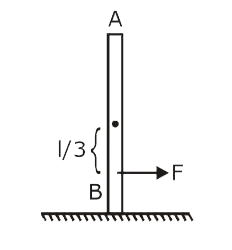
A uniform rod ABC of mass M is placed vertically on a rough horizontal surface. The coefficient of kinetic friction between the rod and the surface is `mu . A ` force F `(gt mu mg)` is applied on the rod at point B at distance `l//3` below centre of the rod as shown in figure. The initial acceleration of point A is

Promotional Banner

Similar Questions

Explore conceptually related problems

A rod of mass M and length L lies on an incline having inclination of theta = 37^(@) . The coefficient of friction between the rod and the incline surface is mu = 0.90 . Find the tension at the mid point of the rod.

A block of mass m lying on a rough horizontal surface of friction coefficient mu is pulled by a force F as shown , the limiting friction between the block and surface will be

A uniform straight rod is placed in vertical position on a smooth horizontal surface and released. As the rod is in motion, the centre of mass moves

A uniform straight rod is placed in vertical position on a smooth horizontal surface and released. As the rod is in motion, the centre of mass moves

A uniform rod of mass M and length L is held vertically upright on a horizontal surface as shown in figure. Assuming zero potential energy at the base of the rod, determine the potential energy of the rod.

A uniform rod of mass M and length L is held vertically upright on a horizontal surface as shown in figure. Assuming zero potential energy at the base of the rod, determine the potential energy of the rod.

A uniform rod is made to lean between a rough vertical wall and the ground. The coefficient of friction between the rod and the ground is mu_(1) and between the rod and the wall is mu_(2) . Find the angle at which the rod can he leaned without slipping.

A uniform metallic rod lies on a smooth horizontal surface. C is centre of mass of rod and A is a point on the rod. As the temperature increase

A thin uniform rod of mass m and length l is kept on a smooth horizontal surface such that it can move freely. At what distance from centre of rod should a particle of mass m strike on the rod such that the point P at a distance l/3 from the end of the rod is instantaneously at rest just after the elastic collision?

A thin uniform rod of mass m and length l is kept on a smooth horizontal surface such that it can move freely. At what distance from centre of rod should a particle of mass m strike on the rod such that the point P at a distance l/3 from the end of the rod is instantaneously at rest just after the elastic collision?