

Home
Class 12
PHYSICS
In the given arrangement, the space betw...

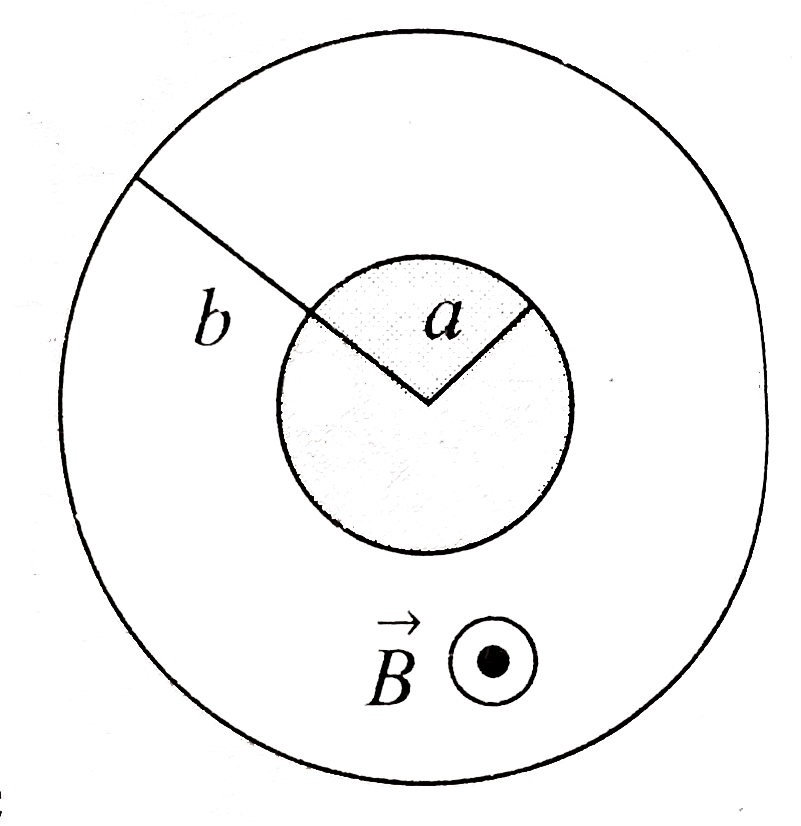
In the given arrangement, the space between a pair of co-axial cylindrical conductors is evacuated. The outer cylinder, called anode, may be given a positive potential V relative to the inner cylinder.
A static homogeneous magnetic field `vec(B)` parallel to the cylinder axis, directed out of plane of figure is aslo present. induced charges in the conductors are neglected.
We study the dynamics of electrons with rest mass m and charge e. The electrons are released at the surface of inner cylinder.
Consider the following two cases

Case 1: Firstly the potential V is turned on, but `vec(B) = 0`. An electron with negligible velocity is ejected at the surface of inner cylinder. It is found to hit the anode.
Case 2: Now V = 0 but `vec(B)` is present. An electron starts out with an initial velocity `vec(v_(0))` in radial direction. For magnetic field larger than critical value `B_(c)` the electron will not reach the anode.
The critical magnetic field `B_(c)` is given by

Promotional Banner

Similar Questions

Explore conceptually related problems

In the given arrangement, the space between a pair of co-axial cylindrical conductors is evacuated. The outer cylinder, called anode, may be given a positive potential V relative to the inner cylinder. A static homogeneous magnetic field vec(B) parallel to the cylinder axis, directed out of plane of figure is aslo present. induced charges in the conductors are neglected. We study the dynamics of electrons with rest mass m and charge e. The electrons are released at the surface of inner cylinder. Consider the following two cases Case 1: Firstly the potential V is turned on, but vec(B) = 0 . An electron with negligible velocity is ejected at the surface of inner cylinder. It is found to hit the anode. Case 2: Now V = 0 but vec(B) is present. An electron starts out with an initial velocity vec(v_(0)) in radial direction. For magnetic field larger than critical value B_(c) the electron will not reach the anode. Considering case 2, the trajectory of electron will be

In the given arrangement, the space between a pair of co-axial cylindrical conductors is evacuated. The outer cylinder, called anode, may be given a positive potential V relative to the inner cylinder. A static homogeneous magnetic field vec(B) parallel to the cylinder axis, directed out of plane of figure is aslo present. induced charges in the conductors are neglected. We study the dynamics of electrons with rest mass m and charge e. The electrons are released at the surface of inner cylinder. Consider the following two cases Case 1: Firstly the potential V is turned on, but vec(B) = 0 . An electron with negligible velocity is ejected at the surface of inner cylinder. It is found to hit the anode. Case 2: Now V = 0 but vec(B) is present. An electron starts out with an initial velocity vec(v_(0)) in radial direction. For magnetic field larger than critical value B_(c) the electron will not reach the anode. Considering the case 1, the trajectory of electron will be

In the given arrangement, the space between a pair of co-axial cylindrical conductors is evacuated. The outer cylinder, called anode, may be given a positive potential V relative to the inner cylinder. A static homogeneous magnetic field vec(B) parallel to the cylinder axis, directed out of plane of figure is aslo present. induced charges in the conductors are neglected. We study the dynamics of electrons with rest mass m and charge e. The electrons are released at the surface of inner cylinder. Consider the following two cases Case 1: Firstly the potential V is turned on, but vec(B) = 0 . An electron with negligible velocity is ejected at the surface of inner cylinder. It is found to hit the anode. Case 2: Now V = 0 but vec(B) is present. An electron starts out with an initial velocity vec(v_(0)) in radial direction. For magnetic field larger than critical value B_(c) the electron will not reach the anode. Considering case 2, the trajectory of electron will be

In the given arrangement, the space between a pair of co-axial cylindrical conductors is evacuated. The outer cylinder, called anode, may be given a positive potential V relative to the inner cylinder. A static homogeneous magnetic field vec(B) parallel to the cylinder axis, directed out of plane of figure is aslo present. induced charges in the conductors are neglected. We study the dynamics of electrons with rest mass m and charge e. The electrons are released at the surface of inner cylinder. Consider the following two cases Case 1: Firstly the potential V is turned on, but vec(B) = 0 . An electron with negligible velocity is ejected at the surface of inner cylinder. It is found to hit the anode. Case 2: Now V = 0 but vec(B) is present. An electron starts out with an initial velocity vec(v_(0)) in radial direction. For magnetic field larger than critical value B_(c) the electron will not reach the anode. Considering the case 1, the trajectory of electron will be

Will there be an induced current in a conductor moved parallel to the magnetic field?

The uniform current flowing through a thin hollow cylindrical conductor is I. What is the magnetic field inside the cylinder?