Home
Class 12
PHYSICS
Two lines, A and B, in the plot given ...

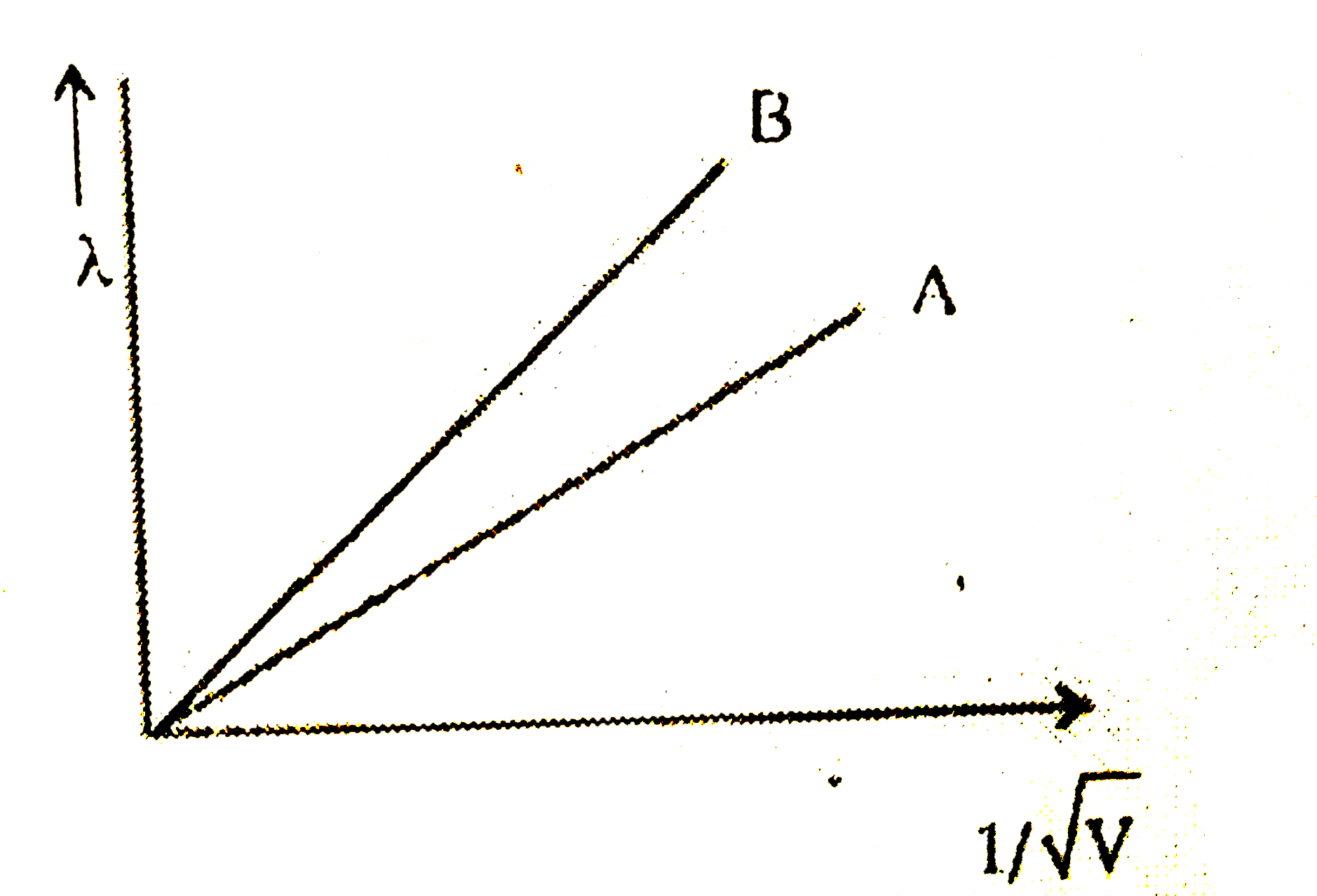
Two lines, A and B, in the plot given below show the variation of de-Broglie wavelength, `lambda` versus `1//sqrt(V)`, where V is the accelerating potential difference, for two particles carrying the same charge. Which one of two represents a particle of smaller mass?

Text Solution

Verified by Experts

`:. lambda=(h)/(sqrt(2meV))rArr lambda=(h)/(sqrt(m).sqrt(2e)).(1)/(sqrt(V))`
`rArr (1)/(sqrt(m))=(sqrt(2e))/(h).((lambda)/(1//sqrt(V))) :. (1)/(sqrt(m))=(sqrt(2e))/(h)xx("Slope of "lambda & sqrt(V)"graph")`
`:. "Slope of B" gt "Slope of A"(1)/(sqrt(m_(B))) gt (1)/(sqrt(m_(A)))rArr sqrt(m_(B)) lt sqrt(m_(A)):. m_(B) lt m_(A)`
Therefore, line B represents a particle of smaller mass.
Promotional Banner

Topper's Solved these Questions

  • XII BOARDS

    XII BOARDS PREVIOUS YEAR|Exercise SET I|70 Videos
  • XII BOARDS

    XII BOARDS PREVIOUS YEAR|Exercise SET II|9 Videos
  • SAMPLE PAPER 2019

    XII BOARDS PREVIOUS YEAR|Exercise SECTION D|6 Videos

Similar Questions

Explore conceptually related problems

Plot a graph showing variation of de-broglie wavelength lambda versus 1//sqrtV , where V is accelerating potential for two particle A and P carrying same charge but of masses m_1 and m_2(m_1gtm_2) . Which one of the two represents a particle of smaller mass and why?

The two lines A and B in fig. shoe the phot of de Broglie wavelength (lamda) as a function of (1)/(sqrtV) (V is the accelerating potential) for teo particles having the same charge. Which of the two represents the particle of heavier mass?

Find the ratio of de Broglie wavelength of an alpha -particle and a deutron if they are accelerating through the same potential difference

The de-Broglie wavelength lambda associated with charged particle of charge q, mass m and potential difference V is

The ratio of de-Broglie wavelength associated with a proton and a mu -particle accelerated through the same potential difference 'V' is

Find the de Broglie wavelength of an alpha particle accelerated through a potential difference of 100 V.

Find the ratio of de Broglie wavelength of a proton and as alpha -particle which have been accelerated through same potential difference.

Show graphically, the variation of the de-Broglie wavelength (lambda) with the potential (V) through which an electron is accelerated from rest.
