Home
Class 12
PHYSICS
A convex lens made up of glass of refrac...

A convex lens made up of glass of refractive index `1.5` is dippedin turn
(i) in a medium of refractive index `1.65`
(ii) in a medium of refractive index `1.33`
(a) Will it behave as converging or diverging lens in the two cases ?
(b) How will its focal length changes in the two media ?

Text Solution

Verified by Experts
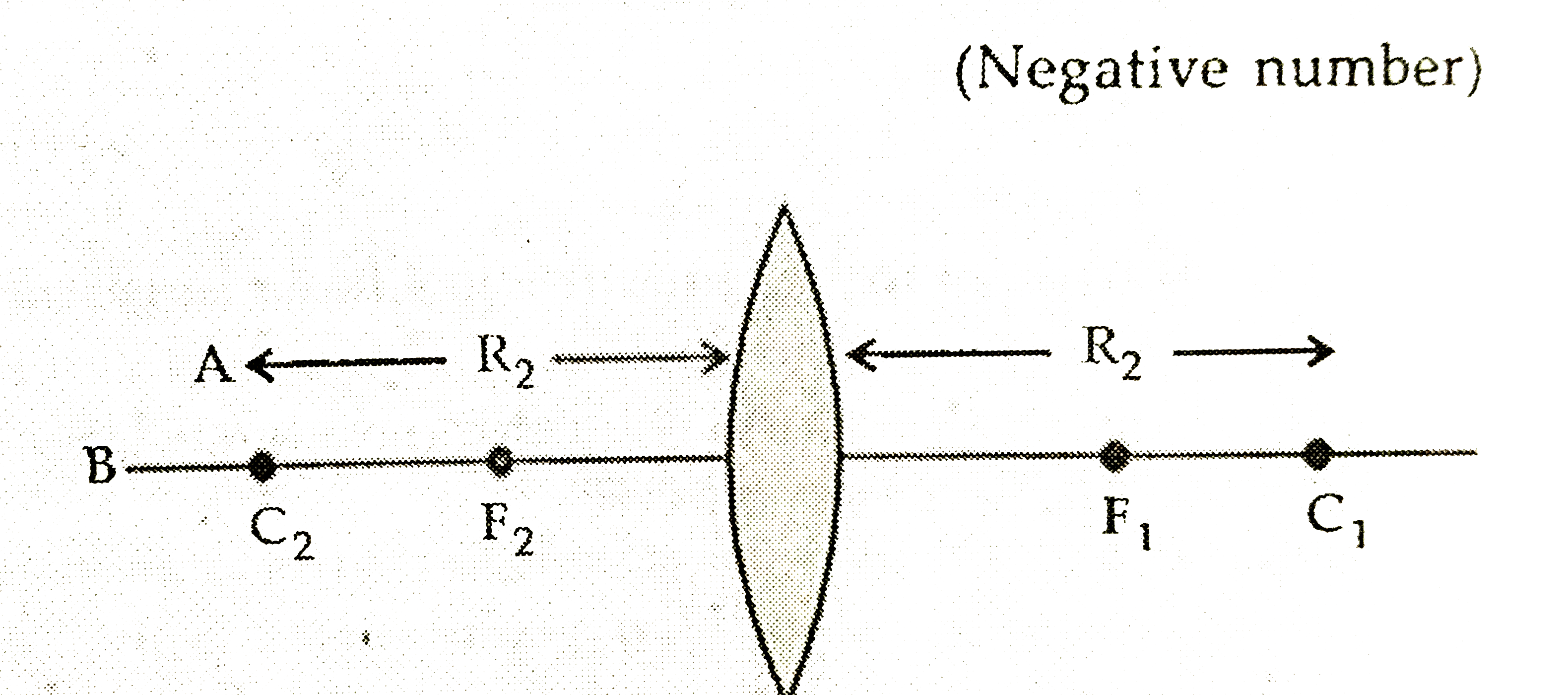
(a) Given refractive index of glass, `mu_(a)=1.5`
Refractive index of 1st medium, `mu_(1)=1.6`
Refractive index of Iind medium, `mu_(2)=1.3`
(i) For 1st medium `mu_(1) gt mu_(a) Rightarrow (mu_(a))/(mu_(1))lt 1`
Hence, `f gt 0` concave lens or diverging lens
(ii) For `II^(nd)` medium `mu_(2) gt mu_(a) Rightarrow (mu_(a))/(mu_(2))gt 1`
Hence, `f lt 0` convex lens or convergin lens.
(b) (i) For first medium, `(1)/(f_(1))=(1-(mu_(a))/(mu_(1)))((1)/(R_(1))-(1)/(R_(2)))_(-R_(2) gt0)^(R_(1)gt0)`
`=(1-(1.5)/(1.6))" "("Positive number) for convex lens")`
`" "(1-0.9)("Positive number")`
`" "(1.1)("Positive number)Original focal length"`
`" "(1)/(f)=(1-mu_(a))((1)/(R_(1))-(1)/(R_(2)))`
`" "(1)/(f)=-0.5" "["Negative number"]`
`Rightarrow (f_(1))/(f)=-(0.5)/(0.1)`
`Rightarrow " "f_(1)=-5f`

Hence, focal length will be 5 times the original focal length and its nature will become diverging.
(ii) For second medium
`(1)/(f_(2))=(1-(mu_(a))/(mu_(2)))((1)/(R_(1))-(1)/(R_(2)))=(1-(1.5)/(1.3))((1)/(R_(1))-(1)/(R_(2)))=(1-1.15)((1)/(R_(1))-(1)/(R_(2))=0.2((1)/(R_(1))-(1)/(R_(2))`
`Rightarrow " "(f_(2))/(f)=(0.2)/(0.1) Rightarrow f_(2)=2f`
Hence, focal length will be twice the original foal length and its nature (converging nature) will remain same.
Promotional Banner

Topper's Solved these Questions

  • XII BOARDS

    XII BOARDS PREVIOUS YEAR|Exercise SET-III|25 Videos
  • XII BOARDS

    XII BOARDS PREVIOUS YEAR|Exercise SET-III DELHI BOARD|11 Videos
  • XII BOARDS

    XII BOARDS PREVIOUS YEAR|Exercise SET-I|165 Videos
  • SAMPLE PAPER 2019

    XII BOARDS PREVIOUS YEAR|Exercise SECTION D|6 Videos

Similar Questions

Explore conceptually related problems

A bi-convex lens made of glass (refractive index 1.5) is put in a liquid of refractive index 1.7. Its focal length will

A biconcave lens made of transparent material of refractive index 1.25 is immersed in water of refractive index 1.33 . Will the lens behave as a convering or diverging lens? Given reason.

A biconcave lens made of a transparent material of refractive index 1.5 is immersed in water of refractive index 1.33. Will the lens behave as a converging or a diverging lens? Give reason.

A biconcave lens made of a transparent material of refractive index 1.25 is immersed in water of refractive index 1.33. Will the lens behave as a converging or a diverging lens? Give reason.

XII BOARDS PREVIOUS YEAR-XII BOARDS-SET-II
  1. (i) Why does the sun appear reddish at sun-set or sun- rise ? (ii) F...

    Text Solution

    |

  2. (i) Why is communication using line of sight mode limited to frequenci...

    Text Solution

    |

  3. A hollow metal sphere of radius 10 cm is charged such that the potenti...

    Text Solution

    |

  4. How are X-rays produced?

    Text Solution

    |

  5. Where on the surface of Earth is the angle of dip zero?

    Text Solution

    |

  6. State the principle of working of a transformer. Can a transformer be ...

    Text Solution

    |

  7. What is ground wave communication? On what factors does the maximum ra...

    Text Solution

    |

  8. A convex lens made up of glass of refractive index 1.5 is dippedin tur...

    Text Solution

    |

  9. A light metal disc on the top of an electromagnet is thrown up as the ...

    Text Solution

    |

  10. In the circuit shown in the figure, identify the equivalent gate of th...

    Text Solution

    |

  11. A parallel beam of light of 600 nm falls on a narrow slit and the resu...

    Text Solution

    |

  12. A write AB is carrying a steady current of 10A and is lying on the tab...

    Text Solution

    |

  13. A conductor loop is help above a current carrying wire 'PQ' as shown...

    Text Solution

    |

  14. Why do the electrostatic field lines not form closed loop?

    Text Solution

    |

  15. A biconcave lens made of a transparent material of refractive index 1....

    Text Solution

    |

  16. To which part of the electromagnetic spectrum does a wave of frequency...

    Text Solution

    |

  17. Estimate the average drift speed of conduction electrons in a copper w...

    Text Solution

    |

  18. Write the functions of the following in communication systems: (i). ...

    Text Solution

    |

  19. Define the term self indutance of a solenoid. Obtained the expresssion...

    Text Solution

    |

  20. A convex lens of focal length 20 cm and a convex mirror of focal lengt...

    Text Solution

    |

