Home
Class 12
PHYSICS
A metallic rod of 'L' length is rotated ...

A metallic rod of 'L' length is rotated with angular frequency of 'w' with one end hinged at the centre and the other end at the circumference of a circular metallic ring of radius L, about an axis passing through the centre and perpendicular to the plane of the ring. A constant and uniform magnetic field B parallel to the axis is present everywhere. Deduce the expression for the emf between the centre and the metallic ring.

Text Solution

Verified by Experts
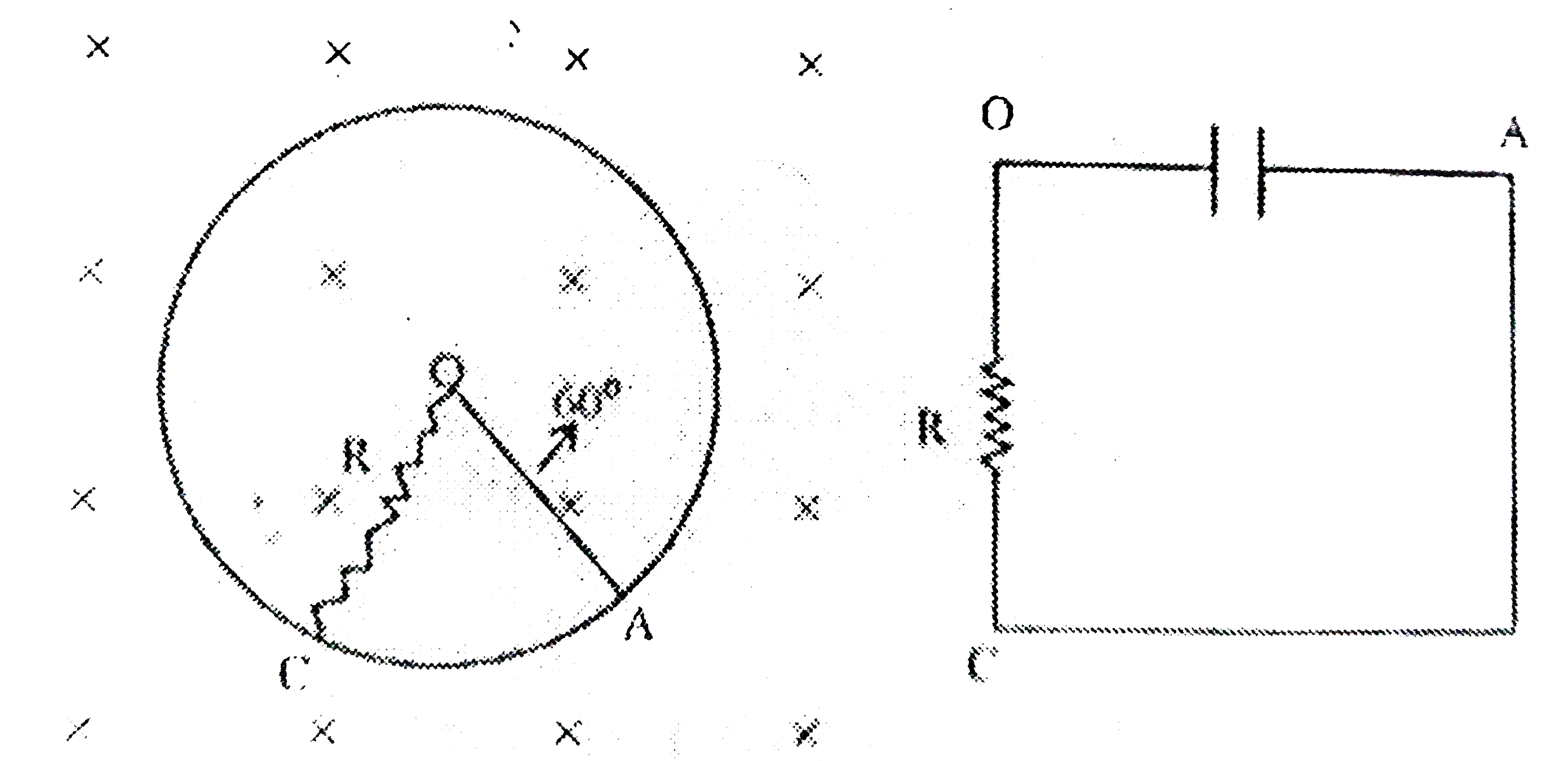

In time t, if `theta` is angle traced by face end then area swept `A= pi l^(2) xx ((theta)/(2pi))=(1)/(2) l^(2) theta`
`phi=B A cos 0^(@)=(1)/(2) Bl^(2) theta`
`(d phi)/(dt)=(1)/(2) Bl^(2)((d phi)/(dt))=(1)/(2) Bl^(2) omega`
The positive charge of the rod will be pushed towards O be replaced by a battery of emf source `(1)/(2) B omega l^(2)` with the positive terminal towards O. The equivalent circuit diagram is shown in figure. The circular loop joins A to C by a resistance less path. The current in the resistance R is
`i=(in)/(R )=(B omega I^(2))/(2R)`
Promotional Banner

Similar Questions

Explore conceptually related problems

A metallic rod of 1 m length is rotated with a frequency of 50 rev//s , with on end hinged at the centre and the other end at the circumference of a circular metallic ring of radius 1 m, about an axis passing through the centre and perpendicular at to the plane of the ring. A constant uniform magnetic field of 1 T parallel to the axis is persent eveywhere. what is the e.m.f. between the centre and the metallic ring?

Derive an expression for moment of inertia of a thin circular ring about an axis passing through its centre and perpendicular to the plane of the ring.

Calculate the ration of radii of gyration of circular ring and a disc of the same radius about the axis passing through their centres and perpendicular to their planes.

The radius of gyration of an uniform rod of length L about an axis passing through its centre of mass and perpendicular to its length is.

A rod of length l is rotated with angular speed omega about an axis passing through the centre of rod and perpendicular to its length. A uniform magnetic field B is applied parallel to the axis of rotation, Potential difference developed between the ends of the rod is

The radius of gyration of an uniform rod of length l about an axis passing through one of its ends and perpendicular to its length is.

