Home
Class 12
PHYSICS
You are given three lenses L(1),L(2) and...

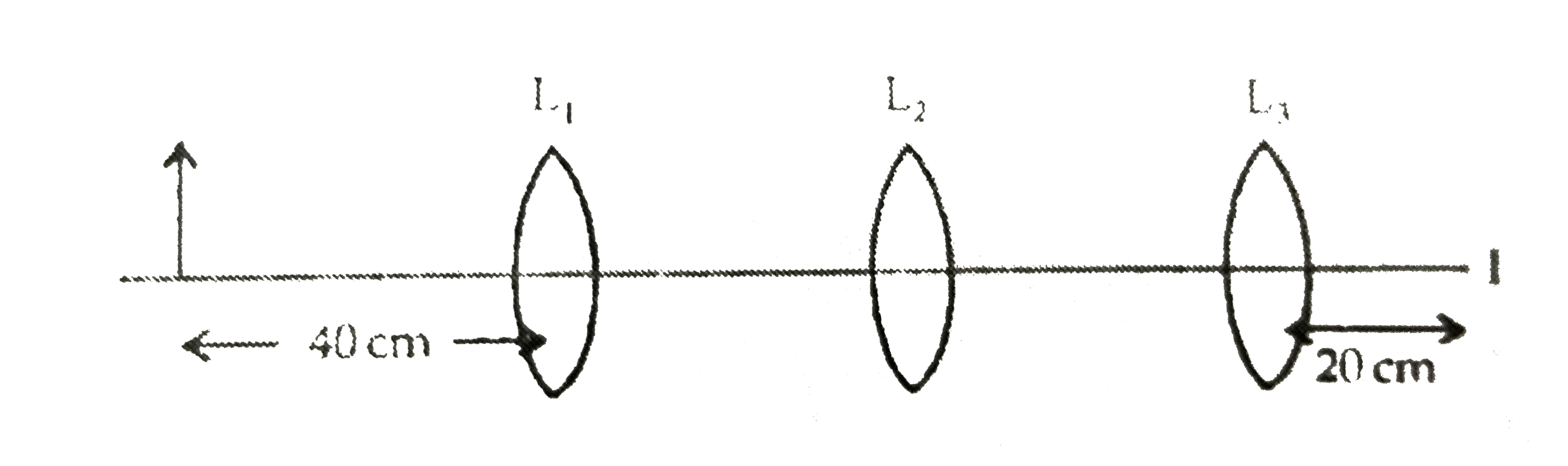
You are given three lenses `L_(1),L_(2) and L_(3)` each of focal length 20 cm. An object is kept at 40 cm in front of `L_(1),` as shown. The final real image is formed at the focus 'I' of `L_(3).` Find the separations between `L_(1),L_(2) and L_(3).`

Text Solution

Verified by Experts

`(1)/(v_(1))-(1)/(u)=(1)/(f_(1))" "rArr(1)/(v_(1))=(1)/(f_(1))+(1)/(u_(1))`
`=(1)/(20)+(1)/(-40)=(1-2-7)/(-40)=(1)/(40)`
`v_(1)=40 cm`
Here, image by `L_(3)` is formed at focus. So, the object should lie at infinity for `L_(3)`. Hence, `L_(2)` will produce image at infinity. So, we can conclude that object for `L_(2)` should be at its focus.
But, we have seen above that image by `L_(1)` is formed at 40 right of `L_(1)` which is at 20 cm left of `L_(2)` (focus of `L_(2)`).
So, `X_(1)=" distance between "L_(1) and L_(2)=(40+20)cm=60 cm.`
Again distance between `L_(2) and L_(3)` does not matter as the image by `L_(2)` is formed at infinity. So, `X_(2)` can take any value.
Promotional Banner

Topper's Solved these Questions

  • XII BOARDS

    XII BOARDS PREVIOUS YEAR|Exercise PHYSICS (Theory) [SET - II]|6 Videos
  • XII BOARDS

    XII BOARDS PREVIOUS YEAR|Exercise PHYSICS (Theory) [SET - III]|10 Videos
  • XII BOARDS

    XII BOARDS PREVIOUS YEAR|Exercise [Set-III]|6 Videos
  • SAMPLE PAPER 2019

    XII BOARDS PREVIOUS YEAR|Exercise SECTION D|6 Videos

Similar Questions

Explore conceptually related problems

You are given three lenses L_(1),L_(2) and L_(3) each of focal length 10 cm. An object is kept at 15 cm in front of L_(1), as shown. The final real image is formed at the focus 'T' of L_(3). Find the separations between L_(1),L_(2) and L_(3).

Three lenses L_1,L_2,L_3 each of focal length 30 cm are placed co-axially as shown in (Fig. 11(b).57). An object is held at 60 cm from the optic centre of lens L_1 . The final real image is formed at the focus of L_3 . Calculate separation between (i) L_1 and L_3 (ii) L_2 and L_3 ? .

(a) Explain with reason, how the power of a diverging lens changes when (i) it is kept in a medium of refractive index greater than that of the lens, (ii) incident red light is replaced by violet light. (b) Three lenses L_(1), L_(2), L_(3) each of focal length 30 cm are placed co-axially as shown in the figure. An object is held at 60 cm from the optic center of lens L_(1) . The final real image is formal at the focus of L_(3) . Calculate the separation between (i) (L_(1) and L_(2)) and " (ii) " (L_(2) and L_(3)) .

If lines l_(1), l_(2) and l_(3) pass through a point P, then they are called…………. Lines.

An eyepiece of a telescope consists of two plano-convex lenses L_(1) and L_(2) each of focal length f separated by a distance of 2f/3. where should L_(1) be plaecd relative to the focus of the objective lens of the telescope so that the final image through L_(2) is seen at infinity ?

In Fig., there are two convex lenses L_(1) and L_(2) having focal lengths F_(1) and F_(2) respectively. The distance between L_(1) and L_(2) will be :

In the figure shown, there are two convex lenses L_(1) and L_(2) having focal. Lengths f_(1) and f_(2) respectively. The distance between L_(1) and L_(2) will be

XII BOARDS PREVIOUS YEAR-XII BOARDS-PHYSICS (Theory) [SET - I]
  1. Explain the scattering of light with an example.

    Text Solution

    |

  2. Describe briefly with the help of a circuit diagram, how the flow of c...

    Text Solution

    |

  3. In the given block diagram of a receiver, Figure, identify the boxes l...

    Text Solution

    |

  4. A light bulb is rated 100 W for 220 V ac supply of 50 Hz. Calculate ...

    Text Solution

    |

  5. An alternating voltage given by V = 140 sin 314 t is connected across ...

    Text Solution

    |

  6. A circular coil of N turns and radius R carries a current I. It is unw...

    Text Solution

    |

  7. Deduce the expression for the electrostatic energy stored in a capacit...

    Text Solution

    |

  8. Calculate the value of the resistance R in the circuit shown in the fi...

    Text Solution

    |

  9. You are given three lenses L(1),L(2) and L(3) each of focal length 20 ...

    Text Solution

    |

  10. Explain thermionic emission, field emission and photoelectric emission...

    Text Solution

    |

  11. Obtain the resonant frequency (omega(r)) of a series LCR circuit withL...

    Text Solution

    |

  12. Mention three different modes of propagation used in communications sy...

    Text Solution

    |

  13. Draw a plot of potential energy of a pair of nucleons as a function of...

    Text Solution

    |

  14. In a Geiger- Marsden experiment, calculate the distance of closest app...

    Text Solution

    |

  15. The ground state energy of hydrogen atom is -13.6eV. If an electron ma...

    Text Solution

    |

  16. Define relaxation time of the free electrons drifting in conductor. Ho...

    Text Solution

    |

  17. (a) In Young's double slit experiment, derive the condition for (i) co...

    Text Solution

    |

  18. (a) How does an unpolarized light incident on polaroid get polarized ?...

    Text Solution

    |

  19. (a) Write the expression for the force, vecF, acting on a charged part...

    Text Solution

    |

  20. (a) Explain, giving reasons, the basic difference in converting galvan...

    Text Solution

    |
