Home
Class 12
PHYSICS
A convex lens of focal length 20 cm is p...

A convex lens of focal length `20 cm` is placed co-axially with a convex mirror of radius of curvature `20 cm`. The two are kept `15 cm` apart from each other. A point object is placed `60 cm` in front of the convex lens. Find the position of the image formed by the combination.

Text Solution

Verified by Experts
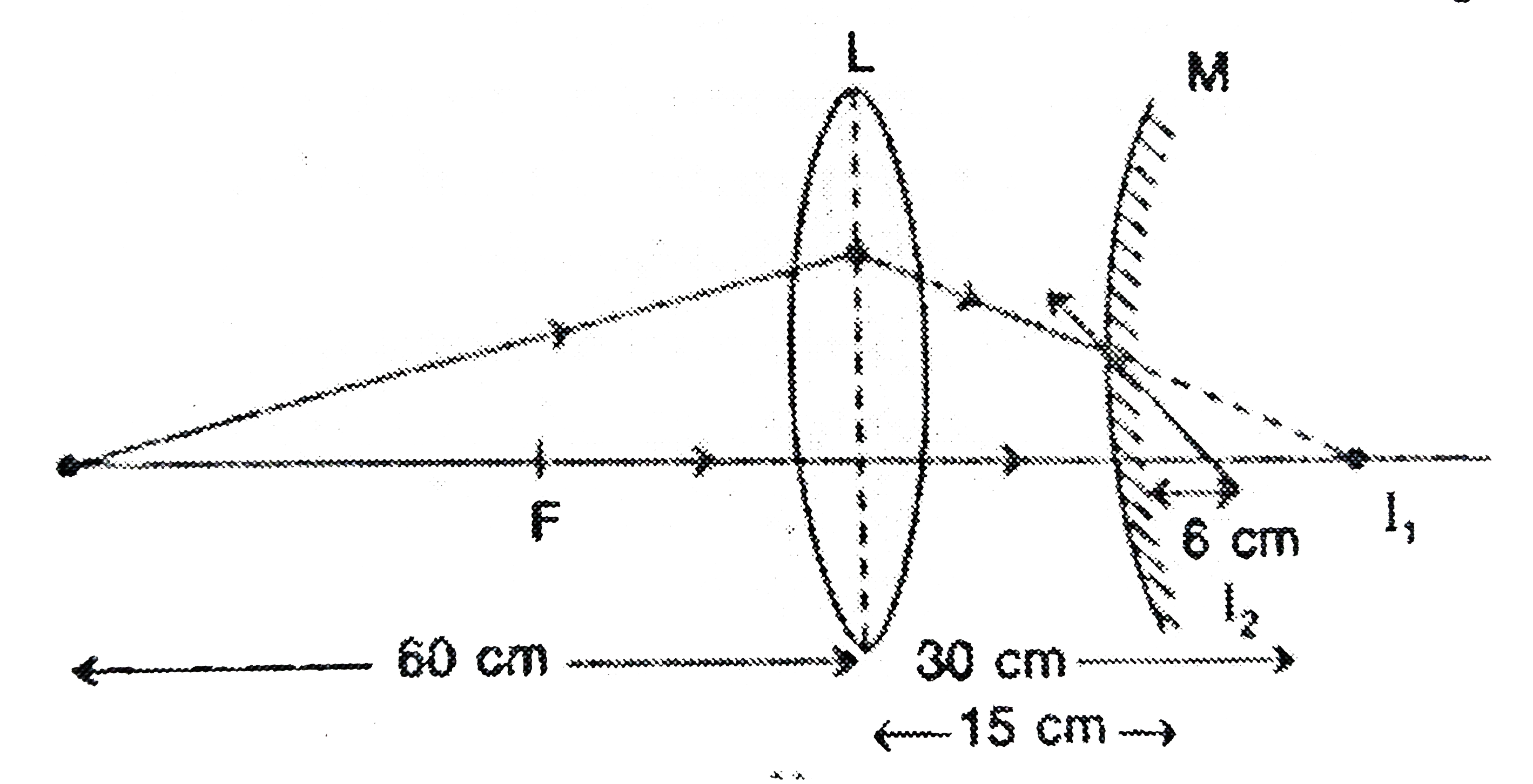
Here, `u=-60 cm,f=20cm`
From the lens formula, we have
`(1)/(v)-(1)/(u)=(1)/(f)`
`(1)/(v)=(1)/(f)+(1)/(u)rArr(1)/(v)=(1)/(120)+(1)/((-60))`

`rArr " " v = 60 cm`
The positive sign shows that the image is formed to the right of teh lens.
`(1)/(v)+(1)/(u)=(1)/(f)`
`u=-60 and f=20cm`
`(1)/(v)=(1)/(f)-(1)/(u)=(1)/(20)+(1)/(60)=(4)/(60)=(1)/(15)`
`rArr " " v = 15 cm`.
Promotional Banner

Topper's Solved these Questions

  • XII BOARDS

    XII BOARDS PREVIOUS YEAR|Exercise SET-II|35 Videos
  • XII BOARDS

    XII BOARDS PREVIOUS YEAR|Exercise SET-III|25 Videos
  • XII BOARDS

    XII BOARDS PREVIOUS YEAR|Exercise SET III|9 Videos
  • SAMPLE PAPER 2019

    XII BOARDS PREVIOUS YEAR|Exercise SECTION D|6 Videos

Similar Questions

Explore conceptually related problems

A convex lens of focal length 20 cm is placed co-axially with a convex mirrir of radius of curvature 20 cm . The two are kept 15 cm apart from eachother. A point object is placed 60 cm in front of the convex lens. Find the position of the image formed by the combination.

A convex lens of focal length 20cm is placed coaxilly with a convex mirror of radius of curvature 20 cm. The two are kept 15 cm apart. A point object is placed 40 cm in front of the convex lens. Find the position of the image formed by this combination. Draw the ray diagram showing the image formation.

A convex lens, of focal length 25 cm, and a concave mirror, of radius of curvature 20 cm. are placed co-axially 4 cm aprat from each other. An incident beam, parallel to the principal axis, is incident on the convex lens. Find the position and nature of the image formed by this combination.

A convex lens of focal length 20 cm and a concave lens of focal length 15 cm are kept 30 cm apart with their principal axes coincident. When an object is placed 30 cm in front of the convex lens, calculate the position of the final image formed by the combination. Would this result change if the object were placed 30 cm in front of the concave lens ? Give reason.

A convex lens of focal length 15 cm , and a concave mirror of radius of curvature 20 cm are placed co-axially 10 cm apart. An object is placed in front of convex lens so that there is no parallax between the object and its image formed by the combination. Find the position of the object.

A convex lens of focal length 20 cm and a convex mirror of focal length 10 cm are placed co-axially 50 cm apart from each other. An incident beam parallel to its principal axis is incideent on the convex lens. Locate the position of final image formed due to the combination.

A convex lens of focal length 10 cm is placed coaxially 5 cm away from a concave lens of focal length 10 cm. If an object is placed 30 cm in front of the convex lens, find the position of the final image formed by the combined system.

An object placed 10 cm in front of a convex lens of focal length 15 cm. The image produced will be

A convex lens of focal length 20cm is placed 10cm in front of a convex mirror or radius of curvature 15cm. Where should a point object be placed in front of the lens so that it images on to itself?

XII BOARDS PREVIOUS YEAR-XII BOARDS-SET-I
  1. Estimate the average drift speed of conduction electrons in a copper w...

    Text Solution

    |

  2. Two monochromatic ray of light are incident normally on the face AB of...

    Text Solution

    |

  3. Write the function of (i) Transducer and (ii) Repeater in the context ...

    Text Solution

    |

  4. Show diagrammatically the behaviour of magnetic field lines in the pre...

    Text Solution

    |

  5. (a) Using the phenomenon of polarization, show, how, transverse natur...

    Text Solution

    |

  6. Define the term 'mutual inductance' between the two coils. Obtain the...

    Text Solution

    |

  7. Answer the following : (a) Why are the connections between the resi...

    Text Solution

    |

  8. R Omega का कोई प्रतिरोध एक पोटेंशियोमीटर से विघुत धारा प्राप्त कर रहा...

    Text Solution

    |

  9. A convex lens of focal length 20 cm is placed co-axially with a convex...

    Text Solution

    |

  10. A voltage V = V(0)sinomegat is applied to a series LCR circuit. Derive...

    Text Solution

    |

  11. Write any two distinguishing features between conductors, semiconducto...

    Text Solution

    |

  12. For the past some time, Aarti had been observing some erratic body mov...

    Text Solution

    |

  13. Write two basic modes of communication. Explain the process of amplitu...

    Text Solution

    |

  14. An electron microscope uses electrons accelerated by a voltage of 50kV...

    Text Solution

    |

  15. Draw a labelled diagram of Van de Graff generator. State its working p...

    Text Solution

    |

  16. (a) Deduce the expression for the torque acting on a dipole of dipole ...

    Text Solution

    |

  17. (a) In Young's double slit experiment, describe briefly how bright and...

    Text Solution

    |

  18. (a) Describe briefly how a diffraction pattern is obtained on a screen...

    Text Solution

    |

  19. (a) Deduce an expression for the frequency of revolution of a charged ...

    Text Solution

    |

  20. (a) Draw a labellel diagram of a moving coil galvanometer. Describe br...

    Text Solution

    |

