Home
Class 12
PHYSICS
(a) Describe briefly how a diffraction p...

(a) Describe briefly how a diffraction pattern is obtained on a screen due to a single narrow slit illuminated by a monochromatic source of light. Hence obtain the condition for the angular width of secondary maxima and secondary minima.
(b) Two wavelengths of sodium light of 590 nm and 596 nm are used in turn to study the diffraction taking place at a single slit of aperture `2xx10^(-6)`m. The distance between the slit and the screen is 1.5 m. Calculate the separation between the positions of first maxima of the diffraction pattern obtained in the two cases.

Text Solution

Verified by Experts
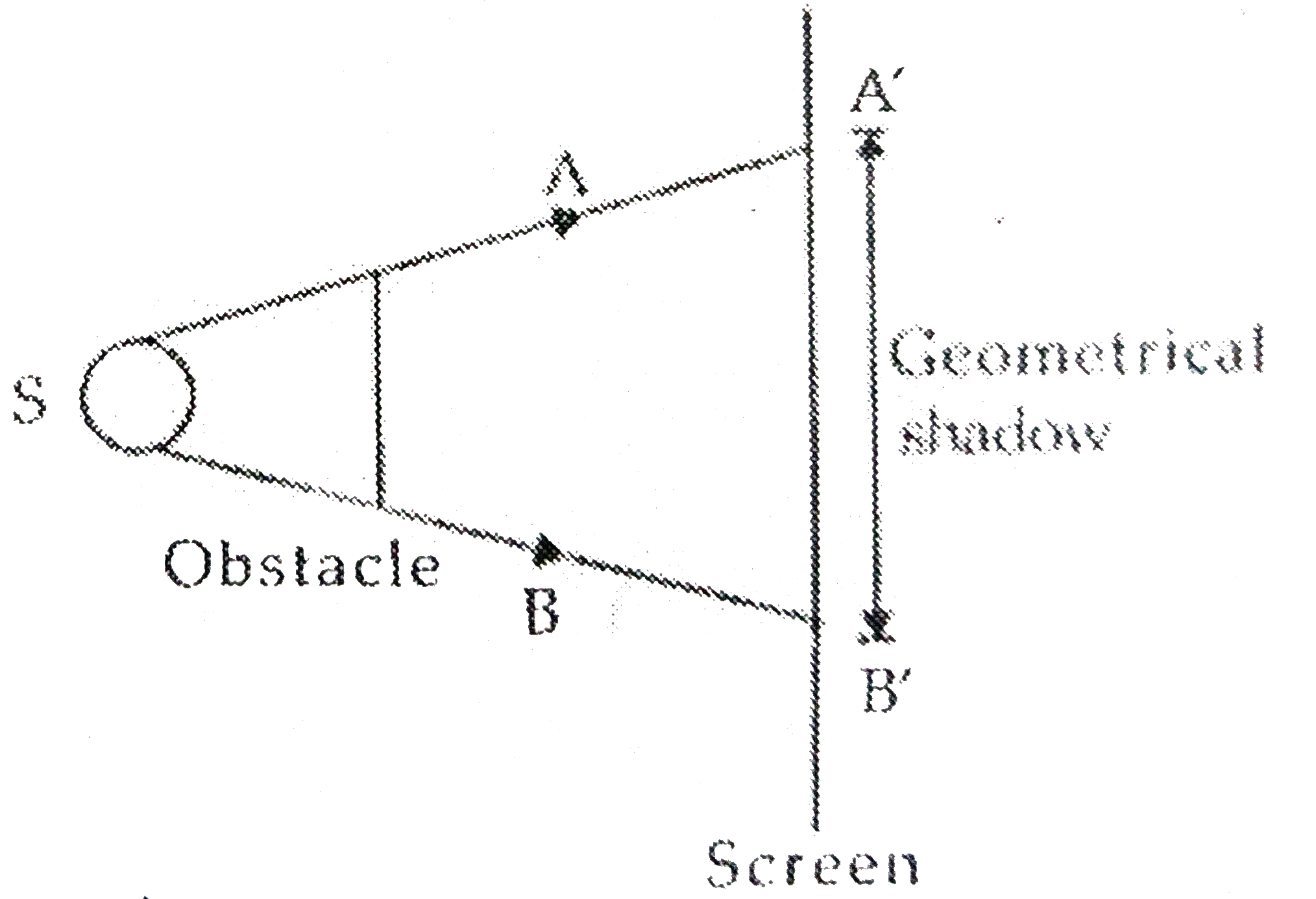
(a) The phenomenon of bending of light round the sharp corners of an obstacle spreading into the regions of geometrical shadow is called diffraction.


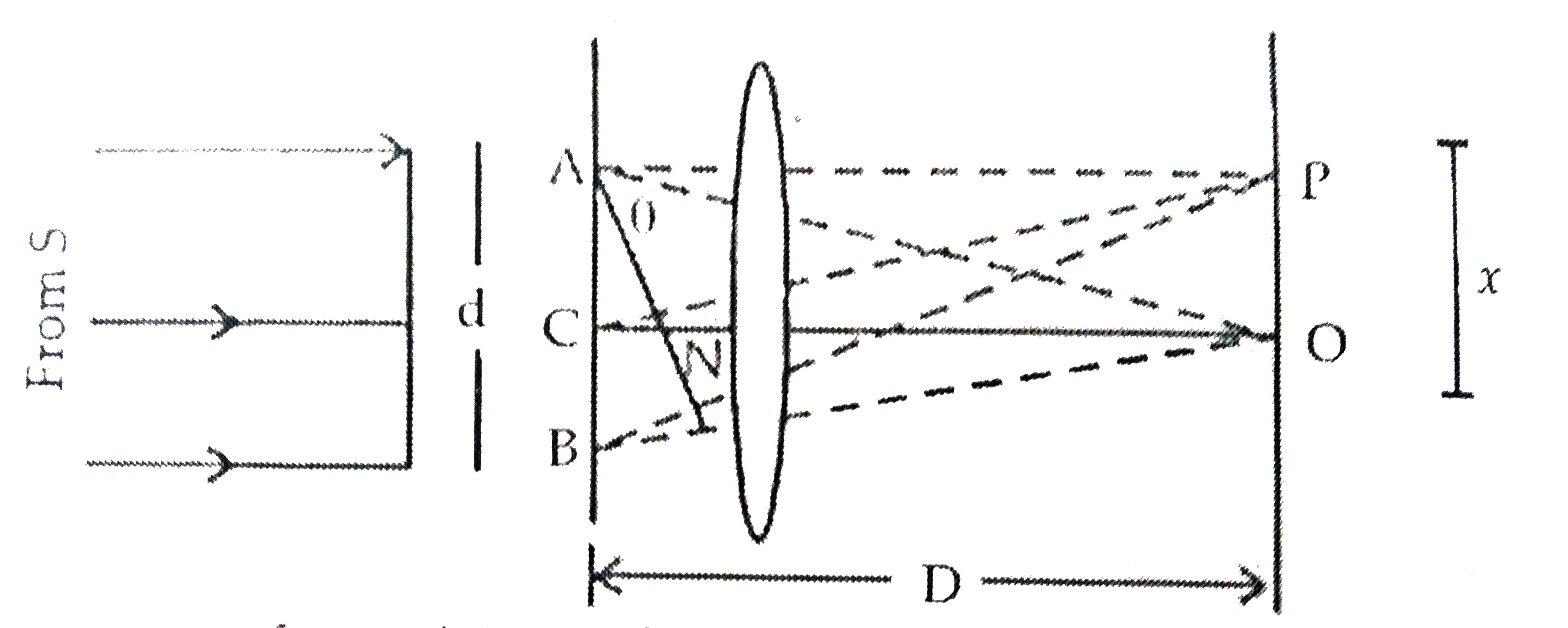
Expression For Fringe Width : Consider a parallel beam of light from a lens failing on a slit AB. As diffraction occurs, the pattern is focused on the screen XY with the help of lens L2. We will obtain a diffraction pattern that is a central maximum at the centre O flanked by a number of dark and bright fringes called secondary maxima and minima.
Central Maximum : '' Each point on the plane wave front AB sends out secondary wavelets in all directions. The waves from points equidistant from the centre C lying on the upper and lower half reach point O with zero path diffference and hence, reinforce each other, producing maximum intensity at point O.
Positions and Widths of Secondary Maxima and Minima : Consider a point P on the screen at which wavelets travelling in a direction making angle theta with CO are brought to focus by the lens. The wavelets from points A and B will have a path difference equal to BN.
From the right angled `Delta ANB`, we have:
`BN=ABsintheta`
`BN=a sintheta" "...(i)`
Suppose `BN=lambda and theta=theta_(1)`
Then, the above equation gives
`lambda = a sintheta_(1)`
`sin theta_(1)=(lambda)/(a)" "...(ii)`
Such a point on the screen will be the position of first secondary minimum.
`BN=2lambdaand theta=theta_(2)`
`2lambda=asintheta_(2)`
If `sintheta_(2)=(2lambda)/(a)" "...(iii)`
Such a point on the screen will be the position of second secondary minimum.
In general, for nth minimum at point P
`sintheta_(n)=(nlambda)/(a)" "...(iv)`
If yn is the distance of the nth minimum from the centre of the screen, from right angled ACOP, we have:
`tantheta_(n)=(OP)/(CO)`
`tantheta_(n)=(y_(n))/(D)" "...(v)`
In case `theta_(n)` is small, `sintheta_(n)=tantheta_(n)4` Equations (iv) and (v) give
`(y_(n))/(D)=(nlambda)/(a)`
`y_(n)=(Dlambda)/(a)`
Width of the secondary maximum,
`beta=y_(n)-y_(n-1)=(nDlambda)/(a)-((n-1)Dlambda)/(a)`
`beta=(Dlambda)/(a)" "...(vi)`
`therefore beta` is independent of n all the secondary maxima are of the same width `beta`.
If `BN=(3lambda)/(2)andtheta=theta'_(1)` from equation (i), we have :
`sintheta'_(1)=(3lambda)/(2a)`
Such a point on the screen will be the position of the first secondary maximum.
Corresponding to path difference,
`BN =(5lambda)/(2)and theta=theta'_(r)`
The second secondary maximum is produced. In general, for the nth maximum at point P,
`sintheta'_(n)=((2n+1)lambda)/(2a)" "...(vii)`
If `y_(n)` is the nth maximum from the center of the screen, then in angular position of the nth maximum is given by
`tantheta'_(n)=(y'_(n))/(D)" "...(viii)`
In case `theta'_(n)` is small `sintheta'_(n)~~tantheta'_(n)`
`therefore y'_(n)=((2n+1)Dlambda)/(2a)`
Width of the secondary minimum,
`beta=y'_(n)-y'_(n-1)`
`=nDlambdaa-(n-1)Dlambdaa`
`beta=(Dlambda)/(a)" "...(ix)`
Since `beta` independent of n, all the secondary minima are of the same width.
(b) For first maxima of the diffraction pattern we know :
`sintheta=3lambda_(2)a,` where is aperture of slit.
For small value of `theta, sintheta~~ tantheta = yD` where y is the distance of first minima from central line and D is the distance between slit and the screen.
So, `y=3lambda_(2)aD`
For 590 nm,
`y_(1)=3xx590xx10^(-92)xx10^(-6)xx1.5 y_(1)`
For 596nm,
`y_(2)=3xx596xx10^(-92)xx10^(-6)xx1.5 y_(2)`
`=0.6705 m`
Separate between the position of first maxima `=y_(2)=y_(1)=0.00675m`.
Promotional Banner

Topper's Solved these Questions

  • XII BOARDS

    XII BOARDS PREVIOUS YEAR|Exercise SET-II|35 Videos
  • XII BOARDS

    XII BOARDS PREVIOUS YEAR|Exercise SET-III|25 Videos
  • XII BOARDS

    XII BOARDS PREVIOUS YEAR|Exercise SET III|9 Videos
  • SAMPLE PAPER 2019

    XII BOARDS PREVIOUS YEAR|Exercise SECTION D|6 Videos

Similar Questions

Explore conceptually related problems

Two wavelengths of sodium light 590 nm and 596 nm are used, in turn, to study the diffraction taking place at a single slit of aperature 2 xx 10^(-4) m . The distance between the slit and the screen is 1.5 m. Calcualate the separation between the positions of first maximum of the diffractions patterns obtained in two cases.

Two wavelength of sodium light 590 nm and 596 nm are used, in turn, to study the diffraction taking placed at a single slit of aperture 2 xx 10^(-4)m . The distance between the slit and screen is 1.5 m . Calculate the separation between the positions of first maxima of diffraction pattern obtained in the two cases.

Two wavelength of sodium light 590 nm and 596 nm are used in turn to study the diffraction at a single slit of size 4 mm . The distance between the slit and screen is 2 m . Calculate the separation between the positions of first maximum of the diffraction pattern obtained in the two cases.

(a) In what way is diffraction from each slit related to the interference pattern in a double slit experiment ? (b) Two wavelengths of sodium light 590 nm and 596 nm are used, in turn, to study the diffraction taking place at a single slit of aperture 2 xx 10^(-4)m. The distance between the slit and the screen is 1.5 m. Calculate the separation between the positions of the first maxima of the diffraction pattern obtained in the two cases.

(a) Explain how the intensity of diffraction pattern changes as the order (n) of the diffraction band varies. (b) Two wavelengths of sodium light 590 nm and 596 nm are used in turn to study the diffraction at a single slit of size 4mm. The distance between the slit and screen is 2m. Calculate the separation between the positions of the first maximum of the diffraction pattern obtained in the two cases.

(a) Write two characteristics features distinguishing the diffraction pattern from the interference fringes obtained in Young's double slit experiment. (b) Two wavelengths of sodium light 590 nm and 596 nm are used , in turn, to study the diffraction taking place due to a single slit of aperture 1xx10^(-4)m . The distance between the slit and the screen is 1.8m. Calculate the separation between the positions of the first maxima of the diffraction pattern obtained in the two cases.

XII BOARDS PREVIOUS YEAR-XII BOARDS-SET-I
  1. Estimate the average drift speed of conduction electrons in a copper w...

    Text Solution

    |

  2. Two monochromatic ray of light are incident normally on the face AB of...

    Text Solution

    |

  3. Write the function of (i) Transducer and (ii) Repeater in the context ...

    Text Solution

    |

  4. Show diagrammatically the behaviour of magnetic field lines in the pre...

    Text Solution

    |

  5. (a) Using the phenomenon of polarization, show, how, transverse natur...

    Text Solution

    |

  6. Define the term 'mutual inductance' between the two coils. Obtain the...

    Text Solution

    |

  7. Answer the following : (a) Why are the connections between the resi...

    Text Solution

    |

  8. R Omega का कोई प्रतिरोध एक पोटेंशियोमीटर से विघुत धारा प्राप्त कर रहा...

    Text Solution

    |

  9. A convex lens of focal length 20 cm is placed co-axially with a convex...

    Text Solution

    |

  10. A voltage V = V(0)sinomegat is applied to a series LCR circuit. Derive...

    Text Solution

    |

  11. Write any two distinguishing features between conductors, semiconducto...

    Text Solution

    |

  12. For the past some time, Aarti had been observing some erratic body mov...

    Text Solution

    |

  13. Write two basic modes of communication. Explain the process of amplitu...

    Text Solution

    |

  14. An electron microscope uses electrons accelerated by a voltage of 50kV...

    Text Solution

    |

  15. Draw a labelled diagram of Van de Graff generator. State its working p...

    Text Solution

    |

  16. (a) Deduce the expression for the torque acting on a dipole of dipole ...

    Text Solution

    |

  17. (a) In Young's double slit experiment, describe briefly how bright and...

    Text Solution

    |

  18. (a) Describe briefly how a diffraction pattern is obtained on a screen...

    Text Solution

    |

  19. (a) Deduce an expression for the frequency of revolution of a charged ...

    Text Solution

    |

  20. (a) Draw a labellel diagram of a moving coil galvanometer. Describe br...

    Text Solution

    |