Home
Class 12
PHYSICS
A convex lens of focal length 20cm is pl...

A convex lens of focal length 20cm is placed coaxilly with a convex mirror of radius of curvature 20 cm. The two are kept 15 cm apart. A point object is placed 40 cm in front of the convex lens. Find the position of the image formed by this combination. Draw the ray diagram showing the image formation.

Text Solution

Verified by Experts
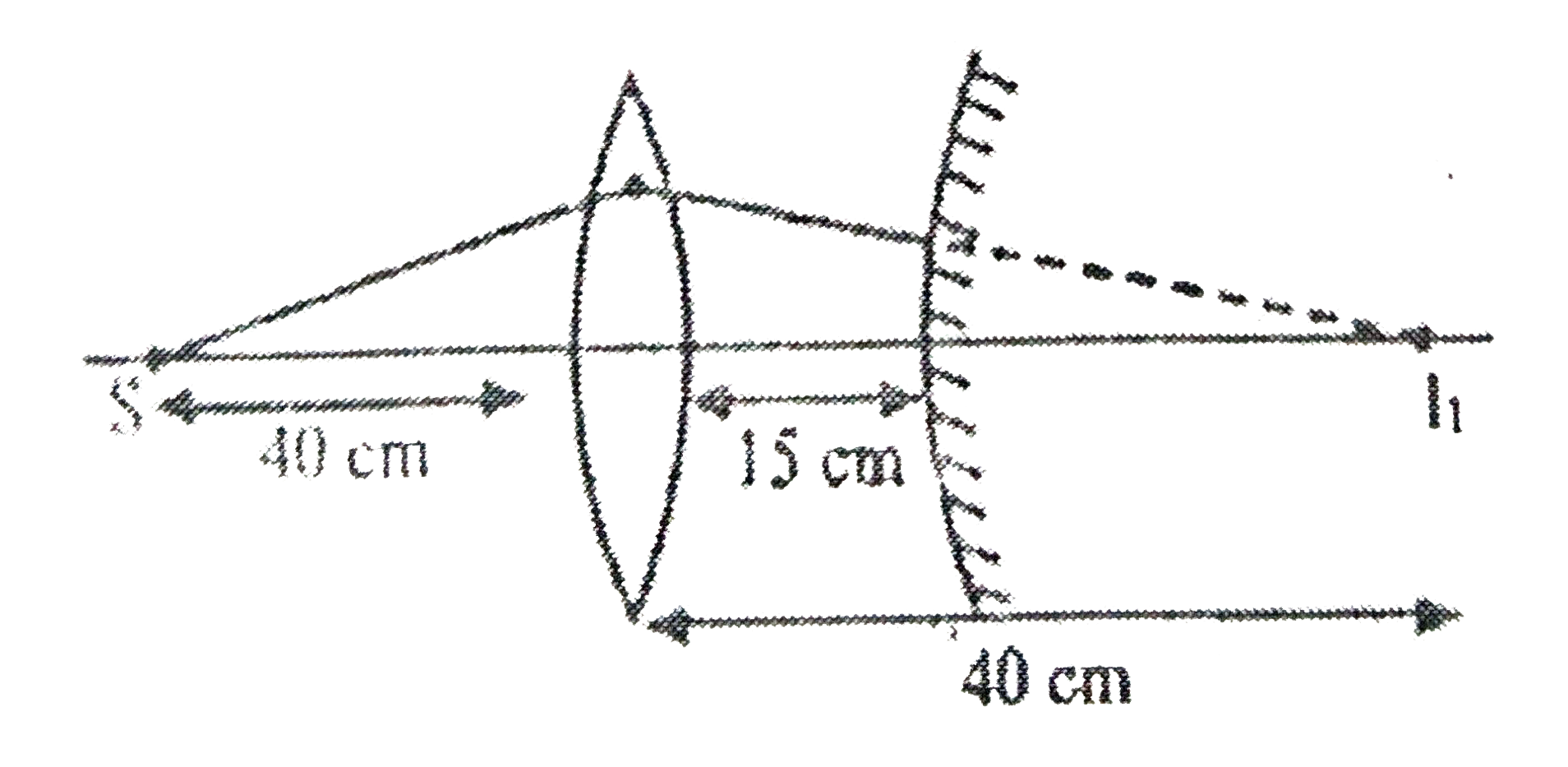
Let us first locate the image of the point obect S formed by the convex lens.
Here:
`u=-40cm,and,f=20cm`
From the lens formula, we have:
`(1)/(v)-(1)/(u)=(1)/(f)rArr(1)/(v)=(1)/(u)+(1)/(f)`
`(1)/(20)+(1)/(-40)=v=40cm`

The positive sign shows that the image is formed to the right of the lens as shown in the following figure.
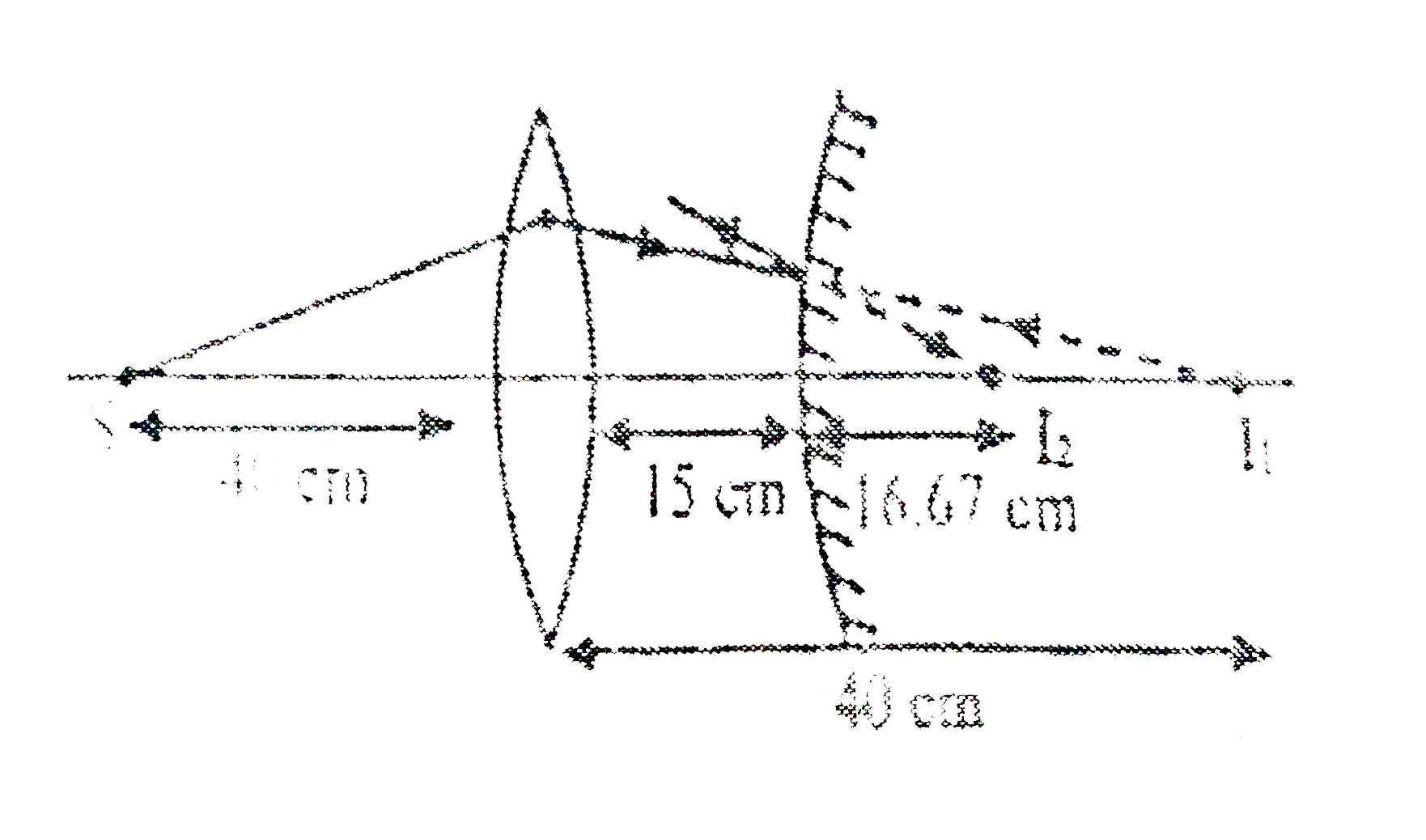
The image `I_(1)` is formed behind the mirror and hence acts as a virtual source for the mirror. The convex mirror forms the image `L_(2)`, whose distance form the mirror can be calcualted as :
`(1)/(v)+(1)/(u)=(1)/(f)`
Hence : `u=25cm and, f=R//2=10cm`
`(1)/(v)=(1)/(f)-(1)/(u)rArr(1)/(v)=(1)/(10)-(1)/(25)`

Hence, the final image is formed at a distance of 16.67 cm from the convex mirror as shown in the following figyure.
Promotional Banner

Topper's Solved these Questions

  • XII BOARDS

    XII BOARDS PREVIOUS YEAR|Exercise SET-III DELHI BOARD|11 Videos
  • XII BOARDS

    XII BOARDS PREVIOUS YEAR|Exercise SET -I|34 Videos
  • XII BOARDS

    XII BOARDS PREVIOUS YEAR|Exercise SET-II|35 Videos
  • SAMPLE PAPER 2019

    XII BOARDS PREVIOUS YEAR|Exercise SECTION D|6 Videos

Similar Questions

Explore conceptually related problems

A convex lens of focal length 20 cm is placed co-axially with a convex mirrir of radius of curvature 20 cm . The two are kept 15 cm apart from eachother. A point object is placed 60 cm in front of the convex lens. Find the position of the image formed by the combination.

A convex lens of focal length 10 cm is placed coaxially 5 cm away from a concave lens of focal length 10 cm. If an object is placed 30 cm in front of the convex lens, find the position of the final image formed by the combined system.

A convex lens of focal length 20cm is placed 10cm in front of a convex mirror or radius of curvature 15cm. Where should a point object be placed in front of the lens so that it images on to itself?

A convex lens of focal length 10 cm is placed co-axially 5 cm away from a concave lens of focal length 10 cm . If an object is placed 30 cm in front of the convex lens, find the position of final image formed by the combined system.

A convex lens of focal length 15 cm , and a concave mirror of radius of curvature 20 cm are placed co-axially 10 cm apart. An object is placed in front of convex lens so that there is no parallax between the object and its image formed by the combination. Find the position of the object.

A convex lens, of focal length 25 cm, and a concave mirror, of radius of curvature 20 cm. are placed co-axially 4 cm aprat from each other. An incident beam, parallel to the principal axis, is incident on the convex lens. Find the position and nature of the image formed by this combination.

(a) (i) Draw a labelled ray diagram to show the formation of image in an astronomical telescope for a distant object. (ii) Write three distinct advantages of a reflecting type telescope over a refracting type telescope. (b) A convex lens of focal length 10 cm is placed coaxially 5 cm away from a concave lens of focal length 10 cm. If an object is placed 30 cm in front of the convex lens, find the position of the image formed by the combined system.

Two thin lenses, both of 10 cm focal length- one convex and other concave, are placed 5 cm apart. An object is placed 20 cm in front of the convex lens. Find the nature and position of the final image.

An object placed 10 cm in front of a convex lens of focal length 15 cm. The image produced will be

XII BOARDS PREVIOUS YEAR-XII BOARDS-SET-III
  1. Two nuclei have mass numbers in the ratio 27 : 125. What is the ratio...

    Text Solution

    |

  2. (i) What is the relation between critical angle and refractive index o...

    Text Solution

    |

  3. A wire of 20 Omega resistance is gradually stretched to double its ori...

    Text Solution

    |

  4. What are polaroids ? Mention some of their practical uses ?

    Text Solution

    |

  5. Define the activity of a radio nuclide. Write its S.I. unit. Give a pl...

    Text Solution

    |

  6. A hollow metal sphere of radius 6 cm is charged such that the potentia...

    Text Solution

    |

  7. How are microwaves produced?

    Text Solution

    |

  8. A converging lens has a focal length of 20 cm in air. It is made of a ...

    Text Solution

    |

  9. You are given a circuit below. Write its truth table. Hence, identify ...

    Text Solution

    |

  10. Two charges of magnitudes +4Q and -Q and located at points (a, 0) and ...

    Text Solution

    |

  11. In the circuit shown in the figure, identify the equivalent gate of th...

    Text Solution

    |

  12. A parallel beam of light of 450 nm falls on a narrow slit and the resu...

    Text Solution

    |

  13. Name the type of waves which are used for line of sight (LOS) communic...

    Text Solution

    |

  14. The graph shows variation of stopping potential V(0) versus frequency ...

    Text Solution

    |

  15. Why do the electric field lines never cross each other ?

    Text Solution

    |

  16. To which part of the electromagnetic spectrum does a wave of frequency...

    Text Solution

    |

  17. Estimate the average drift velocity of conduction electrons in a coppe...

    Text Solution

    |

  18. Write the functions of the following in communication systems: (i). ...

    Text Solution

    |

  19. A convex lens of focal length 20cm is placed coaxilly with a convex mi...

    Text Solution

    |

  20. (a) A rod of length l is moved horizontal with a uniform velocity v in...

    Text Solution

    |