Home
Class 12
PHYSICS
Use Kirchhoff's rules to determine the p...

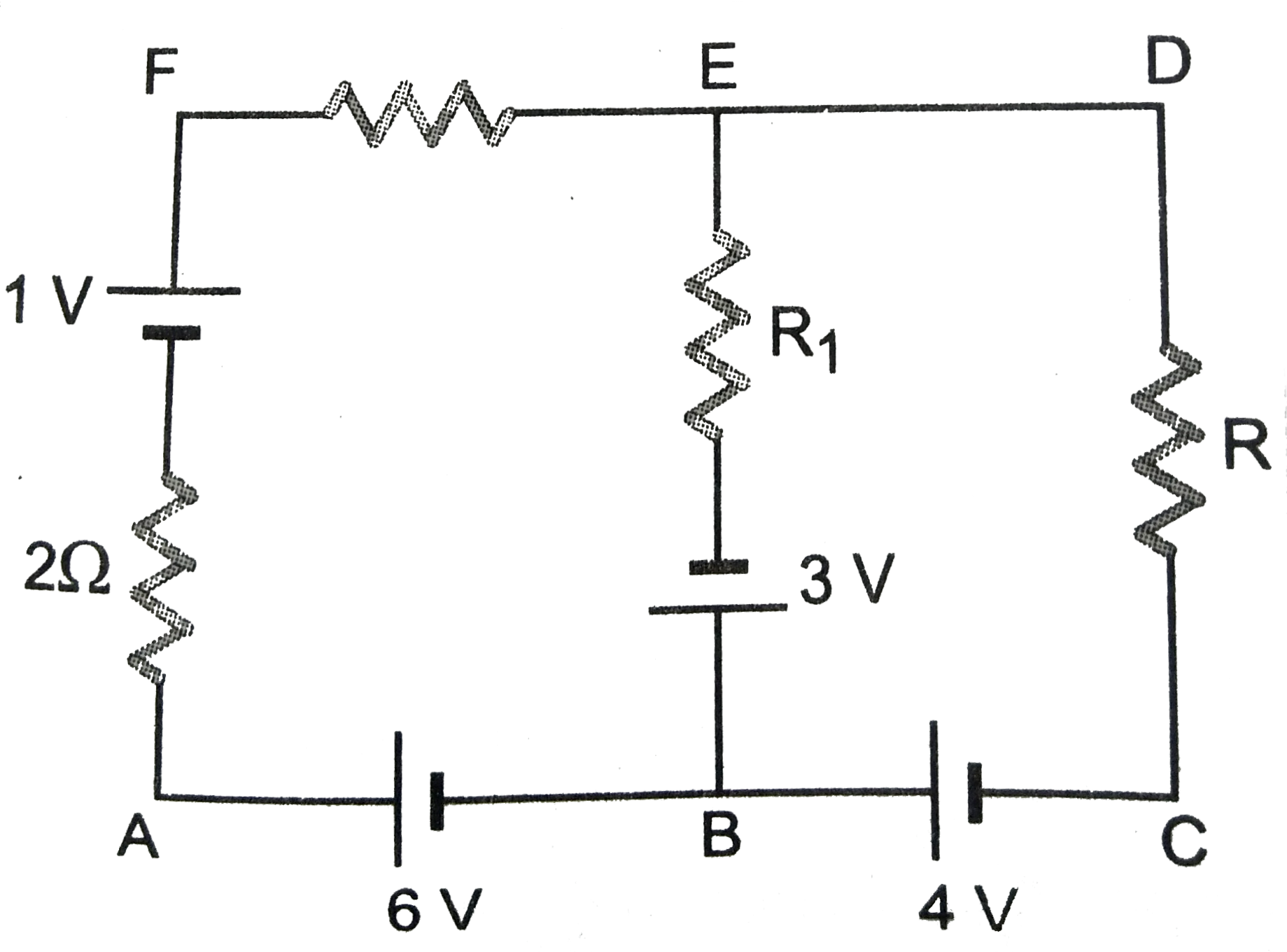
Use Kirchhoff's rules to determine the potential differnce between the poits A and D when no current flows in the arm BE of the electric network shown in figure

Text Solution

Verified by Experts

According to Kirchhoff's junction rule at E or B
Since `I_(2) =0` in the arm BE as given in the question ` I_(3) =I_(1)`
Using Look rule in the loop AFEBA ` + 6V -2I_(3) + 3I_(3) +1_(v) -3I_(3) -I_(2)R_(1) +3V=0`
Rightarrow ` 2L_(3) +3I_(3) +I_(2) R_(1) =10 V `
Since `I_(2) = 0,` so
`5I_(3)=10V Rightarrow I_(3) =2A because I_(3) = I_(2) =2A`
The potenial difference between A and D, along the branch AFED of the closed circuit.
`V_(A) -2I_(3) +1V-3I_(3)-V_(D)=0 Rightarrow V_(A) -V_(D) =2I_(3) -1V +3I_(3) = 2xx 2 -1 +3xx 2=9V`
Promotional Banner

Topper's Solved these Questions

  • XII BOARDS

    XII BOARDS PREVIOUS YEAR|Exercise section C|10 Videos
  • XII BOARDS

    XII BOARDS PREVIOUS YEAR|Exercise section -D|3 Videos
  • XII BOARDS

    XII BOARDS PREVIOUS YEAR|Exercise section A|5 Videos
  • SAMPLE PAPER 2019

    XII BOARDS PREVIOUS YEAR|Exercise SECTION D|6 Videos

Similar Questions

Explore conceptually related problems

Determine the potential difference between X and Y in the circuit shown in figure.

Determine the current in each branch of the network shown in figure.

Calculate the potential difference between points B and D of the network of resistance shown in figure

Determine current in each branch of the network shown in figure

Use kirchhoff's rules to determine the value of current I_(1) flowing in the circuit

In the network shown in the figure, the potential difference between A and B is :
