Home
Class 12
PHYSICS
(a) Explain with reason, how the power o...

(a) Explain with reason, how the power of a diverging lens changes when (i) it is kept in a medium of refractive index greater than that of the lens, (ii) incident red light is replaced by violet light.
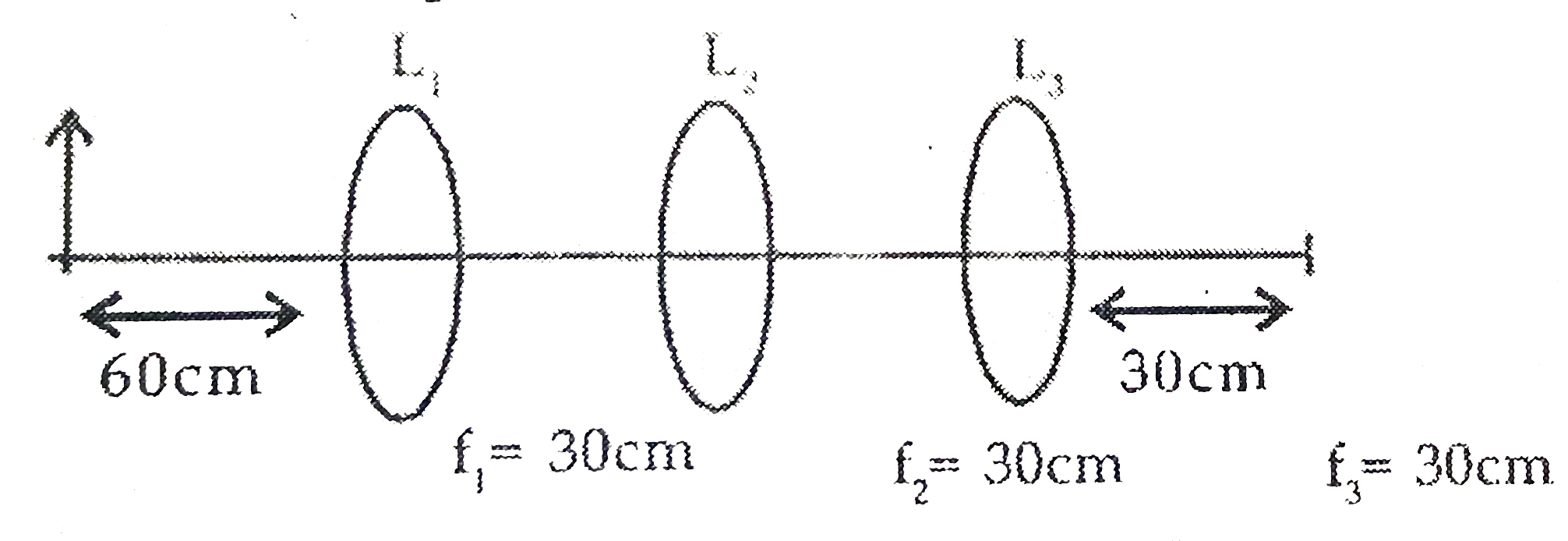
(b) Three lenses `L_(1), L_(2), L_(3)` each of focal length 30 cm are placed co-axially as shown in the figure. An object is held at 60 cm from the optic center of lens `L_(1)`. The final real image is formal at the focus of `L_(3)`. Calculate the separation between (i) `(L_(1) and L_(2)) and " (ii) " (L_(2) and L_(3))`.

Text Solution

Verified by Experts
(a) We have `mu = (mu_(2))/(mu_(1)) = ("Refractive index of lens Material")/("Refractive index of surrounding")`
given `mu_(r) gt mu_(2) " i.e., " mu_(2)//mu_(1) lt 1`
As we know power `P = (1)/(f) = (mu -1) ((1)/(R_(1)) - (1)/(R_(2)))` [Power of diverging lens is negative]
`mu - 1 =` negative `rArr` f is negative so it will diverge
(ii) We know `p prop mu and mu prop 1//lamda^(2)` as the wavelength of red light is greatern than violet light. So, the power of lens for red light is less than power of lens of violet light.
(b)
`f_(1) = 30 cm" " f_(2) = 30 cm " " f_(3) = 30 cm`
For `L_(1) = (1)/(v) - (1)/(u) = (1)/(f)`
`(1)/(v) - (1)/(-60) = (1)/(+30) rArr (1)/(v) = (1)/(30) - (1)/(60) (2 -1)/(60)`
`rArr v = 60 cm`
For `L_(2) (1)/(v) - (1)/(u) = (1)/(f_(3)) rArr (1)/(30) - (1)/(u) = (1)/(+30)`
`(dl)/(dt) = 0 " " u = oo`
for `L_(2) = v = alpha rArr (1)/(v) - (1)/(4) = (1)/(f)`
So `(1)/(oo) (1)/(4) = (1)/(30) rArr u = - 30 cm`

Distance between `L_(1) and L_(2)` = Image distance of lens `L_(1)` from the optical centre of Less `L_(2)` + object distance of `L_(2) = 60 + \\-30 \\= 90cm` for any distance between `L_(2) and L_(3)` the image will be formed at the focus of `L_(3)` i.e., image froms by `L_(3)` is indepdent of distance
Promotional Banner

Similar Questions

Explore conceptually related problems

Explain with reason how the power of a diverging lens changes when (i) it is kept in a medium of refractive by index greater than that of the lens. (ii) incident red light is replaced by violet light.

Three lenses L_1,L_2,L_3 each of focal length 30 cm are placed co-axially as shown in (Fig. 11(b).57). An object is held at 60 cm from the optic centre of lens L_1 . The final real image is formed at the focus of L_3 . Calculate separation between (i) L_1 and L_3 (ii) L_2 and L_3 ? .

You are given three lenses L_(1),L_(2) and L_(3) each of focal length 20 cm. An object is kept at 40 cm in front of L_(1), as shown. The final real image is formed at the focus 'I' of L_(3). Find the separations between L_(1),L_(2) and L_(3).

You are given three lenses L_(1),L_(2) and L_(3) each of focal length 10 cm. An object is kept at 15 cm in front of L_(1), as shown. The final real image is formed at the focus 'T' of L_(3). Find the separations between L_(1),L_(2) and L_(3).

A convex lens of focal length 15 cm is placed on a plane mirror. An object is placed at 30 cm from the lens. The image is

Red light is incident on a converging lens of focal length f . State with reason hoe f will change if red light is replaced by blue light.