Home
Class 12
PHYSICS
(a) Draw a ray diagram to show the imag...

(a) Draw a ray diagram to show the image formation by a combination of two thin convex
lenses in contact . Obtain the expression for the power of this combination in terms of the
focal lengths of the lenses.
(b) A ray of light passing from air through an equilateral glass prism undergoes minimum
deviation when the angle of incidence is `(3)/(4)^(th)` of the angle of prism . Calculate the speed of ltbRgt light in the prism.

Text Solution

Verified by Experts
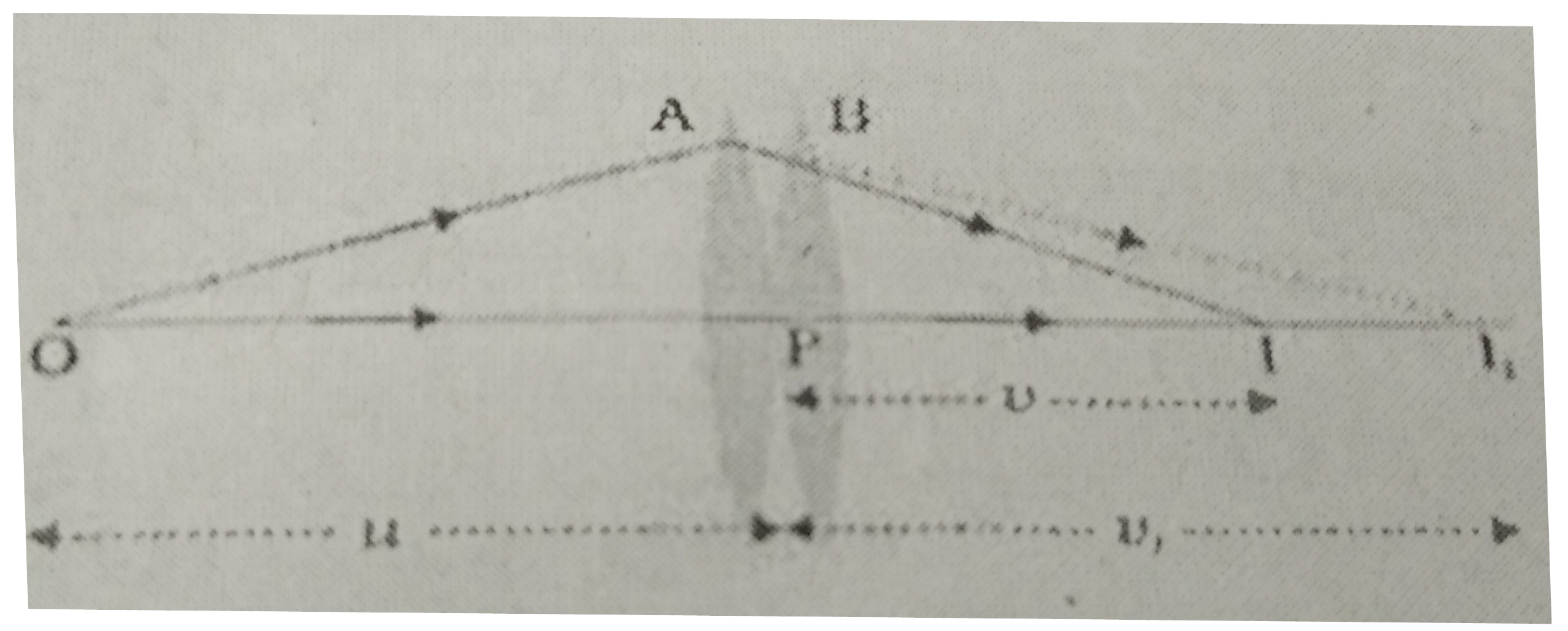
(a) Consider lenes A and B with focal length `f_(1) and f_(2)` placed in contact . Object is placed at O
beyond focus of A . First lens produces image at I, (its real) and serve as virtual object for
lens B producing image I. As the lenses are lenses are thin , so optc centres of lenses are closer to
each other . Let this centre point be denoted by P.
Image formation by A `(1)/(v_(1)) - (1)/(u) = (1) /(f_(1)) ` and ...(i)
Image formation by B `(1)/(v) - (1)/(v_(1)) = (1)/(f_(2)) ` ...(ii)
Adding (i) and (ii) we get , ` (1)/(v) - (1)/(u) = (1)/(f_(1)) + (1)/(f_(2))` ...(iii)

If two lenses system is taken as one lens equivalent system then, eq . (iii) can be ` (1)/(v)- (1)/(u) = (1)/(f)`
where, ` (1)/(f) = (1) /(f_(1)) + (1)/(f_(2))`. Then is valid for any number of lens `f_(1) , f_(2) , f_(3)`... are the focal lengths
of lenses in contact
`(1)/(f) = (1)/(f_(1) ) + (1)/(f_(2)) + (1)/(f_(3)) +.....u`
` P = P _(1) + P_(2) + P _(3) + ...`
(b) Given, ` i = (3)/(4) A`
Also, `mu = ("sin" [(A+ delta m)/(2)])/("sin" (A)/(2)) or , delta _(m) to ` Angle of min . deviation .
or `(C_(1))/(C_(2)) = ("sin" [(A+ delta m)/(2)])/("sin" (A)/(2)) or , delta _(m) = 2i - A = 2xx (3A)/(4) - A = (A)/(2)`
`delta _(m) = (60^(@))/(2) = 30^(@)`
`C_(2) = (3xx10^(8))/(sqrt(2)) ms^(-1) = 1.5 sqrt(2)ms^(-1) xx10^(8)`
`rArr C_(2) 2.12 xx10^(8)` ms^(-1)`.
Promotional Banner

Topper's Solved these Questions

  • XII BOARDS

    XII BOARDS PREVIOUS YEAR|Exercise SECTION-C|55 Videos
  • XII BOARDS

    XII BOARDS PREVIOUS YEAR|Exercise PHYSICS (Theory) DELHI BOARD -2016 [SET -I][COMPTT.]|12 Videos
  • XII BOARDS

    XII BOARDS PREVIOUS YEAR|Exercise SECTION-A|31 Videos
  • SAMPLE PAPER 2019

    XII BOARDS PREVIOUS YEAR|Exercise SECTION D|6 Videos

Similar Questions

Explore conceptually related problems

A ray of light passing through an equilateral triangular glass prism from air undergoes minimum deviation when angle of incidence is (3)/(4) th of the angle of prism. Calculate speed of light in prism.

A ray of light passing through an equilateral triangular glass prism from air undergoes minimum deviation when angle of incidence is 3//4 th of the angle of prism. Calculate the speed of light in the prism.

Calculate the speed of light in the prism if a ray of light is passing through an equilateral triangular glass prism from air and undergoes minimum deviation when angle of incidence is 5//4 th of the angle of prism.

Obtain an expression for focal length of a combination of thin lenses in contact.

Show that a light ray will pass through an equilateral glass prism (mu = 1.5) . If the angle of incidence is greater than 30^(@) .

Draw ray diagram showing the image formation by a convex lens when an object is placed at twice the focal length of the lens.

A ray of light passes through an equilateral prism such that the angle of incidence is equal to the angle of emergence and latter is equal to (3//4)^(th) the angle of prism. The angle of deviation is

The angle of incidence for a ray of light passing through an equilateral glass prism is equal to its angle of emergence. Also, the angle of emergence is 3//4 times the angle of prism. Calculate the angle of deviation and refractive index of prism's material.

XII BOARDS PREVIOUS YEAR-XII BOARDS-SECTION-B
  1. (a) Use Gauss's theorem to find the electric field due to a uniformly...

    Text Solution

    |

  2. A device 'X' is connected to an ac sourde V = V(0) sin omegat. The var...

    Text Solution

    |

  3. (a) Draw a labelled diagrame of an ac generator. Obtain the expressio...

    Text Solution

    |

  4. (a) Define wevefront. Use Huygens 'principle to verify the laws of ref...

    Text Solution

    |

  5. (a) Draw a ray diagram to show the image formation by a combination o...

    Text Solution

    |

  6. Two elelctric bulbs P and Q have their resistance in the ratio of 1...

    Text Solution

    |

  7. A 10 V cell of neglible internal resitsance is connected in parallel...

    Text Solution

    |

  8. In a potentiometer arrangement for determining the emf of cell, the ...

    Text Solution

    |

  9. (a) Why are infrared waves often called heat waves? Explain. (b) ...

    Text Solution

    |

  10. If light of wavelength 412.5 nm is incident on each of the metals give...

    Text Solution

    |

  11. A carrier wave of peak voltage 15 V is used to transmit a message sign...

    Text Solution

    |

  12. Two bulbs are reled (P(1),V)" and "(P(2), V). If they are connected (...

    Text Solution

    |

  13. Calculate the radius of the curvature an equi-concave lens refrective ...

    Text Solution

    |

  14. An equilateral glass prism has a refrective index 1.6 in air. Calculat...

    Text Solution

    |

  15. An alpha-"particle" and a proton of the same kinetic energy are in tur...

    Text Solution

    |

  16. State Both's quantization condition of angular momentum. Calculate the...

    Text Solution

    |

  17. Calculate the orbital period of the electron in the first excited stat...

    Text Solution

    |

  18. Why a signal transmitted from a TV tower cannot received beyound a cer...

    Text Solution

    |

  19. Why is wave theory electromagnetic raiation not able to explain photo ...

    Text Solution

    |

  20. Plot a graph showing variation of a de Broglie wavelength (lamda) asso...

    Text Solution

    |

