

Home
Class 11
PHYSICS
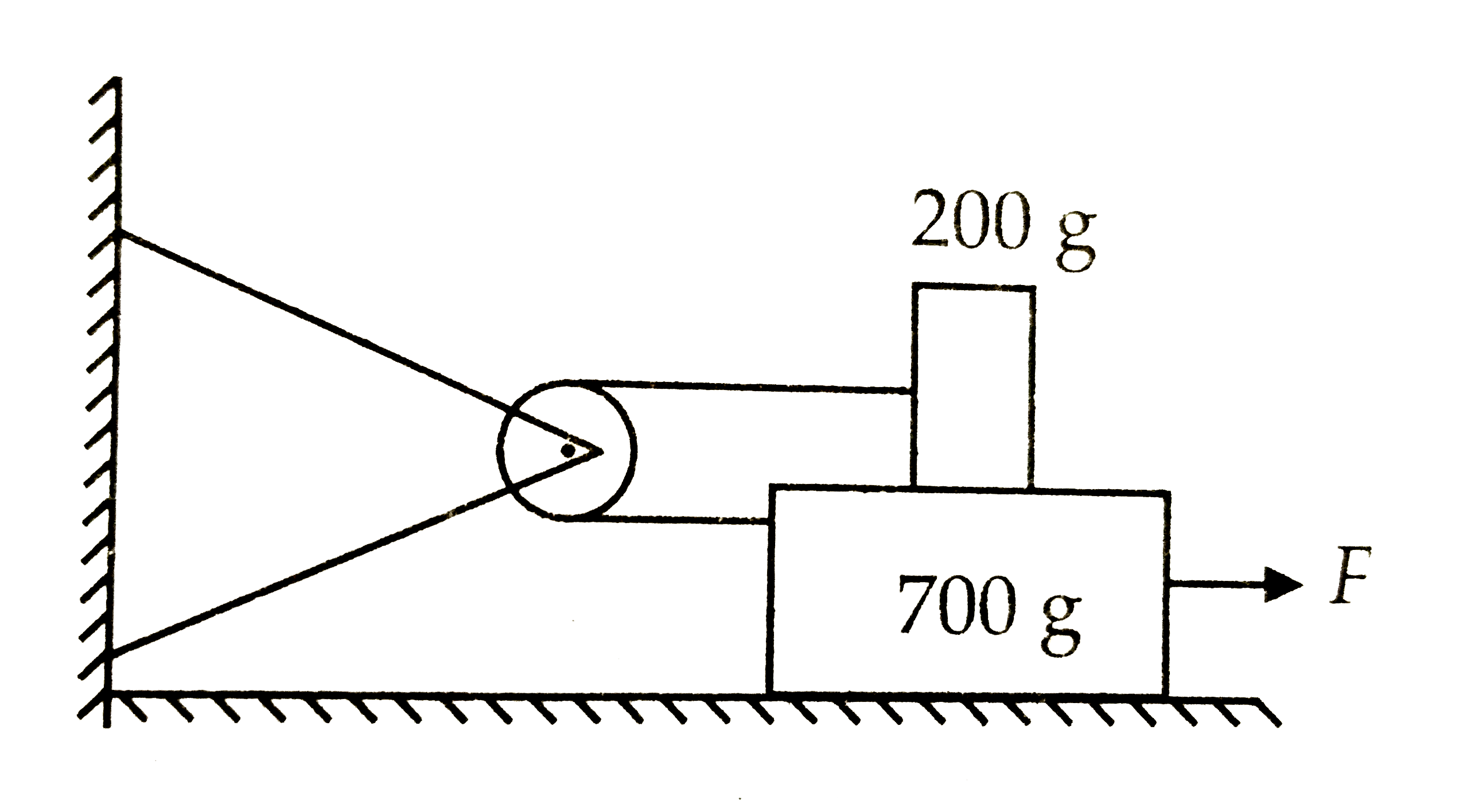
How large must F be in the figure shown ...

How large must F be in the figure shown to give the 700 g block an acceleration of `30 cm s^(-2)` ? The coefficient of friction between all surfaces is 0. 15.

Promotional Banner

Similar Questions

Explore conceptually related problems

The minimum acceleration that must be impprted to the cart in the figure so that the block A will not fall (given mu is the coefficient if friction between the surface of block and cart) is given by:

The minimum acceleration that must be impprted to the cart in the figure so that the block A will not fall (given mu is the coefficient if friction between the surface of block and cart) is given by:

A block of mass 8 kg is sliding on a surface inclined at an angle of 45^(@) with the horizontal. Calculate the acceleration of the block. The coefficient of friction between the block and surface is 0.6. (Take g=10m//s^(2) )

A block of mass 8 kg is sliding on a surface inclined at an angle of 45^(@) with the horizontal. Calculate the acceleration of the block. The coefficient of friction between the block and surface is 0.6. (Take g=10m//s^(2) )

A block of mass 8 kg is sliding on a surface inclined at an angle of 45^(@) with the horizontal . Calculate the acceleration of the block . The coefficient of friction between the block and surface is 0*6 ( Take g = 10 m//s^(2) )

A block of mass 8 kg is sliding on a surface inclined at an angle of 45^(@) with the horizontal . Calculate the acceleration of the block . The coefficient of friction between the block and surface is 0*6 ( Take g = 10 m//s^(2) )

A block of mass 4kg is placed in contact with the front vertical surface of a lorry. The coefficient of friction between the vertical surface and block is 0.8. The lorry is moving with an acceleration of 15 m//s^2 (g = 10ms^(-2)) . The force of friction between lorry and block is