

Home
Class 11
PHYSICS
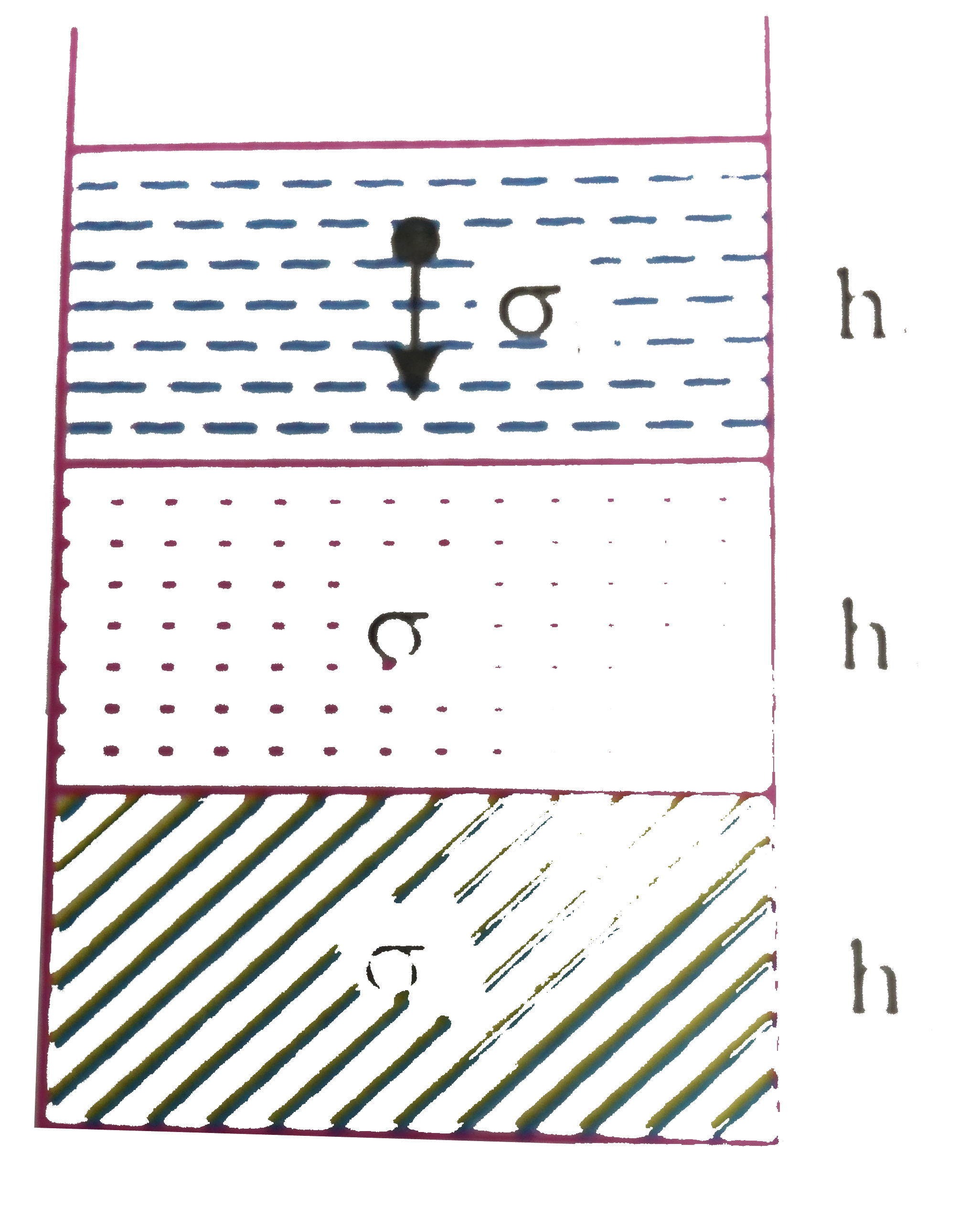
A ball moves successively through three ...


A ball moves successively through three liquids, at rest as shown, of densities `sigma_(1),sigma_(2)` and `sigma_(3)` and viscosity coefficient `eta_(1),eta_(2)` and `eta_(3)` and respectively with the same terminal velocity then

Promotional Banner

Similar Questions

Explore conceptually related problems

Two spheres P and Q of equal radii have densities rho_1 and rho_2 , respectively. The spheres are connected by a massless string and placed in liquids L_1 and L_2 of densities sigma_1 and sigma_2 and viscosities eta_1 and eta_2 , respectively. They float in equilibrium with the sphere P in L_1 and sphere Q in L_2 and the string being taut(see figure). If sphere P alone in L_2 has terminal velocity vecV_p and Q alone in L_1 has terminal velocity vecV_Q , then

Two spheres P and Q of equal radii have densities rho_1 and rho_2 , respectively. The spheres are connected by a massless string and placed in liquids L_1 and L_2 of densities sigma_1 and sigma_2 and viscosities eta_1 and eta_2 , respectively. They float in equilibrium with the sphere P in L_1 and sphere Q in L_2 and the string being taut(see figure). If sphere P alone in L_2 has terminal velocity vecV_p and Q alone in L_1 has terminal velocity vecV_Q , then

Two spheres P and Q of equal radii have densities rho_1 and rho_2 , respectively. The spheres are connected by a massless string and placed in liquids L_1 and L_2 of densities sigma_1 and sigma_2 and viscosities eta_1 and eta_2 , respectively. They float in equilibrium with the sphere P in L_1 and sphere Q in L_2 and the string being taut(see figure). If sphere P alone in L_2 has terminal velocity vecV_p and Q alone in L_1 has terminal velocity vecV_Q , then

Figure shown two infinitely large conducting plates A and B. If electric field at C due to charge densities sigma_(1), sigma_(2), sigma_(3) and sigma_(40 is E hat(i) , find sigma_(2) and sigma_(3) in terms of E. Derive a relation between sigma_(1) and sigma_(4) .

Figure shown two infinitely large conducting plates A and B. If electric field at C due to charge densities sigma_(1), sigma_(2), sigma_(3) and sigma_(40 is E hat(i) , find sigma_(2) and sigma_(3) in terms of E. State whether this much information is sufficient to find sigma_(1) and sigma_(4) in terms of E. Derive a relation between sigma_(1) and sigma_(4) .

Two liquids of densities rhp_(1) and rho_(2) coefficient of viscosity eta_(1) and eta_(2) are found to flow through a capillary tube at the same rate. What is the ration of eta_(1)//eta_(2) ?

If eta_(1) and eta_(2) are the coefficients of viscosity of two liquids, d_(1) and d_(2) their densities and t_(1) and t_(2) the flow times in Ostwald viscometer, then:

Three conducting concentric shell s A,B, and C of radius a,2a,3a are as shown in the figure.The charge on shell B is Q ..The switch S is closed.Then after closing the switch If sigma_(A),sigma_(B) and sigma_(C) are the surface charge densities on A,B and C respectively then sigma_(A):sigma(B):sigma(C) is

A block of volume V and density sigma_(b) is placed in liquid of density sigma_(1)(sigma_(1) gt sigma_(b)) , then block is moved upward upto a height h and it is still in liquid. The increase in gravitational energy of the block is :