

Home
Class 11
PHYSICS
An iron bar (L(1) = 0.1 m, A(1) = 0.02 m...

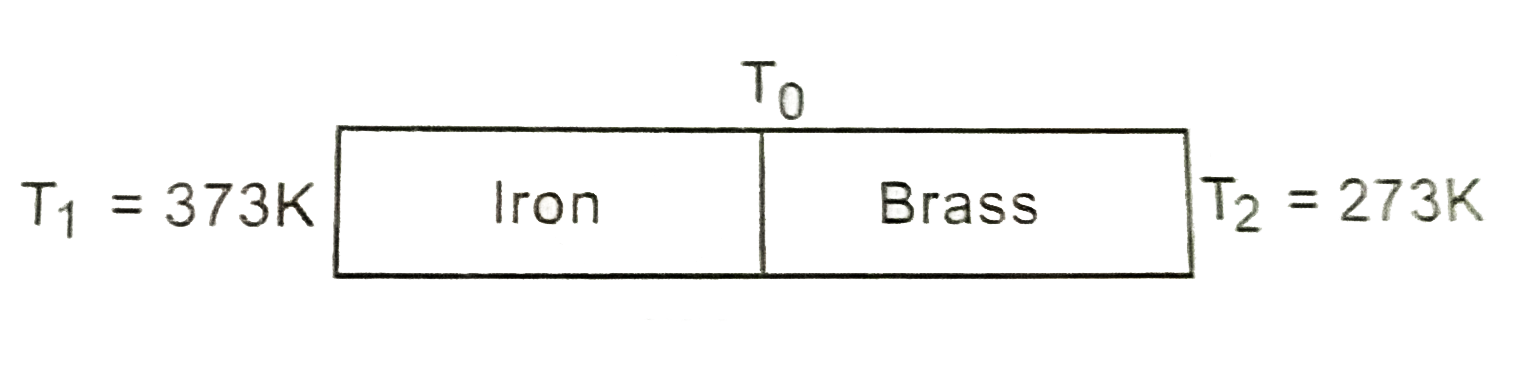
An iron bar (`L_(1) = 0.1 m, A_(1) = 0.02 m^(2) , K_(1) = 79 Wm^(-1) K^(-1)`) and a brass bar `(L_(2)=0.1 m , A_(2) = 0.02 m^(2), K_(2) = 109 Wm^(-1)K^(-1)`) are soldered end to end as shown in fig. the free ends of iron bar and brass bar are maintained at 373 K and 273 K respectively. Obtain expressions for and hence compute (i) the temperature of the juction of the two bars, (ii) the equivalent thermal conductivity of the compound bar and (iii) the heat current through the compound bar.
.

Promotional Banner

Similar Questions

Explore conceptually related problems

An iron bar (L_(1)=0.1" m",A_(1)=0.02" m"^(2),K_(1)=97" Wm"^(-1)K^(-1)) and a brass bar (L_(2)=0.1" m",A_(2)=0.02" m"^(2),K_(2)=109" W m"^(-1)K^(-1)) are soldered end to end as shown in figure. The free ends of the iron bar and brass bar are maintained at 373 K and 273 K respectively. Obtain expressions for and hence compute (i) the temperature of the junction of the two bars, (ii) the equivalent thermal conductivity of the compound bar, and (iii) the heat current through the compound bar.

An iron bar (L_(1) = 0.1 m , A_(1) = 0.02 m^(2), K_(1) = 79 W m^(-1) K^(-1)) and a brass bar (L_(2) = 0.1 m, A_(2) = 0.02 m^(2) , K_(2) = 109 W m^(-1) K^(-1)) are soldered end to end as shown in Fig. 11.16. The free ends of the iron bar and brass bar are maintained at 373 K and 273 K respectively. Obtain expressions for and hence compute (1) the temperature of the function of the two bars, (11) the equivalent thermal conductivity of the compound bar, and (111) the heat current through the compound bar.

An iron bar (L_(1) = 0.1 m , A_(1) = 0.02 m^(2), K_(1) = 79 W m^(-1) K^(-1)) and a brass bar (L_(2) = 0.1 m, A_(2) = 0.02 m^(2) , K_(2) = 109 W m^(-1) K^(-1)) are soldered end to end as shown in Fig. 11.16. The free ends of the iron bar and brass bar are maintained at 373 K and 273 K respectively. Obtain expressions for and hence compute (1) the temperature of the function of the two bars, (11) the equivalent thermal conductivity of the compound bar, and (111) the heat current through the compound bar.

An iron bar (L_(1) = 0.1 m , A_(1) = 0.02 m^(2), K_(1) = 79 W m^(-1) K^(-1)) and a brass bar (L_(2) = 0.1 m, A_(2) = 0.02 m^(2) , K_(2) = 109 W m^(-1) K^(-1)) are soldered end to end as shown in Fig. 11.16. The free ends of the iron bar and brass bar are maintained at 373 K and 273 K respectively. Obtain expressions for and hence compute (1) the temperature of the function of the two bars, (11) the equivalent thermal conductivity of the compound bar, and (111) the heat current through the compound bar.

The outer face of a rectangular slab of equal thickness of iron and brass are maintained at 100^(@)C and 0^(@)C , respectively. Find the temperature of the interface. The conductivities of iron and brass are 14 and 126 Wm^(-1) K^(-1) respectively.

Two metal rods made up of iron (K_1=79Wm^(-1)K^(-1)) and brass (K_2=109Wm^(-1)K^(-1)) are of identical shape and size. These are fused at the junction. If the temperature at the free end of iron is at a steam point and brass at ice point then calculate the temperature at the junction, when the steady state is attained.

An iron plate 10^(-5) m^(2) area, 4 xx 10^(-3) m thick has its opposite faces maintained at 373 K and 223 K respectively. How much heat flows through the plate per second ? Thermal conductivity of iron = 80 "Wm"^(-1) "K"^(-1) .

Two bars of same length and same cross-sectional area but of different thermal conductivites K_(1) and K_(2) are joined end to end as shown in the figure. One end of the compound bar it is at temperature T_(1) and the opposite end at temperature T_(2) (where T_(1) gt T_(2) ). The temperature of the junction is

Two bars of same length and same cross-sectional area but of different thermal conductivites K_(1) and K_(2) are joined end to end as shown in the figure. One end of the compound bar it is at temperature T_(1) and the opposite end at temperature T_(2) (where T_(1) gt T_(2) ). The temperature of the junction is

If L_(1) = (2.02 +- 0.01)m and L_(2) = (1.02 +- 0.01)m then L_(1) + 2L_(2) is (in m)