

Home
Class 11
PHYSICS
In the arrangement shown in figure m(1)=...

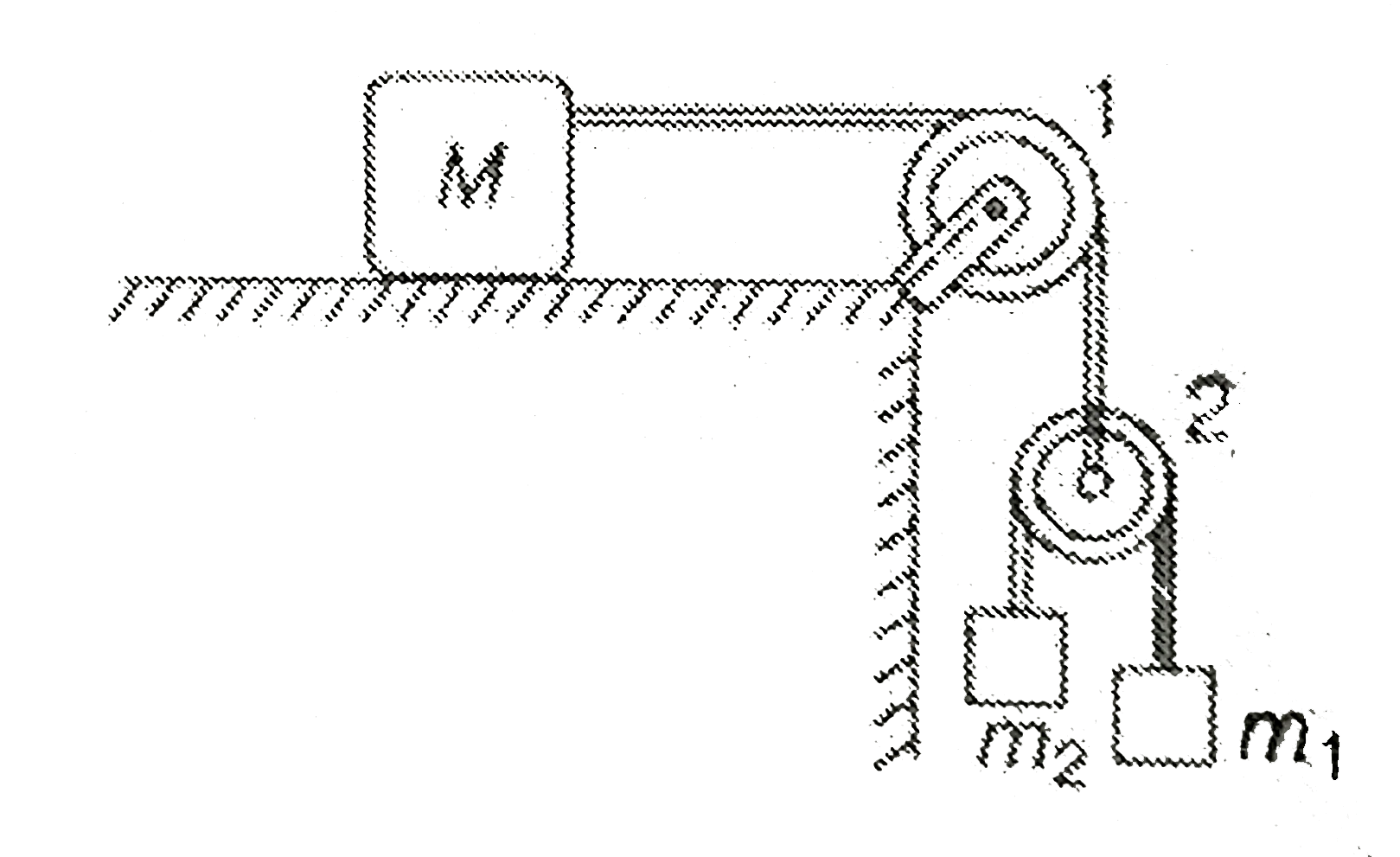
In the arrangement shown in figure `m_(1)=1kg, m_(2)=2kg`, pullyes are massless and strings are light. For what value of M the mass `m_(1)` moves with constant velocity? (Neglect friction)

Promotional Banner

Similar Questions

Explore conceptually related problems

In the arrangement shown in fig. m_(1)=1kg, m_(2)=2 kg . Pulleys are massless and strings are light. For what value of M, the mass m_(1) moves with constant velocity.

In the arrangement shown in fig. m_(1)=1kg, m_(2)=2 kg . Pulleys are massless and strings are light. For what value of M, the mass m_(1) moves with constant velocity.

In the arrangement shown in fig m_(1)=1kg, m_(2)=2 kg Pulleys are massless and string are light. For what value of M the mass m_(1) moves with constant velocity (neglect friction):

In the arrangment as shown below m_(1) = 1 kg, m_(2) = 2 kg . Pulleys are massless and strings are light . For what value of M the mass m_(1) moves with constant velocity . ( Neglect Friction)

In the arrangment as shown below m_(1) = 1 kg, m_(2) = 2 kg . Pulleys are massless and strings are light . For what value of M the mass m_(1) moves with constant velocity . ( Neglect Friction)

In the system shown in figure m_(B)=4kg , and m_(A)=2kg . The pulleys are massless and friction is absent everywhere. The acceleration of block A is.

In the arrangement shown in Figure, m_A=2kg and m_B=1kg . String is light and inextensible. Find the acceleration of centre of mass of both the blocks. Neglect friction everywhere.

In the arrangement shown in Figure, m_A=2kg and m_B=1kg . String is light and inextensible. Find the acceleration of centre of mass of both the blocks. Neglect friction everywhere.

In the arrangement shown in Figure, m_A=2kg and m_B=1kg . String is light and inextensible. Find the acceleration of centre of mass of both the blocks. Neglect friction everywhere.