Home
Class 10
PHYSICS
Write laws of refraction. Explain the sa...

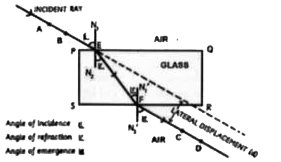
Write laws of refraction. Explain the same with the help of ray diagram, when a ray of light passes through a rectangular glass slab.

Text Solution

Verified by Experts
Refraction of light occurs according to certain laws called the Snell.s laws of refraction.
Law 1 : The incident ray, the refracted ray and the normal at the point of incident, at the interface of the two transparent media, all lie in the same plane.
Law 2 : The ratio of sine of angle of incidence (sin i) to the sine of angle of refraction (sin r) is a constant, for the light of a given colour and for the given pair of media. This is true for angle `0^(@)lt i lt 90^(@)`.
`(sin i)/(sin r)` = constant `= mu`
This constant value `(mu)` is called the refractive index of the second medium with respect to the first.

Explanation :
(i) When the light ray (incident ray AE), travels from air to glass (rarer to denser medium) ,
• The refracted ray EF bends towards the normal `N_(1) N_(2)`.
• Angle of incidence `angle AEN_(1) gt` Angle of refraction `angle N_(2)EF`
(ii) When the light ray EF travels inside the glass slab :
The ray EF travels in a straight line. There is no refraction as there is no change in media here.
• The ray EF strikes the surface SR of the slab at F
• `angle N_(2)EF = angle EFN_(1)`. [Consider `N_(2)N_(1)` and `N_(2).N_(1).` as two parallel lines and EF as the transversal, Interior alternate angles are equal].
(iii) When the incident light ray EF travels from glass to air, (denser to rarer medium),
• The refracted ray FD bends away from the normal `N_(1). N_(2).`.
• The refracted ray FD is also called emergent ray as it is emerging out of the glass slab.
• Angle of incidence `angle EFN_(1). angle` Angle of refraction `angle N_(2).FD` as the light ray is moving from rarer to denser medium.
(iv) if there was no glass slab, the ray AE would have continued in the direction shown by the dotted line, which is the original path of the light ray in the absence of the second medium.
(v) The light ray FD emerging out of the glass slab is at a distance of .d. from the dotted line AE. .d. is called as lateral displacement or leteral shift.
Promotional Banner

Topper's Solved these Questions

  • LIGHT - REFLECTION AND REFRACTION

    ZEN PUBLICATION|Exercise ZEN ADDITIONAL QUESTIONS SECTION (SHORT ANSWER [SA] TYPE - II QUESTIONS)|34 Videos
  • ELECTRICITY

    ZEN PUBLICATION|Exercise ZEN ADDITIONAL QUESTIONS SECTION (MULTIPLE CHOICE QUESTIONS)|60 Videos
  • MAGNETIC EFFECTS OF ELECTRIC CURRENT

    ZEN PUBLICATION|Exercise Additional question section (Higher-order thinking skills [HOTS] questions)|20 Videos

Similar Questions

Explore conceptually related problems

Draw the ray diagram to show the refraction of light through a prism.

Derive the expression for lateral shift produced when a ray of light passes through a parallel sided slab.

List down the factors on which the lateral displacement of a light ray which emerges out from a rectangular glass slab depends.

When light passes through a nicol prism, the extraordinary ray is

A glass prism is immersed in water. A ray of light passing through it,

A glass prism produces a spectrum when white light passes through it but a glass slab does not do so. Explain.

ZEN PUBLICATION-LIGHT - REFLECTION AND REFRACTION-ZEN ADDITIONAL QUESTIONS SECTION (LONG ANSWER [LA] QUESTIONS)
  1. Draw ray diagrams showing the image formation by a concave mirror when...

    Text Solution

    |

  2. Draw ray diagrams showing the image formation by a convex lens when an...

    Text Solution

    |

  3. Write laws of refraction. Explain the same with the help of ray diagra...

    Text Solution

    |

  4. Draw ray diagram showing the image formation by a concave lens when an...

    Text Solution

    |

  5. Draw ray diagrams showing the image formation by a convex mirror when ...

    Text Solution

    |

  6. Suppose you have three concave mirrors A, B, C of focal lengths 10 cm,...

    Text Solution

    |

  7. If the image formed by a spherical mirror for all positions of the obj...

    Text Solution

    |

  8. Where is this mirror used and why ?

    Text Solution

    |

  9. Define the radius of curvature of a spherical mirror. Find the nature ...

    Text Solution

    |

  10. Analyse the observation table which shows variation of image distance ...

    Text Solution

    |

  11. To find the image - distance for varying object - distance in the case...

    Text Solution

    |

  12. A student wants to project the image of a candle flame on a screen 48 ...

    Text Solution

    |

  13. The image of an object formed by a mirror is real, inverted and is of ...

    Text Solution

    |

  14. An object placed between the pole and focus of a concave mirror produc...

    Text Solution

    |

  15. What is meant by power of a lens ? You have three lenses A, B, C of po...

    Text Solution

    |

  16. Draw ray diagrams showing the image formation by a concave mirror when...

    Text Solution

    |

  17. Draw ray diagrams showing the image formation by a convex lens when an...

    Text Solution

    |

  18. Write laws of refraction. Explain the same with the help of ray diagra...

    Text Solution

    |

  19. Draw ray diagram showing the image formation by a concave lens when an...

    Text Solution

    |

  20. Draw ray diagrams showing the image formation by a convex mirror when ...

    Text Solution

    |

