

Home
Class 11
PHYSICS
A block of mass 1kg is placed on a rough...

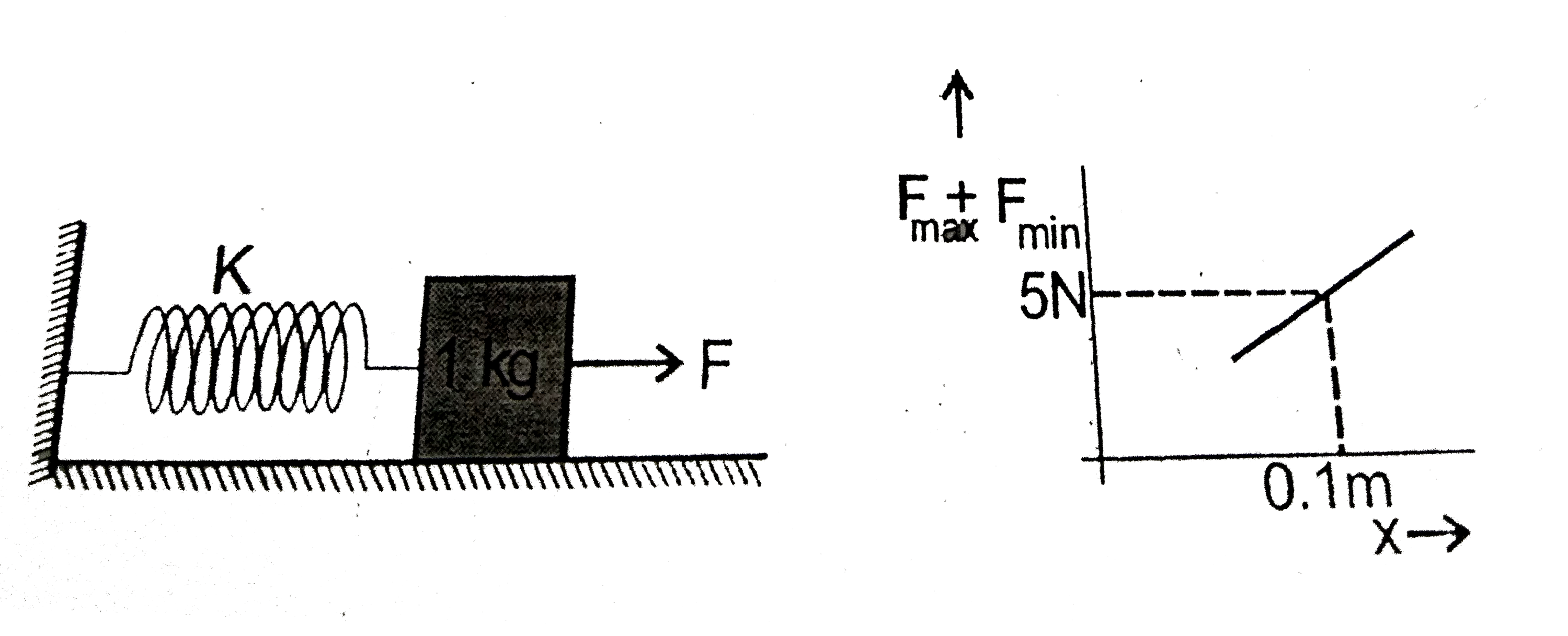
A block of mass `1kg `is placed on a rough horizontal surface. A spring is attached to the block whose other end is joined to a rigid wall, as shown in the figure. A horizontal force is applied on the block so that it remains at rest while the spring is elongated by `x(x ge (mumg)/(k))`. Let `F_(max)` and `F_(mi n)` be the maximum and minimum values of force `F` for which the block remains in equilibrium. For a particular `x, F_(max)-F_(mi n)=2N`. Also shown is the variation of `F_(max)+F_(mi n)` versus `x`, the elongation of the spring.

The coefficient of friction between the block and the horizontal surface is `:`

Promotional Banner

Similar Questions

Explore conceptually related problems

A block of mass 1kg is placed on a rough horizontal surface. A spring is attached to the block whose other end is joined to a rigid wall, as shown in the figure. A horizontal force is applied on the block so that it remains at rest while the spring is elongated by x(x ge (mumg)/(k)) . Let F_(max) and F_(mi n) be the maximum and minimum values of force F for which the block remains in equilibrium. For a particular x, F_(max)-F_(mi n)=2N . Also shown is the variation of F_(max)+F_(mi n) versus x , the elongation of the spring. The value of F_(mi n) , if x=3cm is :

A block of mass 1kg is placed on a rough horizontal surface. A spring is attached to the block whose other end is joined to a rigid wall, as shown in the figure. A horizontal force is applied on the block so that it remains at rest while the spring is elongated by x(x ge (mumg)/(k)) . Let F_(max) and F_(mi n) be the maximum and minimum values of force F for which the block remains in equilibrium. For a particular x, F_(max)-F_(mi n)=2N . Also shown is the variation of F_(max)+F_(mi n) versus x , the elongation of the spring. The value of F_(mi n) , if x=3cm is :

A block of mass 1kg is placed on a rough horizontal surface. A spring is attached to the block whose other end is joined to a rigid wall, as shown in the figure. A horizontal force is applied on the block so that it remains at rest while the spring is elongated by x(xge(mumg)/(k)) . Let F_(max) and F_(mi n) be the maximum and minimum values of force F for which the block remains in equilibrium. For a particular x, F_(max)-F_(mi n)=2N . Also shown is the variation of F_(max)+F_(mi n) versus x , the elongation of the spring. The spring constant of the spring is :

A block of mass 1kg is placed on a rough horizontal surface. A spring is attached to the block whose other end is joined to a rigid wall, as shown in the figure. A horizontal force is applied on the block so that it remains at rest while the spring is elongated by x(xge(mumg)/(k)) . Let F_(max) and F_(mi n) be the maximum and minimum values of force F for which the block remains in equilibrium. For a particular x, F_(max)-F_(mi n)=2N . Also shown is the variation of F_(max)+F_(mi n) versus x , the elongation of the spring. The spring constant of the spring is :

A block is placed on a smooth inclined plane as shown . For what value of horizontal force F, the block will remain at rest ?

A block is placed on a smooth inclined plane as shown . For what value of horizontal force F, the block will remain at rest ?

A block of unknown mass is at rest on a rough, horizontal surface. A horizontal force F is applied to the block. The graph in the figure shows the acceleration of the block with respect to the applied force. The mass of the block is

A block of unknown mass is at rest on a rough, horizontal surface. A horizontal force F is applied to the block. The graph in the figure shows the acceleration of the block with respect to the applied force. The mass of the block is

A cubical block of side .L. rests on a rough horizontal surface with coefficient of friction mu . A horizontal force F is applied on the block as shown in figure. The minimum force required to topple the block is