

Home
Class 12
PHYSICS
A laser beam propagates through a spheri...

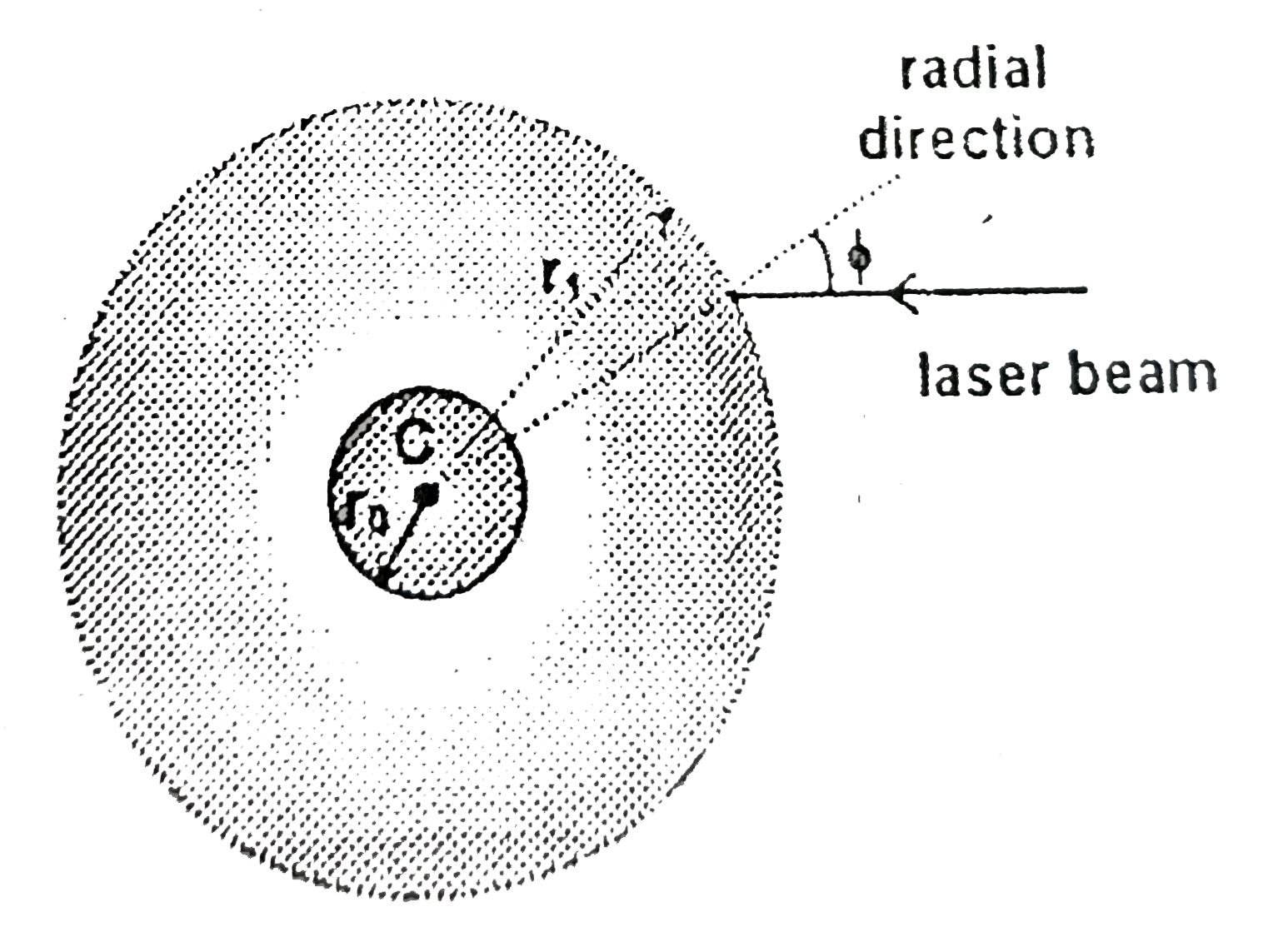
A laser beam propagates through a spherically symmetric medium, as shown in the figure. The refractive index varies with the distance to the symmetry centre `C` by the law `mu(r )=mu_(0)(r )/(r_(0))`, where `mu_(0)=1`, `r_(0)=3cm`, `r_(0) le r lt oo`. The beam's trajectory lies in the plane that includes `C`. At distance `r_(1)=8sqrt(2)cm` the beam makes an angle `phi=30^(@)` with `vecr_(1)` as shown in the figure. Find the minimum distance (in `cm`) the beam reach relative to the symmetry centre `C`.

Promotional Banner

Similar Questions

Explore conceptually related problems

Draw a graph of electric field E(r) with distance r from the centre of the shell for 0 le r le 0 .

A narrow parallel beam of light falls on a glass sphere of radius R and refractive index mu at normal incidence. The distance of the image from the outer edge is given by-

A cyclist rides along the circular path of a circular horizontal plane of radius R, the firctional coefficient being dependent only on distance r from the centre O of the plane as mu = mu_(0) (1 - (r )/(R )) , where mu_(0) is a constant. What is the cyclist's maximum velocity ?

A cyclist rides along the circular path of a circular horizontal plane of radius R, the firctional coefficient being dependent only on distance r from the centre O of the plane as mu = mu_(0) (1 - (r )/(R )) , where mu_(0) is a constant. Find the radius of the circle such that the cyclist can ride with the maximum velocity.

The refractive index of an anisotropic medium varies as mu=mu_(0)sqrt((x+1)) , where 0lexlea . A ray of light is incident at the origin just along y-axis (shown in figure). Find the equation of ray in the medium .

A current I is flowing through the loop. The direction of the current and the shape of the loop are as shown in the figure. The magnetic field at the centre of the loop is (mu_(0)I)/(R ) (MA=R,MB=2R,angleDMA=90^(@))

The resistance t R of a conductor varies with temperature t as shown in the figure. If the variation is represented by R_(t) = R_(0)[1+ alphat +betat^(2)] , then