

Home
Class 11
PHYSICS
The axle of a pulley of mass 1 kg is att...

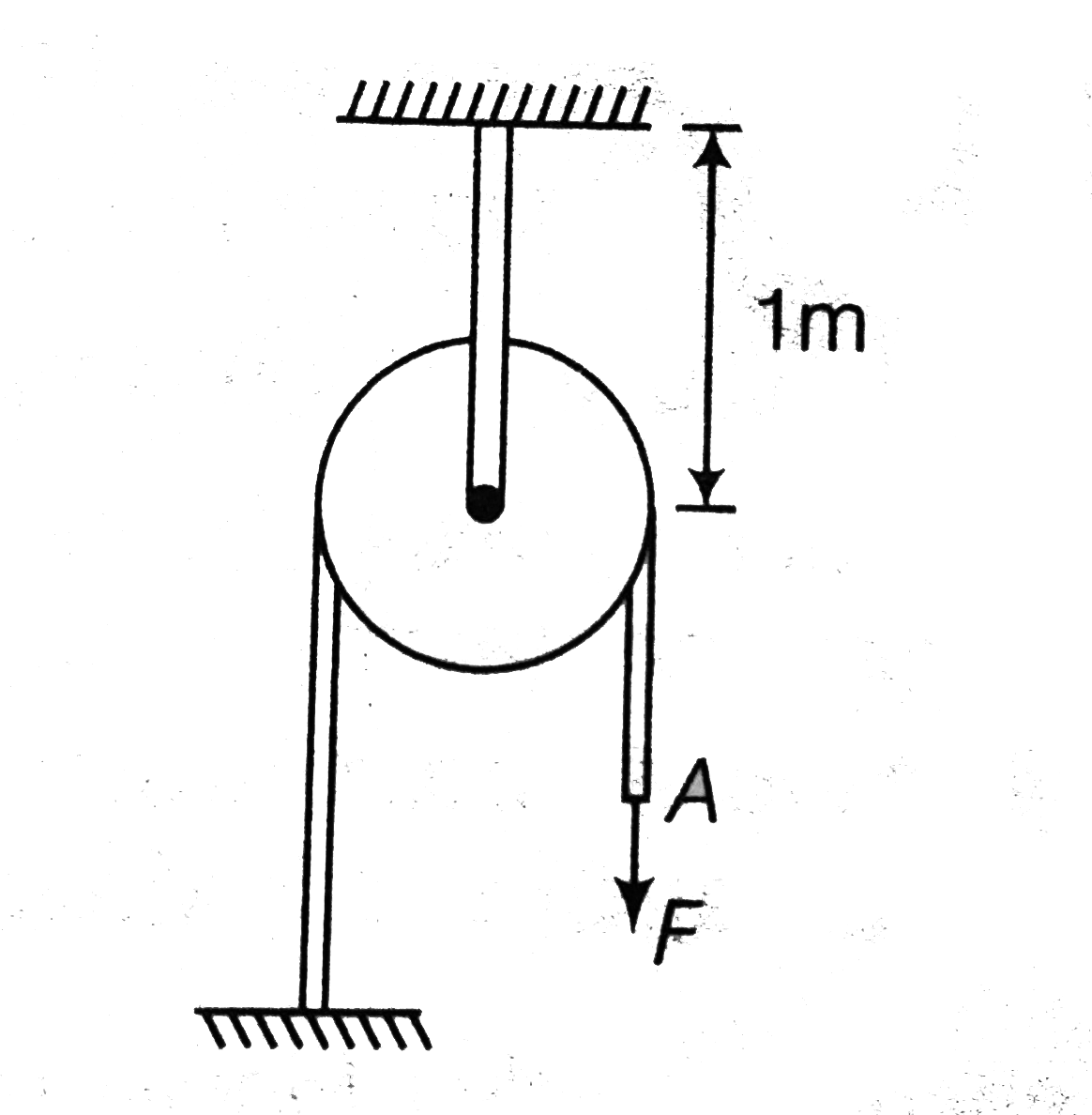
The axle of a pulley of mass `1 kg` is attached to the end of an elastic string of length `1m`, cross- sectional area `10^(-3) m^(2)` and young's modulus `2xx10^(5) Nm^(-2) `,whose other end is fixed to the ceiling. A rope of negligible mass is placed on the pulley such that its left end is fixed to the ground and its right end is hanging freely , from the pulley which is at rest in equilibrium . Now, the rope and the pulley can be neglected. (Given, `g = 10 ms^(-2)`)

The elongation of the string before applying force is

Promotional Banner

Similar Questions

Explore conceptually related problems

An iron rod of length 2m and cross section area of 50 mm^(2) , stretched by 0.5 mm, when a mass 250 kg is hung from its lower end. Young's modulus of the iron rod is

One end of a long metallic wire of length L, area of cross-section A and Young's modulus Y is tied to the ceiling. The other end is tied to a massless spring of force constant k and a mass m is hung from the free end of the spring. If m is slightly pulled down and released, then its time period of oscillation is

A metal wire of negligible mass, length 1 m and cross-sectional area 10^(-6) m^(2) is kept on a smooth horizontal table with one end fixed on the table. A ball of mass 2kg is attached to the other end of the wire. When the wire and the ball are rotated with angular velocity of 20 rad/s, it is found that the wire is elongated by 10^(-3)m . If the Young's modulus of the metal is n xx 10^(11) N//m^(2) , then the value of n is

One end of a string of length L and cross sectional area A is fixed to a support and the other end is fixed to a bob of mas m. The bob is revolved in a horizontal circle of radius r with an angular velocity omega such that the string makes an angle theta with the vertical. Young's modulus is Y. The increase DeltaL in length of the string is

A pulley fixed to the ceiling carried a thread with bodies of masses m_(1) and m_(2) attached to its ends. The mases of the pulley and the thread are negligible and friction is absent. Find the acceleration of the centre of mass of this system.

A pulley fixed to the ceiling carries a thread with bodies of masses m_1 and m_2 attached to its ends. The masses of the pulley and the thread are negligible, friction is absent. Find the acceleration w_C of the centre of inertia of this system.