

Home
Class 12
PHYSICS
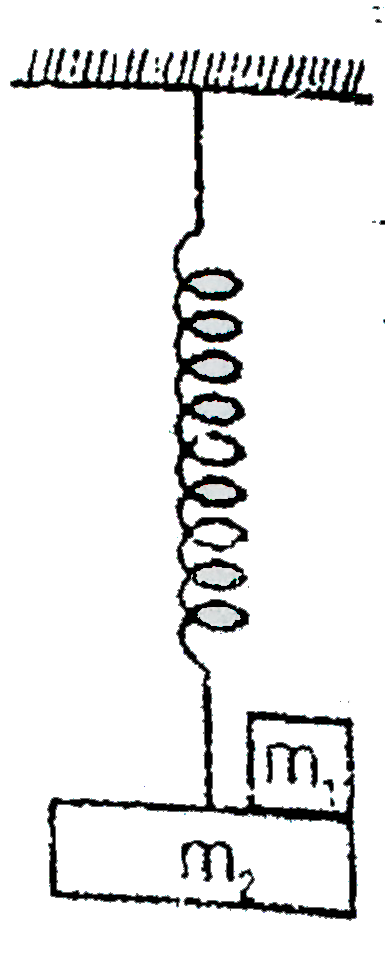
The system is in equilibrium and at rest...

The system is in equilibrium and at rest. Now mass `m_(1)` is removed from `m_(2)`. Find the time period and amplituded of resultant motion. Spring constant is `K`.

Promotional Banner

Similar Questions

Explore conceptually related problems

The system is in equilibrium and at rest. Now mass m1 is removed from m2 . Find the time period and amplitude of resultant motion. (Given : spring constant is K.)

Block of mass m_(2) is in equilibrium as shown in figure. Anotherblock of mass m_(1) is kept gently on m_(2) . Find the time period of oscillation and amplitude.

Block of mass m_(2) is in equilibrium as shown in figure. Anotherblock of mass m_(1) is kept gently on m_(2) . Find the time period of oscillation and amplitude.

Block of mass m_(2) is in equilibrium as shown in figure. Anotherblock of mass m_(1) is kept gently on m_(2) . Find the time period of oscillation and amplitude.

A horizontal spring block system of mass M executes simple harmonic motion. When the block is passing through its equilibrium position, an object of mass m is put on it and the two move together. Find the new amplitude and frequency of vibration. Given, k is the spring constant of the system.

A horizontal spring block system of mass M executes simple haormonic motion. When the block is passing through its equilibrium position, an object of mass m is put on it and the two move together. Find the new amplitude and frequency of vibration. Given, k is the spring constant of the system.

Find the time period of oscillation of block of mass m. Spring, and pulley are ideal. Spring constant is k.

Find the time period of oscillation of block of mass m. Spring, and pulley are ideal. Spring constant is k.

Two blocks of mass m_(1) and m_(2) are connected with a spring of natural length l and spring constant k. The system is lying on a smooth horizontal surface. Initially spring is compressed by x_(0) as shown in figure. Show that the two blocks will perform SHM about their equilibrium position. Also (a) find the time period, (b) find amplitude of each block and (c) length of spring as a function of time.