

Home
Class 11
PHYSICS
A horizontal plane supports a plank with...

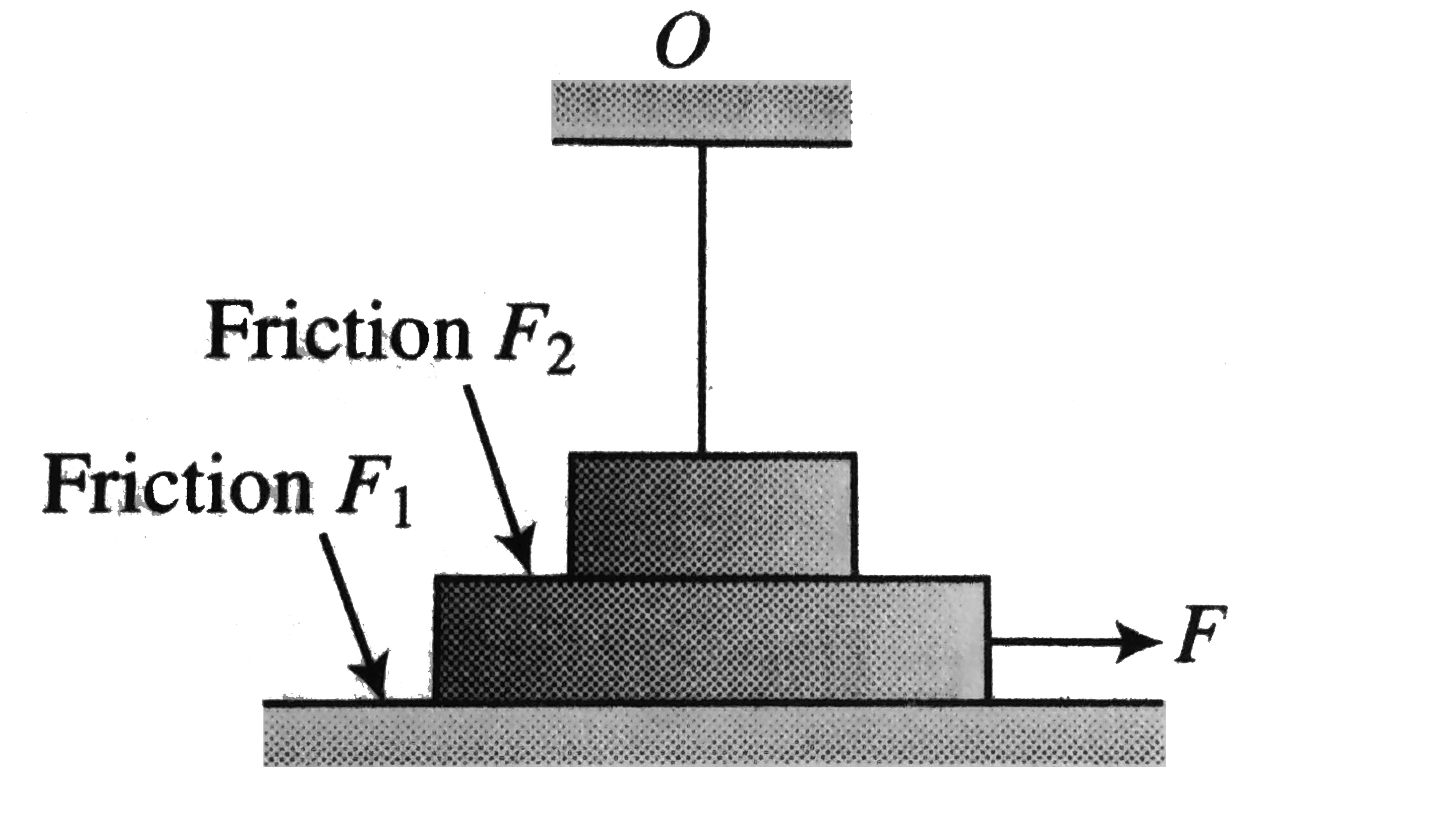
A horizontal plane supports a plank with a block placed on it. A light elastic string is attached to the block, which is attached to a fixed point O. Initially, the cord is unstretched and vertical. The plank is slowly shifted to right until the block starts sliding over it. It occurs at the moment when the cord deviates from vertical by an angle `theta=0^@`. Work done by the force F equals

Promotional Banner

Similar Questions

Explore conceptually related problems

A horizontal plane supports a plank with a bar of mass m placed on it and attached by a light elastic non-deformed cord of length l_0 , to a point O. The coefficient of friciton between the bar and the plank is equal to m . The plank is slowly shifted to the right until the bar starts sliding over it. It occurs at the moment when the cord derivates from the vertical by an angle theta . Find the work that has been performed by the moment by the frictional force acting on the bar in the reference frame fixed to the plane.

A horizontal plane supports a plank with a bar of mass m placed on it and attached by a light elastic non-deformed cord of length l_0 , to a point O. The coefficient of friciton between the bar and the plank is equal to m . The plank is slowly shifted to the right until the bar starts sliding over it. It occurs at the moment when the cord derivates from the vertical by an angle theta . Find the work that has been performed by the moment by the frictional force acting on the bar in the reference frame fixed to the plane.

A horizontal plane supports a plank with a bar of mass m=1.0kg placed on it and attached by a light elastic non-deformed cord of length l_0=40cm to a point O(figure). The coefficient of friction between the bar and the plank equals k=0.20 . The plank is slowly shifted to the right until the bar starts sliding over it. It occurs at the moment when the cord deviates from the vertical by an angle theta=30^@ . Find the work that has been performed by that moment by the friction force acting on the bar in the reference frame fixed to the plane.

Asseration : A plank A is placed on a rough surface over which a block B is placed. In the shown situation, elastic cord is unstretched. Now a gradually increasing force F is appled slowly on A until the relative motion between the block and plank starts. . At this moment cord is making an angle theta with the vertical. Work done by force F is equal to energy lost against fricton f_(2) , plus potential energy stored in the cord. Reason : work done by static friction f_(1) on the system as a whole is zero.

Asseration : A plank A is placed on a rough surface over which a block B is placed. In the shown situation, elastic cord is unstretched. Now a gradually increasing force F is appled slowly on A until the relative motion between the block and plank starts. . At this moment cord is making an angle theta with the vertical. Work done by force F is equal to energy lost against fricton f_(2) , plus potential energy stored in the cord. Reason : work done by static friction f_(1) on the system as a whole is zero.

A block is placed on a rough horizontal plane attached with an elastic spring as shown in the figure. Initially spring is unstretched. If the plane is now gradually lifted from 0^(@) to 90^(@) , then the graph showing extension in the spring (x) versus angle (theta) is

A horizontal plank has a rectangular block placed on it. The plank starts oscillating vertically and simple harmonically with an amplitude of 40 cm. The block just loses contact with the plank when the latter is at momentary rest Then.

A horizontal plank has a rectangular block placed on it. The plank starts oscillating vertically and simple harmonically with an amplitude of 40 cm. The block just loses contact with the plank when the latter is at momentary rest Then.