

Home
Class 11
PHYSICS
In the figure shown S is a large noncond...

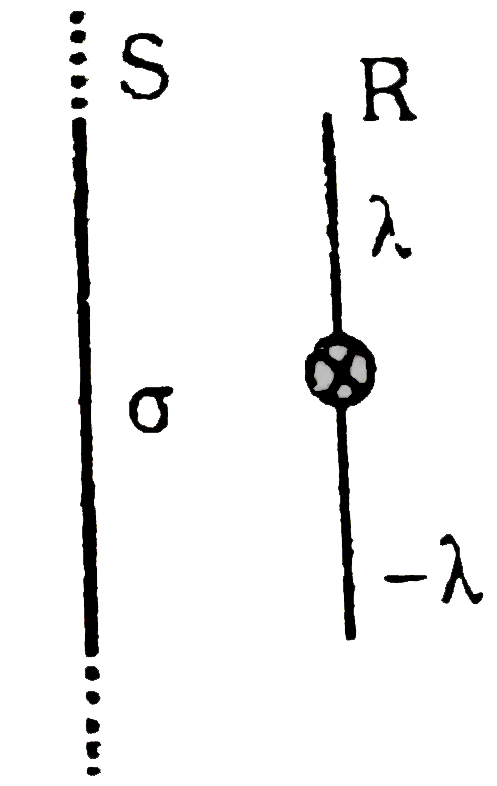
In the figure shown S is a large nonconducting sheet of uniform charge density `sigma`. A rod R of length `l` and mass 'm' is parallel to the sheet and hinged at its mid point. The linear charge densities on the upper and lower half of the rod are shown in the figure. Find the angular acceleration of the rod just after it is released.

Promotional Banner

Similar Questions

Explore conceptually related problems

In the figure shown S is a large nonconducting sheet of uniform charge density sigma . A rod R of length l and mass 'm' is parallel to the sheet and hinged at its point. The linear charge densities on the upper and lower half of the rod are shown in the figure. Find the angular acceleration of the rod just after it is released [(3sigmalambda)/(2m in_(0))]

Two infinite nonconducting sheets of uniform charge density (+delta) and (-delta) are parallel to each other as shown. Electric field at the

A large nonconducting sheet M is given a uniform charge density. Two unchared small metal rods A and B are placed near the sheet as shown in figure

A large nonconducting sheet M is given a uniform charge density. Two unchared small metal rods A and B are placed near the sheet as shown in figure

A large nonconducting sheet M is given a uniform charge density. Two unchared small metal rods A and B are placed near the sheet as shown in figure

A large nonconducting sheet M is given a uniform charge density. Two unchared small metal rods A and B are placed near the sheet as shown in figure

A uniform rod of mass m length l is attached to smooth hinge at end A and to a string at end B as shown in figure. It is at rest. The angular acceleration of the rod just after the string is cut is :

A uniform rod of mass m length l is attached to smooth hinge at end A and to a string at end B as shown in figure. It is at rest. The angular acceleration of the rod just after the string is cut is :

Two infinite sheets of unifrom charge density +sigma and -sigma are parallel to each other as shown in the figure. Electric field at the