

Home
Class 11
PHYSICS
A uniform disc of mass m and radius R is...


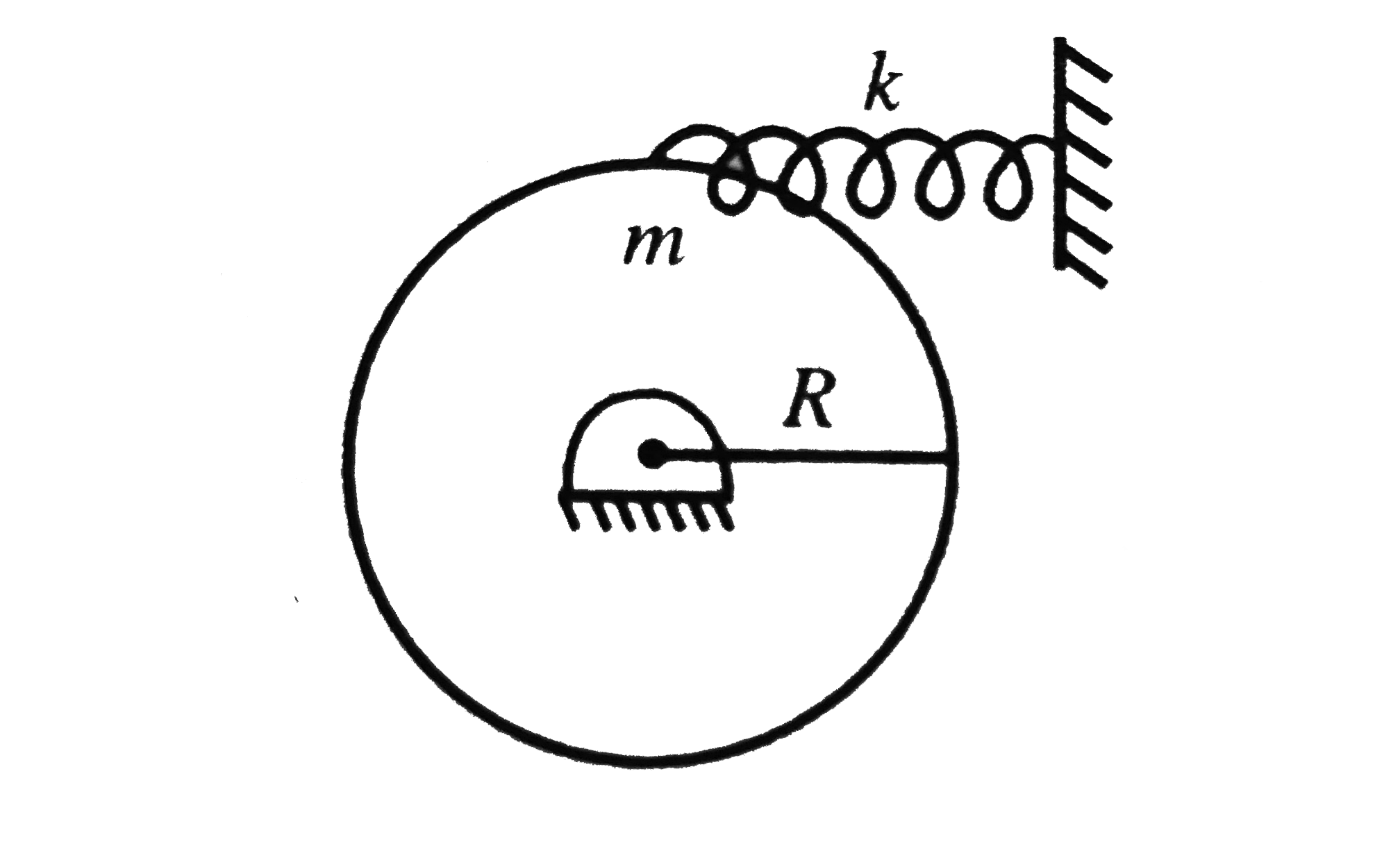
A uniform disc of mass `m` and radius `R` is pivoted smoothly at its centre of mass. A light spring of stiffness `k` is attached with the dics tangentially as shown in the Fig. Find the angular frequency in `(rad)/(s)` of torsional oscillation of the disc. (Take `m=5kg` and `K=10(N)/(m)`.)

Promotional Banner

Similar Questions

Explore conceptually related problems

A uniform disc of mass M and radius R is hinged at its centre C . A force F is applied on the disc as shown . At this instant , angular acceleration of the disc is

A uniform disc of mass M and radius R is hinged at its centre C . A force F is applied on the disc as shown . At this instant , angular acceleration of the disc is

A disc of mass M = 4 kg, radius R = 1 m is attached with two blocks A and B of masses 1 kg and 2 kg respectively on rim and is resting on a horizontal surface as shown in the figure. Find angular frequency of small oscillation of arrangement:

A uniform disc of mass M and radius R is hinged at its centre C. A force F is applied on the disc as shown. At this instant, the angular acceleration of the disc is

A uniform cylinder of mass m and radius R is in equilibrium on an inclined plane by the action of a light spring of stiffness k , gravity and reaction force acting on it. If the angle of inclination of the plane is phi , then angular frequency of small oscillations of the cylinder is...........

A disk of mass m is connected to two springs of stiffness k_(1) and k_(2) as shown in the figure. Find the angular frequency of the system for small oscillation. Disc can roll on the surface without slipping

A uniform disc of mass M and radius R is pivoted about the horizontal axis through its centre C A point mass m is glued to the disc at its rim, as shown in figure. If the system is released from rest, find the angular velocity of the disc when m reaches the bottom point B.

A uniform disc of mass M and radius R is pivoted about the horizontal axis through its centre C A point mass m is glued to the disc at its rim, as shown in figure. If the system is released from rest, find the angular velocity of the disc when m reaches the bottom point B.