

Home
Class 11
PHYSICS
Two inclined planes AB and BC are at inc...

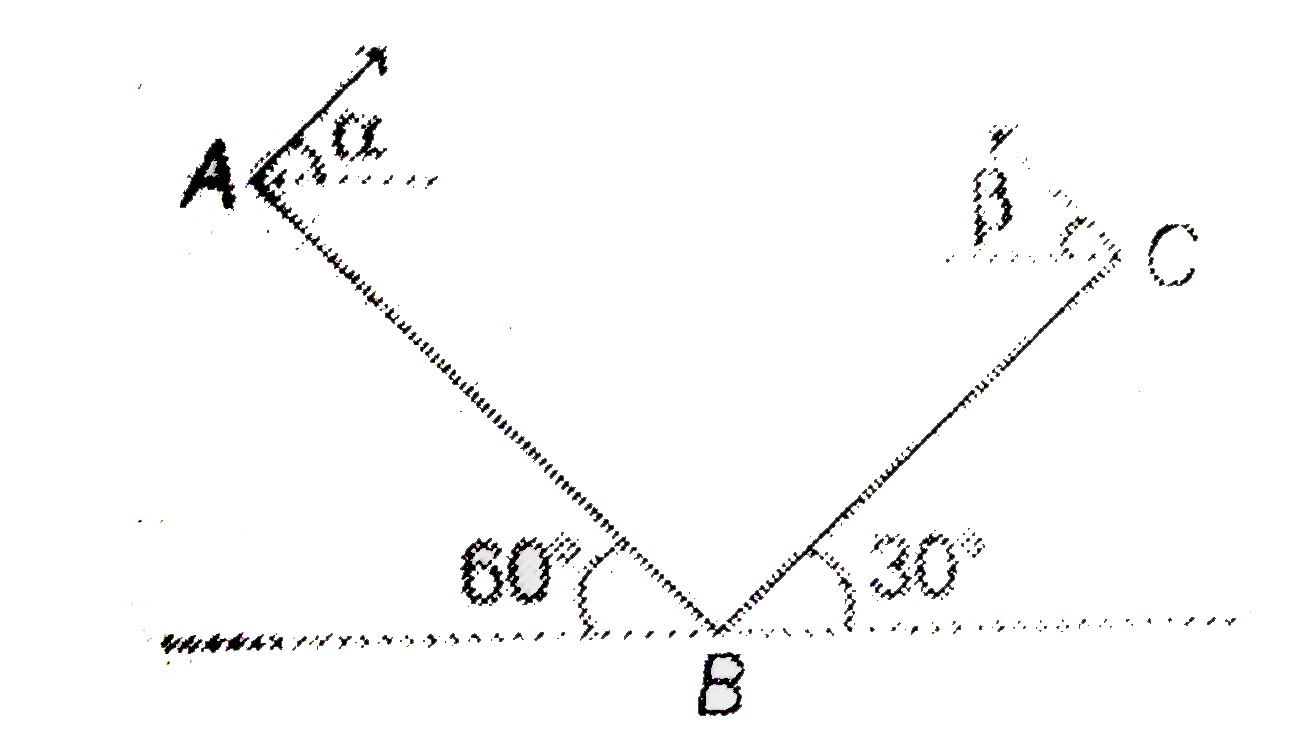
Two inclined planes `AB` and `BC` are at inclinations of `60^(@)` and `30^(@)` as shown in the figure. The two projectiles are thrown simultaneously from `A` and `C` with speed `2m//s` and `v_(0)` respectively. They strike at `B` with same speed. If length of `AB` is `1/(sqrt(3))m`and `BC` is `1m,` then find the value of `v_(0)` ( in m/s)

Promotional Banner

Similar Questions

Explore conceptually related problems

Two lines AB and CD intersect at O at an inclination alpha , as shown in figure. If they move out parallel to themselves with the speed v, find the speed of O.

Two particles A and B are projected simultaneously in the direction shown in the figure with velocities V_(A)=20m//s and V_(B)=10m//s respectively. If they collide in air after 1/2 sec. then

Two particles are projected with speed 4m//s and 3m//s simultaneously from same point as shown in the figure. Then:

Two particles are projected with speed 4m//s and 3m//s simultaneously from same point as shown in the figure. Then:

Two particles are projected with speed 4 m//s and 3 m//s simultaneously from same point as shown in the figure. Then :

Two particles A and B are projected simultaneously in the directins shown in figure with velocities v_(A) = 20 m//s and v_(B) = 10 m//s respectively. They collide in air after 1/2 s. Find (a) the angle theta (b) the distance x. .

Two particles A and B are projected simultaneously in the directins shown in figure with velocities v_(A) = 20 m//s and v_(B) = 10 m//s respectively. They collide in air after 1/2 s. Find (a) the angle theta (b) the distance x. .

Two particles A and B are projected simultaneously in the directins shown in figure with velocities v_(A) = 20 m//s and v_(B) = 10 m//s respectively. They collide in air after 1/2 s. Find (a) the angle theta (b) the distance x.

Two particles A and B of masses m_(A) and m_(B) respectively and having the same charge are moving in a plane . The speeds of the particles are v_(A) and v_(B) respectively and the trajectories are as shown in the figure. Then