

Home
Class 12
PHYSICS
Many planets are revolving around the fi...

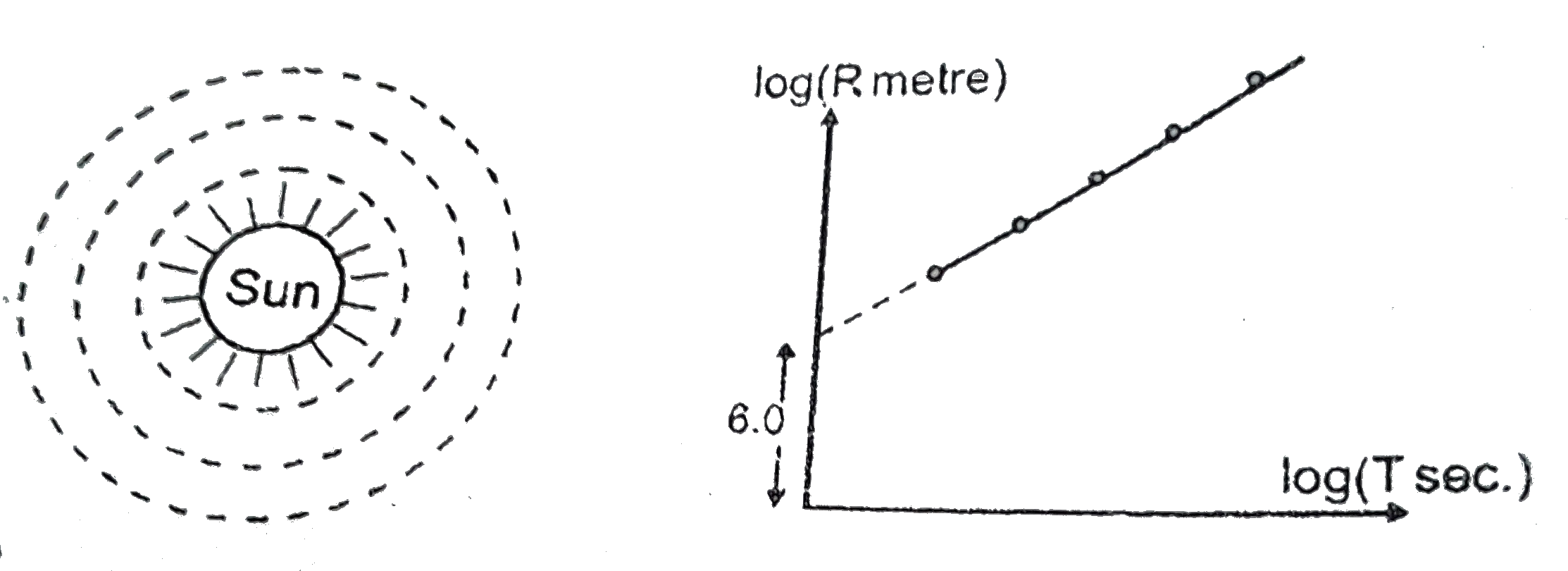
Many planets are revolving around the fixed sun in circular orbits of different radius `(R)` and difference time period `(T)` To estimate the mass of the sun the orbital radius `(R)` and time period `(T)` of planets were noted. Then `"log"_(10)` T v/s `"log"_(10)R` curve was plotted.
The curve was found to be approximately straight line (as shown in) having y intercept `=6.0` (Neglect the gravitational interaction among the planets) [Take `G = (20)/(3) xx 10^(-11)` in MKS, `pi^(2)= 10`]

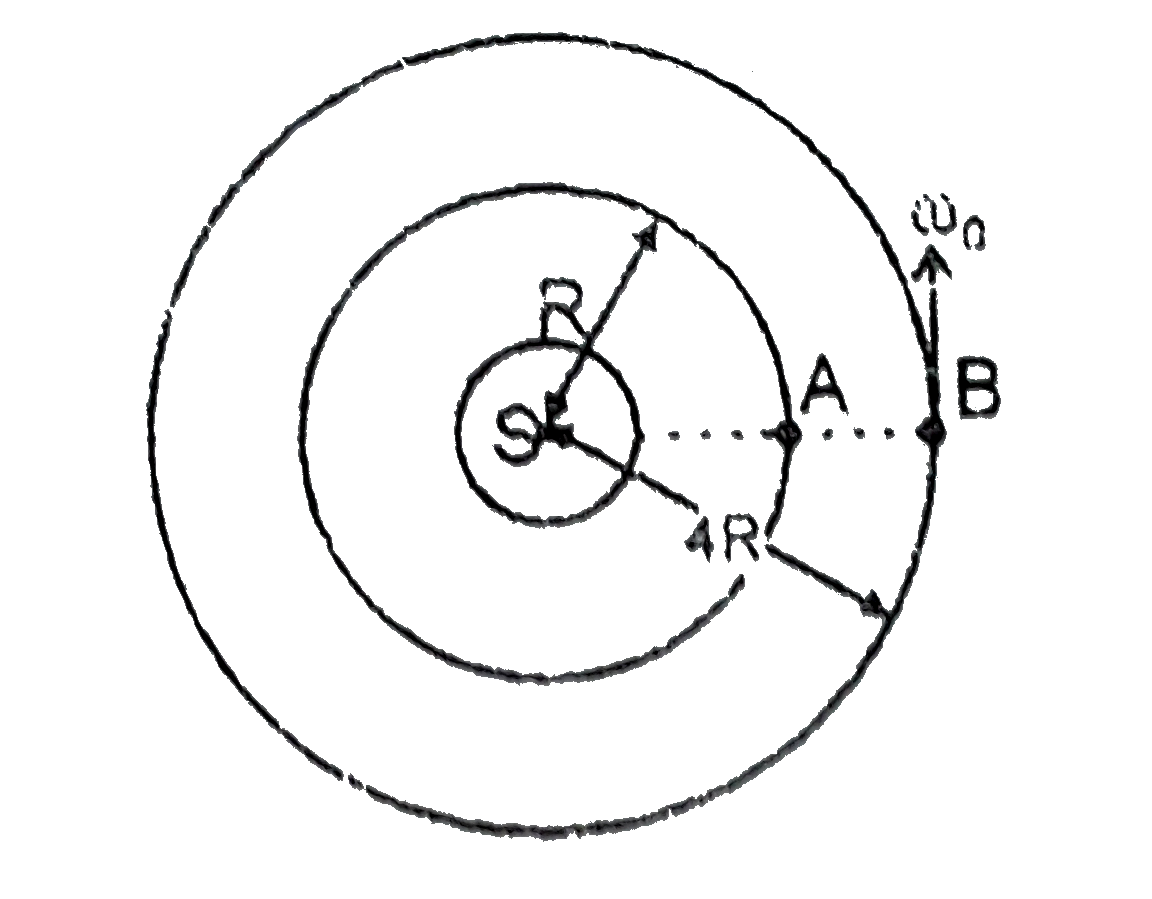
Two plantes `A` and `B` having orbital radius `R` and `4R` are initally at the closest position and rotating in the same direction if angular velocity of planet `B` is `omega_(0)` then after how much time will both the planets be again in the closest postion? (Neglect the interaction between planets)
.

Promotional Banner

Similar Questions

Explore conceptually related problems

Many planets are revolving around the fixed sun in circular orbits of different radius (R) and difference time period (T) To estimate the mass of the sun the orbital radius (R) and time period (T) of planets were noted. Then "log"_(10) T v/s "log"_(10)R curve was plotted. The curve was found to be approximately straight line (as shown in) having y intercept =6.0 (Neglect the gravitational interaction among the planets) [Take G = (20)/(3) xx 10^(-11) in MKS, pi^(2)= 10 ] Estimate the mass of the sun .

Many planets are revolving around the fixed sun in circular orbits of different radius (R) and difference time period (T) To estimate the mass of the sun the orbital radius (R) and time period (T) of planets were noted. Then "log"_(10) T v/s "log"_(10)R curve was plotted. The curve was found to be approximately straight line (as shown in) having y intercept =6.0 (Neglect the gravitational interaction among the planets) [Take G = (20)/(3) xx 10^(-11) in MKS, pi^(2)= 10 ] The slope of the line should be .

Many planets are revolving around the fixed sun in circular orbits of different radius (R) and difference time period (T) To estimate the mass of the sun the orbital radius (R) and time period (T) of planets were noted. Then "log"_(10) T v/s "log"_(10)R curve was plotted. The curve was found to be approximately straight line (as shown in) having y intercept =6.0 (Neglect the gravitational interaction among the planets) [Take G = (20)/(3) xx 10^(-11) in MKS, pi^(2)= 10 ] The slope of the line should be .

If a planet of mass m is revolving around the sun in a circular orbit of radius r with time period, T then mass of the sun is

If a planet of radius R and density D is revolving around the sun in a circular orbit of radius r with time period T, then the mass of the sun is

If a planet of mass .m. is revolving around the sun in a circular orbit of radius .r. with time period T, then the mass of the sun is